The lineup of PFAS treatment technologies keeps expanding. Some processes destroy the “forever chemicals.” Others capture them in some form of media, like granular activated carbon or ion-exchange resin.
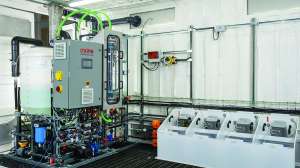
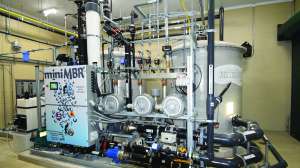
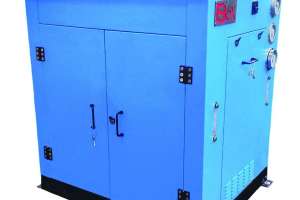
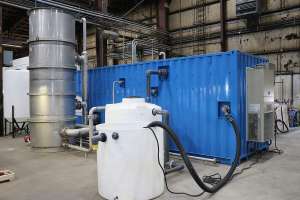
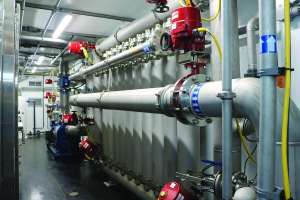
Now Aqua-Aerobic Systems has introduced the AquaPRS PFAS removal system, which uses a unique sorbent slurry to capture PFAS and a microfilter separator to produce clean water from the suspension.
The slurry concept prevents biofouling and controls solids and mineral buildup, according to the manufacturer. The material is engineered to adsorb more PFAS per gram than the same amount of GAC or ion-exchange resin. This means lower life-cycle operating cost.
The entire process including adsorbent replacement is automated. The process allows adjustments in response to changing influent PFAS concentrations. Single-stage operation removes PFOS, PFOA and other regulated PFAS contaminants to levels below EPA standards when treating low to moderate influent levels, the manufacturer states.
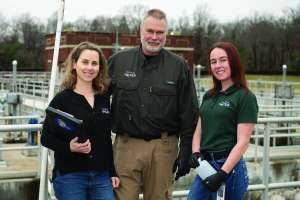
For very high influent PFAS concentrations (greater than 1,000 ng/L) or difficult influent characteristics, a two-stage configuration can yield effluent levels meeting EPA standards. John Dyson, product manager for PFAS Solutions, and Terry Reid, director of research and development, both with Aqua-Aerobic Systems. talked about the technology in an interview with Treatment Plant Operator.
TPO: What was the motivation for bringing this technology to market?
Reid: About seven years ago, we were focused on PFAS issues at military sites with a pump-and-treat design to remove very high concentrations from groundwater. We began looking at the water market after the U.S. EPA proposed regulations for PFOS and PFOA at 4 ng/L through the drinking water standards. We thought our technology would be well suited for those applications.
TPO: What differentiates this offering from others in the marketplace?
Dyson: The goal for our technology is to reduce the overall net present value operating cost of PFAS removal. Most classical solutions produce a waste stream that needs to be dealt with and use a very large amount of adsorbent material, which means a high operating cost when evaluated over a 20- or 30-year period due to the costs of media replacement and disposal or reactivation.
TPO: What is the function of the separation system using the microfilter barrier?
Reid: The barrier consists of a robust, abrasion-resistant material with a 0.1 micron pore size, similar to what is used in drinking water treatment to remove TSS and pathogens. In this case it allows us to use media with much smaller particles and therefore much more adsorbent surface area. With media like GAC or ion-exchange resin, the packed bed arrangement limits adsorption because of the relatively large particle size needed to improve hydraulics through the system. The tight barrier allows us to make the particle size as small as we want and optimize adsorbent capacity. The adsorbent slurry ties up the PFAS, and the barrier allows the treated water to go downstream while the adsorbent remains in the system.
TPO: In basic terms, how does this process work?
Dyson: Water coming into our adsorption tank has 5-10 minutes of contact time. The water is then pumped into the separation system where it enters a recirculation loop. The recirculation flow keeps mixing occurring in the adsorption tank while all the solids are retained there. We back-pulse periodically, pushing effluent back through the separation device to displace adsorbent particles that may collect on the surface of the microfilter barrier. All adsorbent material stays in the loop. We create no waste. By loading the adsorption media to its maximum potential, we dramatically reduce adsorbent usage and so also reduce the final disposal cost. Meanwhile, because of the 0.1 micron barrier, we produce exceptionally high-quality microfiltered effluent.
TPO: How often does the adsorbent in the system need to be changed?
Dyson: The replacement frequency depends on the influent quality. With contaminated water very high in PFAS, the adsorbent may need to be changed out every two weeks, whereas with drinking water with low TSS, TOC and PFAS, the system may operate for three months before changeout.
TPO: What is the process for replacing the adsorbent when it becomes spent?
Dyson: The process is fully automated. We drain the adsorption tank to another vessel. We then flush the adsorbent tank with permeate from the separator process so that we get all the used adsorbent out. Then we reload the system with adsorbent and we’re back up and operating. It takes about an hour to empty and refill the system. The operator only needs to press a button to do the changeout.
TPO: How easy is the technology for plant personnel to learn and operate?
Reid: The basic technologies have been common to water and wastewater treatment systems for many years, so any operator would readily recognize them. What we have done with the operation and the piping is unique, but in terms of what operators see, it’s something that’s familiar and that they would know how to run.
TPO: What maintenance does this technology require?
Dyson: It’s basically the maintenance of pumps and valves. There could eventually be fouling on the microfilter barrier due to hardness or scaling. That may require a clean-in-place process once or twice a year, and that process is also automated.
TPO: How do the energy and other ownership costs compare with other technologies?
Dyson: We do have higher energy costs than gravity-based or pressurized adsorbent systems because we have the recirculation pumping, but we are far less energy intensive than reverse osmosis. At the same time, our adsorbent volume is significantly less, which means the purchase and disposal costs are far lower, and the savings there dwarf the difference in the cost of electricity. In evaluating PFAS treatment, users need to consider the long-term costs that ultimately will be passed along to ratepayers.
TPO: Is there a sweet spot for this technology in facility size or other parameters?
Dyson: It can be applied on a wide range of influent water qualities and on flows from very small to very large. For waters with very low levels of PFAS, it would take a long time to see the economic payback. The higher the PFAS in the influent, the quicker the payback.
TPO: What has been done to prove the reliability of this technology?
Reid: We have conducted many pilot studies and have performed extensive preliminary work with universities and the Department of Defense. We have had many positive experiences in attaining PFAS removal targets. The basic technologies we use have been installed and operated for decades. We continue to do research and development, and in time we plan to have multiple adsorbents so that we can deal with any type of PFAS in water.