Multiple technologies now compete for removal of PFAS from water streams of different types and strengths.
Adsorbents represent one category of treatment and include traditional ion exchange and granular activated carbon systems. Now industry vendors are introducing new adsorbent-based systems designed specifically for PFAS.
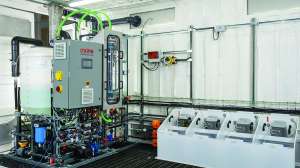
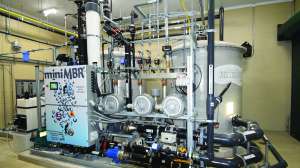
Aqua-Aerobic Systems has developed the AquaPRS PFAS removal system, which uses a micro-sorbent suspension to capture PFAS and a robust separator to extract clean water from the suspension.
The micro-sorbent media is engineered to hold much more PFAS than other adsorbents, according to the company. A recirculation system helps ensure that the sorbent capacity is fully utilized before the material must be removed and replaced, and so minimizes life cycle cost.
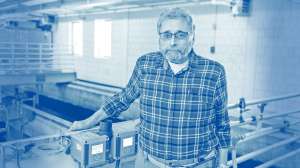
The process is fully automated, including sorbent loading and replacement. System parameters can be adjusted to accommodate different influent PFAS concentrations. John Dyson, product manager for PFAS solutions, talked about the technology in an interview with Treatment Plant Operator.
TPO: What conditions led to the development of this technology?
Dyson: We initially targeted our technology for highly contaminated water such as those related to military bases, industrial sites and airports, thinking those would receive the most regulatory emphasis. But in 2022, the U.S. EPA surprised everyone by establishing very low PFAS limits for drinking water. And it turned out that our technology was applicable to drinking water applications.
TPO: What differentiates this offering from other adsorbent-based treatments?
Dyson: The key is to remove PFAS very efficiently and to reduce the amount of sorbent needed over the long term. We do that in two ways. First, we use a very small micro-sorbent, approximately 1 micron in size, that is super efficient. Second, we use a unique ceramic separator that produces microfiltered-quality effluent while retaining the adsorbent in the system.
TPO: How would you generically describe the adsorbent media?
Dyson: It’s an organic-based material that we provide in a very high concentration, along with certain additives.
TPO: In basic terms, how does the treatment process function?
Dyson: The water comes into a contactor that contains a site-specific content of micro-sorbent, generally from 1 to 40 grams per liter. The water is mixed with that adsorbent slurry for a contact time of 5 to 10 minutes. Then a recirculation pump transfers the mixture to the separation process, which produces effluent that is essentially PFAS-, pathogen- and particle-free. The micro-sorbent is continuously recycled back to the contact tank; it is used over and over so that it is loaded up with PFAS until it is close to its capacity. That helps minimize the amount of micro-sorbent required for treatment over the process life cycle.
TPO: What happens when the micro-sorbent has approached its full capacity?
Dyson: The treatment is paused, and the system goes through a process of concentrating the micro-sorbent. Then we empty the contactor, flush out of the separator system to a tank and let the micro-sorbent settle. Once it is reconcentrated, it goes into a storage bin to await transport to a landfill or to a thermal destruction process.
TPO: Does the process include any regular cleaning of the separator?
Dyson: The system operates in the recirculation mode for a week, two weeks, a month, depending on the influent PFAS concentration and other water quality characteristics. During that time, about every 30 minutes, the system back-pulses to knock off micro-sorbent material that sticks to the separator surface.
TPO: Where in a drinking water treatment process would this technology typically be deployed?
Dyson: In well water applications, it could be applied at the source. In a surface water treatment plant, it would be applied after conventional clarification and filtration. The reason for that is to first remove organics and suspended solids that would inhibit the adsorption process, or reduce the amount of PFAS that can be adsorbed before the micro-sorbent needs replacing.
TPO: How easy is the technology for plant personnel to learn and operate?
Dyson: We originally designed it for military and industrial customers who don’t want to be water treatment experts. Therefore, automation was very important. We spent extensive time developing the process to make it as automated and hands-free as possible. The goal was to have a slurry of micro-sorbent loaded into the system, and then have it run automatically. When it’s time to change out the micro-sorbent, they hit a button and the material is removed and reloaded.
TPO: What maintenance does the process require?
Dyson: As in many water treatment technologies, pumps and valves are the maintenance items. The separator is made of a ceramic material and so is very robust. It may occasionally require a chemical cleaning, but that process is also automated.
TPO: How does the technology compare in terms of energy efficiency?
Dyson: Because we do recirculation, the energy consumption is more than for granular activated carbon or ion exchange. But our process uses far less power than, for example, a reverse osmosis system used for PFAS treatment. Overall, the sorbent savings offset any power differences, resulting in a net present value savings. We’re always looking at ways to reduce the energy usage for recirculation.
TPO: What kinds or sizes of facilities is this process best suited for?
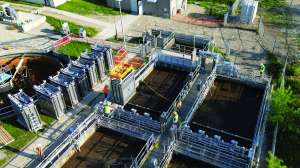
Dyson: On the low end, we have rental units rated for 150 gpm. From there, we can use the technology into the tens of millions of gallons per day in drinking water applications.
TPO: What is an example of a site where this product is being deployed?
Dyson: We began promoting the technology in mid-2024, and we are transitioning from the pilot stage, although we continue to conduct pilots to develop business. Our first rental system went on site in February 2026. The customer plans to use it for about two and one-half years to treat some of their water while we design and construct a full-scale facility. We have other projects moving into the design phase.
TPO: What does the future look like for AquaPRS technology?
Dyson: Right now, we’re marketing one technical solution, but we’re working on other applications for PFAS removal. We see a need for PFAS treatment across a huge range of customer needs. We’ll continue to develop cost-effective solutions to fit different niches. That includes working on additional micro-sorbent materials, all with very small size, to efficiently remove PFAS and other microcontaminants.