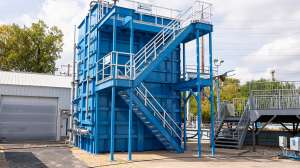
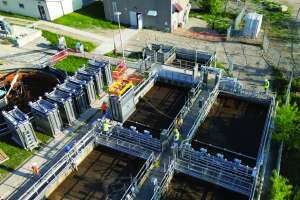
The Elmira Wastewater Treatment Plant is easy to miss in its location tucked behind an industrial park.
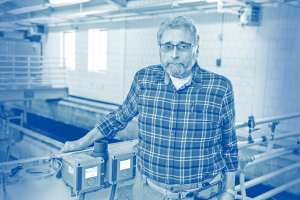
But don’t let its low profile fool you. “It’s a little plant, but it puts out a big punch,” says Jeff Medd, project manager for the plant’s owner, the Region of Waterloo.
That punch was necessary. By 2020 the facility, in the village of Elmira, Ontario, was facing a perfect storm of operational challenges. High-strength waste from industry and inflow from aging residential sewers were pushing the plant to its limits.
Worse, the site was effectively landlocked, making construction of new secondary treatment capacity physically impossible. The region needed to treat more water to a higher standard, but couldn’t pour more concrete.
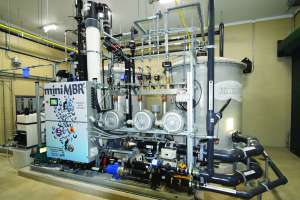
The solution was to intensify the biology, rather than expand the geography. In the largest installation of its kind in North America, the region in 2023 retrofitted its existing tanks with DuPont’s OxyMem membrane aerated biofilm reactor technology. It also installed an advanced nitrous oxide monitoring system to detect emissions from the MABR. The data gathered will be analyzed using AI-assisted software.

“Elmira is the first operational OxyMem MABR plant in Canada,” says Medd, who helped lead the MABR project. “The region is a leading expert in this technology moving forward. We now have two of the first MABR plants in Ontario. The other is in Hespeler, using a different technology, and we’re getting great results out of both of them.”
For its efforts, the region received the 2025 Platinum Award of Merit from the Association of Consulting Engineering Companies Grand River Chapter.
Tight for Space
Built in 1965, the Elmira treatment plant has been expanded twice to serve a growing village of 12,000 people. Today, it has a rated capacity of 7,800 m3/d (2.06 mgd) and an average flow of 3,750 m3/d (0.989 mgd).
“We had no room to build more tanks while the plant experienced significant operational challenges and unreliable performance due to high inflows,” Medd says. “This is due to factors such as typical postwar construction where weeping tiles are connected to the sanitary sewers, plus high solids and organic loads coming from industrial discharges.”
That is why the region chose the MABR system. Preliminary studies by the Jacobs engineering firm showed that the process was suitable to meet strict Environmental Compliance Approval restrictions on nitrogen and phosphorus without expanding the plant footprint: “It allows us to handle much more wastewater within our existing infrastructure.”

How MABR Works
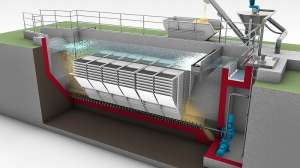
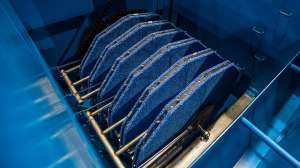
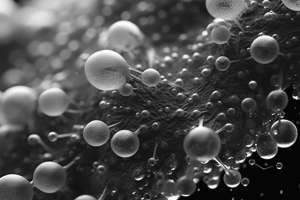
The OxyMem MABR, which is submerged in the secondary treatment tanks, consists of a collection of hollow-fiber membranes. The outer membrane surfaces act as a support structure for a biofilm of waste-converting bacteria. Air bubbles delivered directly to the biofilm through the membranes allow the bacteria to efficiently consume nutrients.
“MABR technology has become an attractive process intensification technology when implemented in combination with suspended growth activated sludge systems, particularly in the first anoxic zone selectors,” Medd says. “The hybrid configuration targets contaminants such as ammonia while allowing the activated sludge system to provide supplemental treatment of residual ammonia, nitrate, nitrite and organic contaminants.
“Meanwhile, the bacteria on the membrane’s outer surface, particularly the nitrifiers, allow for more reliable nitrification. When compared to other options such as fine-bubble aeration, MABR systems have higher oxygen transfer efficiency due to their ability to deliver oxygen directly to the biomass at much lower operating pressures.”
Making the Upgrade
The installation process is described in a white paper that Medd and four other authors presented at the 2025 WEFTEC conference: North America’s First Full-scale OxyMem-based MABR: Lessons and Performance Results.
Elmira’s treatment process consists of flow equalization, coarse screening, influent pumping, fine screening, vortex grit removal, primary clarification, dual-point chemical phosphorus removal, secondary treatment, tertiary sand filtration (Baker Hughes) and UV disinfection (Trojan Technologies). Secondary treatment uses two parallel bioreactors (Bioreactor 1 and Bioreactor 2), each with five cells.
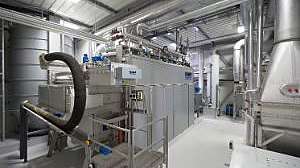
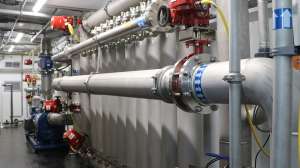
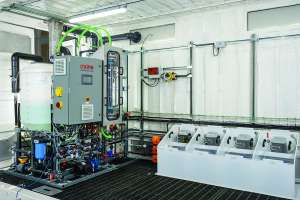
Four MABR modules were installed in each bioreactor’s Cell B anoxic zone along with a stainless steel support frame, access walkways, two AERZEN positive displacement process air blowers (one duty and one standby) and two AERZEN positive displacement scour blowers (one duty and one standby). The installation also includes new mechanical submersible mixers (Xylem SR4630 from Pro Aqua) and associated instrumentation.

“We installed the MABR; then we installed the cassettes into the existing tankage,” says Medd.
The white paper reports. “The process air blowers provide oxygen directly to the membranes and ultimately the biofilm while the scour blowers provide mixing shear force inside each module to control the biofilm thickness. The MABR system was designed to achieve an oxygen transfer rate of 92.7 kg O2/day and a nitrification rate target of 20.3 kg N/day, which corresponds to 23% of the design ammonia load.”
The project cost $2.7 million and was completed in 2023. The project team consisted of Medd for the Region of Waterloo, Jacobs for design and equipment selection, contractor H2Ontario and operational support from Derek Forwell, operator with the Ontario Clean Water Agency.
“We had a really great team,” says Medd. “We also had a good supplier in DuPont OxyMem. In this case, everything fell into place.”
Challenges, Solutions and Results
Installing the MABR system came with some challenges. The equipment was developed in Ireland where winters are mild, while in Ontario the system’s condensate lines froze in temperatures reaching 13 degrees F below zero. “We had some cold-weather issues,” Medd says. “We had to work through that.” The project team resolved this issue by installing additional heat tracing and insulation on the MABR off-gas manifolds.
Meanwhile, the system’s initial oxygen sensors proved unreliable due to condensate. The team fixed that by switching to new Aqua Amplify sensors. Then on-site elevation discrepancies made it difficult to keep the membranes submerged at the correct depth for the airlift system to work. The project team fixed that through hydraulic modeling, installing spacers between the frames and modules, and adjusting effluent weirs.
The results: Three years after installation, the MABR is working even better than expected. “We’re achieving removal rates of 25 to 35 kilograms [55 to 77 pounds] of nitrogen a day,” says Medd. “The requirement that we asked OxyMem to reach was 20.3 kg [44.5 pounds]. Seeing our MABR system doing this well — it’s massive. It has definitely justified our investment.”