The city of Chandler is known for farms raising ostriches for feathers to decorate women’s hats.
Chandler, in central Arizona (population 292,195), is also a desert community whose leaders and residents understand the value of water. Chandler supplies potable water to about 90,000 accounts, processing about 60 mgd. Its three wastewater treatment plants process 25 mgd, from which 20-22 mgd is reused for irrigation and industrial cooling.
Faced with arid conditions and the possibility of Colorado River supply reductions, the city has taken tangible steps to reduce demand. Its wide-ranging conservation strategy covers everything from school programs to high-tech leak detection and has cut per capita residential water use by 20% over the past 25 years.
At a time when water resources are increasingly squeezed in the Southwest, those are heartening results, according to Simone Kjolsrud, water resources manager: “We have a very long history of robust water conservation programs. We were one of the cities that adopted water conservation as an ethos very early on.”
Complying with conservation
While Chandler’s progress is impressive, it is also mandatory since Arizona’s Groundwater Management Act requires municipalities to do what they can to reduce demand. “All water providers must adhere to best management practices for water conservation perspective,” Kjolsrud says. “The state requires us to report on all of our programs every year. So this is not a new thing.”
To comply and meet its own conservation goals, the city targets residential, commercial and industrial users, including homeowners associations and others with large landscapes. The strategy uses a mix of financial incentives, hands-on assistance and widespread education.
Landscape rebates
Traditional lawns and gardens consume a lot of water, but converting them to drought-tolerant landscaping can be expensive for property owners. To cushion the blow, Chandler launched the Grass to Xeriscape rebate program.
The city provides homeowners with a $1.50 for every square foot of living grass replaced with a xeriscape (low water usage) design, up to a maximum of $2,000. Commercial and HOA properties can receive rebates for 25% of the conversion cost, up to $20,000.
An average residential lawn conversion can reduce household water consumption by an estimated 75,000 gallons per year — good news for the city and for the people who pay the water bills.
The Grass to Xeriscape program comes with conditions. For instance, at least 500 square feet of lawn and gardens must be converted to xeriscaping, and at least 50% of the converted area must have shade coverage from low water use plants at maturity, to reduce evaporation from the ground.
“The main qualification really is that you’re converting your landscape to xeriscape design principles,” says Kjolsrud. “We are not trying to incentivize conversion to artificial turf. So when someone submits an application and shows that they’re planning to take out grass and replace it with artificial turf, we would have to explain that they don’t qualify.”
Once an applicant has been accepted for a rebate, city staff members review the proposed plant selections to ensure appropriate native or drought-tolerant species and meet the shade requirements.

Conservation education
In addition to the rebates, Chandler focuses on education to promote water conservation. For example, workshops focus on proper irrigation scheduling, explaining zone management and appropriate watering schedules for desert plants. The city also hosts an annual two-day water festival for fourth-grade students, to educate the next generation.
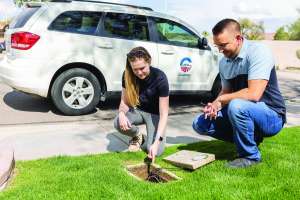
When customers notice unusual spikes in their water bills, the city’s Water-Wise Site Visit program sends a team to look for problems. “They’ll try to help them identify all the most common areas where leaks occur, understand how to read their meter, and how to tell whether their meter shows that they’ve got continuous flow,” says Kjolsrud.
The city also enforces ordinances that minimize water waste. These require property owners to maintain irrigation systems properly; those who allow water to overflow into the street can be subject to fines.
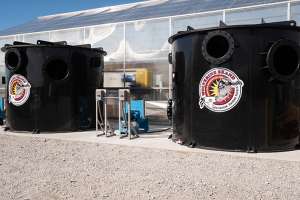
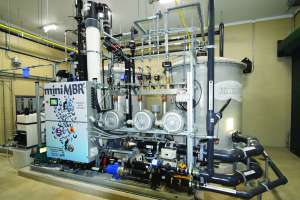
The commitment to water conservation extends to industrial partnerships. A case in point: Chandler operates the Ocotillo Brine Reduction Facility, a wastewater processing plant built through a public-private partnership with Intel Corporation, which has two major campuses in the city that employ more than 12,000 people.
“This advanced water treatment facility uses reverse osmosis technology,” says Josef Kennis, Chandler’s wastewater manager. “The first-pass brine reject water from the ROs within the Intel factory comes to the OBRF. We treat that to ultra-pure water standards and send it back to Intel for reuse.”
Working closely with customers of all sizes is vital to the conservation strategy. “We’ve had a lot more engagement and conversation with users and with the public at large over the last few years,” says Kennis. “We do our best to promote conservation and people’s ability to reduce their use of water in all aspects.”
Data-driven future
Looking ahead, Chandler is banking on technology to refine its conservation efforts. The city is nearing completion of an advanced metering infrastructure implementation, converting all of its 90,000 accounts to smart meters.
Until now, Chandler has relied on manual meter reading, which means a leak might go undetected for a month. “Once we’re fully converted to AMI, we’ll have effectively real-time data on all of the meters in our service area,” Kjolsrud says.
“That will give us very robust data analysis tools to reduce water loss, improve water efficiency and improve water conservation — allowing us to take a more proactive approach whenever we see a high water-use spike on an account.”
The bottom line: Chandler’s multifaceted approach to conservation is working. A 20% reduction in water usage over 25 years is a goal to which any community can aspire.