Membrane bioreactors are well suited to a variety of decentralized wastewater plant applications.
They’re proven capable of meeting strict, multiparameter effluent permit limits, they’re energy-efficient and their automated processes make them easy to operate.
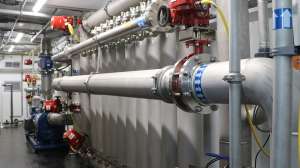
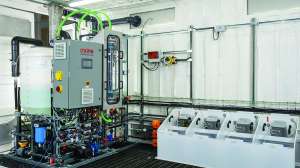
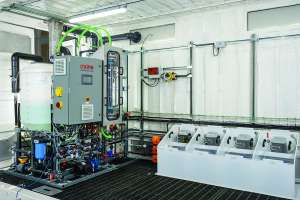
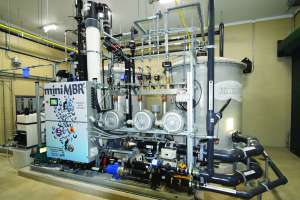
For this market sector, Innovative Treatment Products (Innovatreat) offers an MBR designed for nutrient reduction and water reuse in facilities with relatively low influent flows. The miniMBR uses a robust, externally mounted tubular ultrafiltration membrane in a downflow configuration. This enables the system to operate with low energy consumption.
Each unit is customized to meet limits for BOD, TSS, bacterial and viral reduction, UV transmittance, turbidity, nitrogen and phosphorus as required. The system’s self-cleaning fine screen is efficient, compact and reliable, ensuring clean mixed-liquor suspended solids and optimized membrane performance, according to the manufacturer.
A fully automated SCADA control package provides comprehensive monitoring, alarming and remote operation capability. Robert Kershner, Innovatreat CEO, talked about the technology in an interview with Treatment Plant Operator.
TPO: What was the motivation for creating this technology?
Kershner: I was working as a manufacturer representative in Maryland when the state enacted strict enhanced nutrient removal requirements under the Chesapeake Bay Program. When those requirements were extended to smaller treatment plants, under 500,000 gpd, I sold a number of MBR systems and recognized their limitations. I believed that based on my experience and my knowledge of MBR technologies, I could devise a better way to enable small-flow treatment plants to meet the nitrogen and phosphorus limits in a more efficient way.
TPO: What differentiates this offering from others in the marketplace?
Kershner: Our approach was to adapt very robust industrial tubular membranes in a low-pressure, low-energy orientation. Our membranes are not immersed in the biological reactor. Basically we inject air into the mixed liquor in a way that distributes air bubbles down the membrane tubes. It’s inside-out versus outside-in filtration as in submerged systems. We expose the membrane surfaces to an air/water mixture to create surface turbulence that prevents fouling and plugging inside the tubes. Instead of operating our industrial-duty membranes at their typical 80 to 100 psi, we run at less than 10 psi. We also orient the membranes vertically and inject air at the top. This allows us to minimize the air scour required.
TPO: In basic step-by-step terms, how does this process work?
Kershner: Influent first passes through a 2-3 mm coarse screen followed by an equalization tank that enables us to attenuate peak flows. The water then passes through a 0.5 mm perforated self-cleaning microscreen that removes fibers, hair and similar materials so that our mixed liquor is very clean and dramatically reduces membrane maintenance. That screened material is delivered to the sludge tank along with the waste activated sludge. We then run through a normal multistage biological process before membrane filtration.
TPO: What effluent quality can this process achieve?
Kershner: We often customize the process for advanced nutrient removal. We often guarantee effluent total nitrogen at 3 mg/L and phosphorus at 0.1 mg/L, or even lower. BOD is typically less than 5 mg/L and generally near nondetect. TSS is also nondetect because we use a true ultrafiltration membrane with a 0.3 micron pore size.
TPO: How easy is the technology for plant personnel to learn and operate?
Kershner: There is a learning curve because the technology is so different, but we provide the training and introduce operators to new ways of thinking. The operators who run these systems find that due to the high level of automation, they are very hands-off.
TPO: What maintenance does the membrane require?
Kershner: We reverse the permeate pump to backwash the membranes every few minutes. We also have a clean-in-place system called the Membrane Laundry. Because we have extricated the membrane from the biological tank, we only require a small amount of cleaning solution for a maintenance clean (sodium hypochlorite) or recovery clean cycle (citric acid). The membrane tolerates a wide range of pH and cleaning chemicals. We scour the interior and exterior of the tubes so that the membrane remains clean and operates at very high permeability.
TPO: What other maintenance is necessary?
Kershner: It’s basically just looking for leaks on the mechanical seals and maintaining the instrumentation. The DO, pH, ORP and MLSS probes require weekly cleaning and periodic calibration.
TPO: How would you characterize the membrane’s durability?
Kershner: We use an industrial membrane designed to operate at 50 to 100 psi and run it at 7 psi. Our experience is that the membranes will last at least 10 years, and we project a service life closer to 15-20 years.
TPO: How does this technology compare for energy efficiency?
Kershner: We are typically 30%-40% lower in energy consumption versus a submerged-membrane system at the same flow and loading. The reason is that we require significantly less compressed air for membrane air scour.
TPO: What sizes of facilities is this technology best suited for?
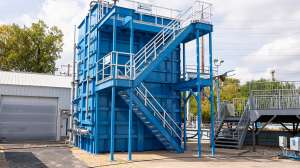
Kershner: We are very cost-competitive up to 500,000 gpd, and we’re developing a larger skid that will get us up to about 1 mgd. Our skids are rated from 5,000 to 120,000 gpd. We can place skids in parallel where they operate independently but are connected with the computer control system. Our packages are fully enclosed, compact and very quiet.
TPO: What future applications do you envision for the miniMBR?
Kershner: We see emerging demand for direct and indirect potable reuse. One thing our system can do in those applications is perform online automated membrane integrity tests.