“If at first you don’t succeed …”
That old adage is appropriate for the Lackawanna River Basin Sewer Authority, which had tried for several years to fix a nasty odor problem at a pump station.
Finally, the authority team pilot-tested a hydroxyl radical fogging system from GOVAPEX. Finding it effective, they installed a full-scale unit. “It has been operating since 2023,” says Robert Davis, wastewater treatment plant superintendent. “It has essentially eliminated the odor. You can’t smell anything by the lift station.”
Headquartered in Throop, Pennsylvania, northeast of Scranton, the authority serves 17 municipalities along the river basin. It owns and operates three wastewater treatment plants, 21 miles of interceptor sewers, 50 miles of collector sewers and eight pumping stations. Average total flow to the plants is about 10 mgd.
Close to homes
The odor complaints came from homeowners near a pumping station in a residential area. Some homes are just 50 feet from the station fence line. It’s a standard lift station with a wet well, manual screen, two Pentair Fairbanks Nijhuis dry-pit submersible pumps with variable-frequency drives, and a 55 kW diesel-fueled Caterpillar emergency generator.
The flow to the station includes wastewater from restaurants and food processing plants, some producing ready-to-eat, cooked and packaged meals. Even with industrial pretreatment in place and enforced, this wastewater has an odd odor. “On hot days, that smell would just hang around the lift station,” Davis says.
The authority tried several solutions without success. First was to seal the wet well and vent the odorous air into a 25-foot vertical stack that relied on air currents to carry it away. “This was before my time, but I was told it worked OK on most days,” says Davis. “But we still had odors around the site, especially on hot, humid days.”
The next attempt was to install a biofilter filled with a mulch-like natural material kept moist with heated water. The odorous air passed through the filter and then up the stack. This was much better than the stack alone, but it presented challenges during cold weather.
After 25 years, the biofilter reached end of life and, unable to get replacement parts, the authority had to replace it or try other solutions. Next in line was addition of magnesium hydroxide at an upstream pump station and installation of a wet-well aerator. Both helped considerably and are still in use.
Shortly thereafter came an odor neutralizer sprayed into the problem wet well and the exhaust stack. The combination of chemical feed, aeration and odor neutralizer worked well; “I’d say it was effective about 80% of the time.”
However, the odor neutralizer system required a large compressor that was costly to operate and noisy, especially in summer when the lift station vents were open to keep the station cool. Some residents complained about the noise. In addition, in winter, the odor neutralizer and magnesium hydroxide system had to be shut down because of freezing.
Finding the answer
Finally, the authority came across the real solution in a hydroxyl radical misting system. “We were at a technical conference,” Davis recalls. “We were sitting around a table at lunch and everyone was introducing themselves and explaining what they did. An attendee from GOVAPEX mentioned using ozone generation for odor control. We became interested and asked about a proposal.”
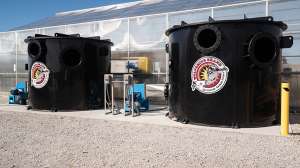
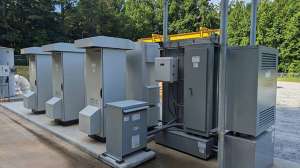
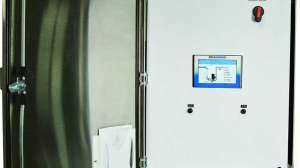
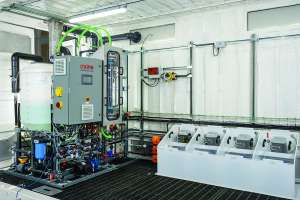
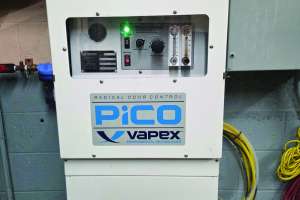
That led to the pilot study, which the manufacturer maintained and operated. The test unit was simple and operated successfully on the lift station odors. “We couldn’t believe how effective it was,” Davis says. A full-scale GOVAPEX PICO unit with a low-volume nozzle was installed and began operating in September 2023.
The unit combines ozone, water and air to create hydroxyl radicals, the most potent vaporized oxidant used in municipal wastewater odor control. The hydroxyl radicals break down odorous compounds, eliminating hydrogen sulfide, mercaptans and amines.
The nozzle sprays the hydroxyl radical mist into enclosed spaces like wet wells, treating the odors where they are generated. There are no small orifices to clog, and no adjustments are required at the nozzle, making the device efficient and easy to operate. The unit uses only 1.5 gph of water and does not require high-pressure water or specialized filters. It consumes about the same amount of 110-120-volt AC single-phase power as a standard refrigerator.
The hydroxyl radicals can slow the rate of microbial-induced corrosion by mitigating sulfur-reducing bacteria. They also eliminate or reduce surface FOG by breaking the carbon-double bonds in fatty acid chains, preventing FOG from reforming downstream.
The system has required minimal maintenance. “When we check the wet well, we make sure the nozzle is clean as well,” Davis says. Supplier technicians visit every six months and are readily available by phone if needed.
Proven benefits
The system has made a “huge difference,” according to Davis: “We no longer have odors at the fence surrounding the pump station, and on nearly all days we have no odors at the railing surrounding the wet well. We have a hydrogen sulfide meter on the fence facing the homes. On occasion, we record the presence of H2S, but the levels are very low.”
A poll of residents turned up almost no odor complaints, and when someone does complain, the odors present when staff investigates are minor when compared to those that existed before the GOVAPEX system.
“Overall, it’s been a good experience,” Davis says. The authority had been seeking funds for an odor-control study at the lift station, “But there’s no need for that now. It’s pretty amazing how well the odor control system works.”