The Colfax Wastewater Treatment Plant faced electric rate increases averaging 8% per year from Pacific Gas & Electric.
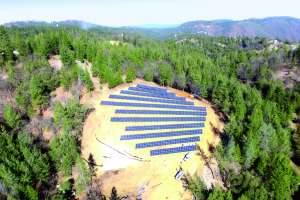
Leaders of Colfax, just north of Sacramento, California, saw potential for savings by building on-site power generation. In 2023, the city commissioned a 481 kW DC photovoltaic array developed with solar energy supplier Holt Renewables. It is expected to save the city $5.1 million over the next 30 years.
Optimum efficiency
Colfax, a community of 2,000, built its new activated sludge wastewater treatment plant in 2008 with a design capacity of 0.5 mgd. The city and Holt Renewables determined that on-site solar power would cost much less than pulling electricity from the utility grid.
The solar installation consists of 1,118 Canadian Solar 440-watt panels mounted on a precision-tilted racking system (APA Solar), according to Aaron Arriaga, commercial project developer with Holt Renewables.
The solar arrays were anchored using heliox ground screws, made necessary by bedrock conditions on the site. Arriaga notes that the fixed-tilt, ground-mount system was right-sized at a capacity of 80%-90% of the treatment plant’s electricity usage. Additions to the scope of work allow for battery energy storage in the future.
Any electricity not used at the treatment plant will be exported to the PG&E grid under a feed-in tariff. Under ideal conditions, however, the treatment plant will use all of the electricity generated, as that is more valuable than selling electricity back to the utility.
The 481 kW DC power system, which converts to 375 kW AC, is expected to have a rapid return on investment, since payback on such systems in California currently averages about four years. The system is expected to produce 854.2 MWh of electricity per year, which would offset just over 100% of the plant’s total usage.
The financial side
The city of Colfax was able to apply grant funds to build out the infrastructure while Holt Renewables leveraged its experience in building out these systems. A panel warranty also provides assurance of at least 82% functionality at the end of 30 years.
One hiccup during the project was that upgrades were needed to the downstream substations and transformers; this meant approval for interconnection with the utility grid was delayed. Arriaga notes that approval typically is received before a contract with the utility is signed.
Colfax chose to own the solar system rather than enter a power purchase agreement, under which a supplier such as Holt Renewables would own and operate the system and sell the power to the city at a contracted price.
Under a power purchase agreement, the supplier would often recommend a tracker system to move the solar panels to follow the sun through the day and so maximize power generation. Where the client owns the system, Arriaga recommends the fixed-tilt system, which does not require special expertise from treatment plant operators.
In any case, Holt Renewables will use real-time monitoring on the site to provide notification of problems even before something goes wrong. Given the fixed installation, problems are unlikely, Arriaga believes.
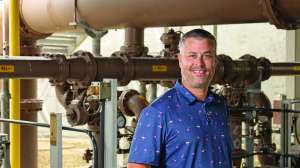
Matt Anderson, wastewater treatment plant operator, observes, “It was really a perfect world. We already owned the land, which is right next to the treatment plant, and the slope was perfect for what we needed.”
His advice to those looking to convert to solar was to allow space to upsize for potential future projects. In all, he says, the community was completely supportive, and communication with Holt throughout the project made for a smooth transition.
Evaluating projects
Arriaga offered several items of advice to communities considering solar power for drinking water or wastewater treatment plants. First, he says, plant operators should understand that electric power needs to be shut down to interconnect the solar array with the facility.
When addressing a community about the economics of a solar energy project, he asks about the rates and demand charges the utility currently pays, the acceptable payback period. From there, he says, a company such as Holt Renewables can determine whether such a system would be feasible.
“All they need is 12 months of bills and then reach out to someone like us,” he says. “We can evaluate it and let them know if it’s going to be financially beneficial.” The expected electricity price increases, year on year, also need to be evaluated against the life of the solar system for a municipality to understand whether a project makes sense.
Factors like shading, monetizing of roof space, future expansion and other considerations follow the economic discussion. Arriaga looks at projects more as partnerships than as sales transactions. He found that approach well suited to the Colfax plant project. “I didn’t ever get any ill-will feelings toward solar,” he says.
While the project was in progress, Arriaga stayed in the area and was able to talk to many residents, all of whom supported the project. Often, he said, objections to solar energy are based on misinformation; conversations with residents put those concerns to rest.
Arriaga stresses that municipalities need to stay alert and perform due diligence before making any decisions about capital expenditures. Unpredictable tariffs make equipment pricing fluid, and construction does not move extremely fast.
He also notes that after 2027, solar project tax credits will go away; smaller projects could get built out before then, and even larger projects showing continuous production by July 2026 would still be able to receive the credits.