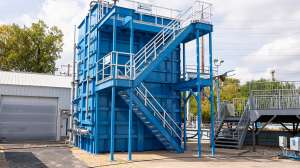
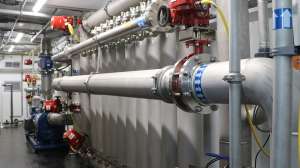
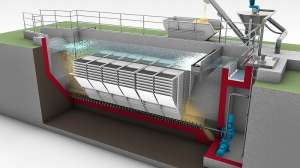
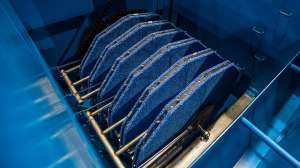
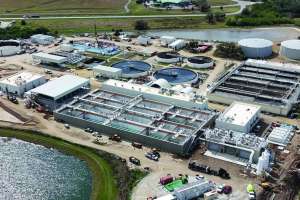
The nearly complete upgrade at Sarasota County’s Bee Ridge Water Reclamation Facility does more than boost capacity.
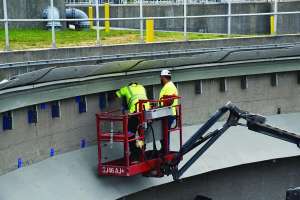
The $280 million project includes a major technological change as well as a variety of steps to make sure the facility can withstand high winds, high water and power outages, and in the bargain meet advanced wastewater treatment standards. All of the new processes are expected to be online by December 2025.
The expansion focuses on advanced wastewater treatment to reduce nutrient runoff affecting surface water. The utility emphasizes water reuse for irrigation. During low irrigation demand, excess reclaimed water is stored or repurposed, such as through deep injection into aquifers to combat seawater intrusion.
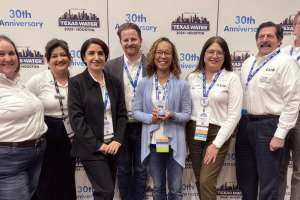
In January, the upgrade project received an Envision Gold Award from the Institute for Sustainable Infrastructure. The award cited the utility, the design team (Carollo Engineers) and the general contractor (Garney Construction) for environmental stewardship, climate resilience, resource efficiency and community benefits. Bee Ridge is the first wastewater treatment plant in Florida to receive a Gold Award.
Nutrient reduction
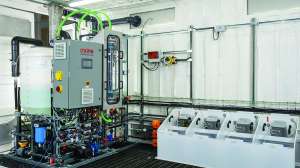
The project will expand the plant’s capacity from 12 mgd to 18 mgd (average flow is about 7.5 mgd) and transform the process to an advanced water treatment system with five-stage biological nutrient removal and a membrane bioreactor.
The treatment process starts with coarse screening (Hydro-Dyne Engineering), grit removal (Hydro International) and fine screening (also Hydro-Dyne). The waste stream moves to an equalization tank and then into the five-stage Bardenpho BNR process, which consists of an anaerobic zone, followed by an anoxic zone, an aerobic zone, another anoxic zone and another aerobic zone.
Equipment in this part of the process includes 400 hp blowers (Continental), mixers (Invent Environmental Technologies), fine-bubble diffusers (Sanitaire - a Xylem brand), 15 hp waste activated sludge pumps (Flygt - a Xylem Brand), 139 hp return activated sludge pumps (Sulzer Pumps Solutions) and 8.3 hp internal recycle pumps (also Flygt).
The new secondary process is expected to cut effluent nitrogen from 12 mg/L to less than 3 mg/L and to reduce phosphorus from 4 mg/L to less than 1 mg/L. The water then will go through a membrane bioreactor (DuPont MEMCORE), followed by chlorination. The ultrafiltration membranes produce high-quality final effluent with minimal suspended solids.
The final effluent will meet drinking water standards but is not intended for potable use. Instead, it will be used mainly for irrigation or, when not needed for that purpose, stored or injected into a deep aquifer. Almost all effluent is used for irrigation in the dry months. Low nutrients in that water helps ensure against runoff contributing to algal blooms.
Preparing for growth
Brooke Bailey, utilities director, says the most important aspect of the project is the expansion and the capability to expand still further. Existing clarifiers will be removed when the new process comes online, creating space that could be used for additional expansion.
“We’re going from 12 to 18 mgd, which should take care of our needs for another 20 years,” she says. “After that, we’ll have the ability to expand again, doubling our capacity, in the same footprint.” The project was executed quickly, considering its size.
“From concept to concrete, it was three years. From concept to completion, it will be five years,” Bailey says. “It was a very fast process.” Bee Ridge is the largest of three water reclamation facilities in Sarasota County. The utility plans to convert the other two to similar advanced treatment; one conversion will start this year.
Weather resiliency
Bailey says the plant, built in the 1990s, has proven resilient in the face of extreme weather. In August 2024, when Tropical Storm Debby dumped 17 inches of rain on Sarasota in 24 hours, Bee Ridge kept operating: “We got up to handling 20 mgd, but we stayed in compliance with our permit.”
She also saw evidence that the ongoing efforts to line sewer pipes in the community were paying off. The high flows at the plant abated two days after the storm, indicating that the surges resulted from inflows at flooded manholes and submerged lift stations, rather than infiltration into leaking pipes from the super-saturated ground.
With the expansion, the plant will have more storage to cope with high-water events. Additional flood protection is provided by moving most of the treatment facilities out of the flood plain to a level one foot above the 100-year flood elevation.
Power reliability has also been addressed. The plant will have two separate feeds from the power grid, and it has four new 1,750 kW emergency generators (Caterpillar). Dave Sell, wastewater division manager, says the plant will be able to continue operating for four days if its connections to the grid go down.
Salinity barrier
All effluent from Bee Ridge not used for irrigation flows into a deep injection well. During the irrigation season, the plant is committed to putting 2 mgd into the injection wells; when no water is needed for irrigation, more of the plant’s 7.5 mgd average flow can go to the wells.
Utility leaders don’t know yet if the technique will work, but the staff is watching for results. “We’re testing the deep injection well barrier,” says Sell. “We have monitoring wells in numerous locations.” The state requires a two-year testing cycle for salinity barrier wells, so the monitoring will continue until March 2026.
Even if injecting water into aquifers is not effective against intrusion, at least the water going into the aquifers will have very low nutrient levels.