
Water utilities in the arid Southwestern United States are starved for water supplies and increasingly look to indirect and direct potable reuse as part of the answer to meeting demand.
El Paso Water is helping lead the way in potable reuse, breaking ground in late February for the 10 mgd Pure Water Center, which it calls the nation’s first direct-to-distribution water reuse facility. For more than a decade the utility has worked with the Texas Commission on Environmental Quality to make sure the facility produces water that meets all state and federal requirements.
Utility President and CEO John Balliew observes, “This is the next step in El Paso’s long history of water reuse, and we hope it will serve as a model for other communities facing water-related challenges.”
The Pure Water Center will receive effluent from the Roberto Bustamante Wastewater Treatment Plant that is now used for irrigation or discharged to the Rio Grande. The water will undergo a multistep purification process that includes membrane filtration, reverse osmosis, UV light with advanced oxidation, granular activated carbon adsorption and chlorine disinfection.
Designed by Carollo Engineers, it will be built by a joint venture of PCL Construction and Sundt Construction. The total project cost is estimated at $295 million; completion is planned for 2028.
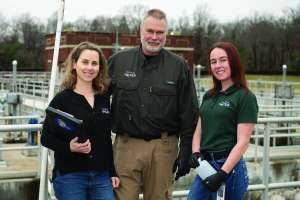
Describing the project in an interview with Treatment Plant Operator were Christina Montoya-Halter, communications and marketing manager, and Arturo Ruiz, chief plant manager, both with El Paso Water; Caroline Russell, vice president and chief technologist with Carollo Engineers; and Dana Lebeda, area manager with PCL Construction.
TPO: How would you sum up the big picture of water scarcity in the Southwest?
Russell: Carollo works with a number of clients throughout the Southwest and other parts of the country that are increasingly looking to reuse options to meet water demands as traditional sources are undergoing drought conditions, either sustained or short-term.
TPO: How would you describe the specific challenges El Paso is facing?
Montoya-Halter: We are facing ongoing prolonged river droughts. In a normal year, we get about half of our water supply from the Rio Grande, and we supplement that with groundwater, aquifer recharge and desalination. Diversification is a model that we follow, and this year we expect to receive a significantly reduced amount of river water. The Pure Water Center is an addition to our portfolio of resources to ensure that we can meet demand.
TPO:What water source requires desalination?
Ruiz: We are desalinating brackish groundwater. We draw from a cluster of wells that have high salinity.
TPO: How would you define the term “direct-to-distribution reuse”?
Montoya-Halter: We will be the first in the nation to do pipe-to-pipe reuse, taking effluent from the wastewater plant, putting it through the Pure Water Center, and then putting it directly into our distribution system. At other facilities, potable reuse may involve treatment at another water plant or putting water into a storage area.
TPO: Please briefly describe the process El Paso Water and partners went through in conceptualizing the Pure Water Center.
Russell: In 2012, there was a review of opportunities to reclaim water from the Bustamante treatment plant, which is co-located with the Rio Bosque Wetland Park and the Jonathan W. Rogers Water Treatment Plant. The initial concept was indirect potable reuse — treating the wastewater to a level that could then be conveyed to the wetland park, allowing the water to infiltrate into the shallow aquifer, and then recapturing that water as a potable supply.
TPO: How did that evolve into the direct-to-distribution concept?
Russell: Due to permitting requirements and other site-specific considerations, a decision was made to pursue potable reuse. The technology supported it, and from that point forward the project proceeded in that direction.
TPO: Briefly, what were the regulatory steps required to win project approval?
Russell: El Paso Water conducted pilot testing for nine months as required by TCEQ.
At the time, the utility had a third-party independent advisory panel of experts in health, environmental engineering and water treatment that reviewed the conceptual treatment train and the pilot test results. With approval of the pilot results, TCEQ allowed El Paso Water to proceed with preliminary design. After that, the project moved into detailed design and there were several regulatory steps through that process before TCEQ approved the final design.
TPO: Did El Paso Water have a history of potable reuse?
Montoya-Halter: The decision to go to direct potable reuse relied on the fact that we’ve been doing indirect potable reuse for 40 years. We’ve been doing that successfully at our Fred Hervey Water Reclamation Facility, and we’ve had a desalination plant open since 2007. The next logical step was to look to direct potable reuse.
TPO: What role did public outreach play in winning approval for the project? How were potential negative perceptions overcome?
Montoya-Halter: Outreach has been a big part of this project from day one. I was born and raised here. I recall hearing conservation messages since I was in elementary and middle school, and our customers are also attuned to that. The foundation of trust, understanding and engagement was a big factor when we started talking about this plant in 2015. We did surveys in 2014, and the majority were in favor of us treating wastewater to drinking water standards and putting it directly into the distribution system.
So right at the outset we had support, and we built upon that. When we had the pilot facility open, we made it available for tours. We did surveys there and again we found a majority in favor of the project. We remain very engaged with our local media, our elected officials and our customers. We’re going to ramp up a speaker’s bureau in which our employees will be trained to speak about the facility to groups like civic clubs and neighborhood associations.
TPO: Will the completed center include features such as a tour program or public education center?
Montoya-Halter: The facility will include a visitor center with a viewing site where people can look into the treatment area. Animated videos will explain each step of the process. There will be an amphitheater where we can show more educational videos. Other exhibits will explain where we get our water from, why it’s important to diversify our sources, the benefits of the Pure Water Center, and the technology and what makes it safe. We expect a lot of visitors, not only from El Paso, but from all over the country and the world.
TPO: Can you walk me step by step through the treatment process at the new facility?
Russell: Each step of the treatment process does something different. The membrane filtration process creates a physical barrier that prevents passage of particles as small as 0.1 micrometer in diameter into the treated water. Reverse osmosis rejects small ions. UV advanced oxidation provides disinfection and degrades any trace chemicals. Granular activated carbon is a polishing step to adsorb remaining trace chemicals, and then chlorine provides final chemical disinfection. Also, there is significant attention to instrumentation and control. We have identified critical control points and alarms to make sure that each treatment step is operating as intended.
TPO: Can you briefly outline the construction schedule?
Lebeda: The construction team has been given notice to proceed on the first work package, which is to procure some of the long-lead-time process equipment, specifically the membranes. We’re in the middle of pricing subsequent packages so that we can break ground, perform utility relocations and then start bottom-up construction, followed by commissioning. We expect substantial completion in late 2028.
TPO: What particular challenges have to be met during construction?
Lebeda: The unique aspect is that when we build water plants, we don’t typically see all of these treatment technologies under one roof. On a typical water treatment plant project we may see a handful of these processes depending on the water source, but in my experience we haven’t seen them all combined together. So the challenge will be to get all these processes to work together, so we can ensure that we hit the required water-quality goals before distribution to the public.
TPO: How will operators be involved in the process and be trained up for the facility?
Ruiz: We are in the process of selecting a plant superintendent and assistant superintendent who will be involved in the meetings as the plant goes up. Once it is about halfway completed, we will start selecting operators so that they can begin training. In the meantime, we’re moving ahead and training a large portion of our operating staff.
TPO: What does the training program look like?
Ruiz: It will be a combination of things. We’re working with the South Central Membrane Association, which will provide the initial membrane training, covering low- and high-pressure membranes and basic membrane operation. Then we’ll work with Hazen and Sawyer on more formal training. And once the plant starts coming online, we’ll start incorporating vendors for specific training on the equipment.
TPO: Will operations team members be integrated with the construction process?
Lebeda: The El Paso Water team will be in lock step with the construction team, especially as we get into the exposed piping and process equipment. So if there are any small modifications we can make in the field to enhance operability and maintenance, we’re certainly going to work together to do that.
TPO: Do you see this facility having an impact on the water industry, especially in water-stressed regions?
Montoya-Halter: Yes. Once this plant is online, and even through construction, we hope to receive visitors from the water industry and other communities. This plant is a game-changer for the industry in terms of direct potable reuse, and a cornerstone of El Paso Water’s mission is to help advance research and be a model for solutions across the nation.