Charlotte Water operates one of the largest Class B biosolids land application programs in the southeastern United States. It is on its way to getting bigger and better.
A biosolids master plan calls for treating primary and waste activated sludges from four of six water resource recovery facilities to Class A quality with a thermal hydrolysis process in a central location at the utility’s McAlpine Creek WRRF.
At present, Charlotte Water — the largest water and wastewater utility in the Carolinas — produces some 100,000 wet tons per year of anaerobically digested and dewatered biosolids, according to Giovanna Forti Portiolli, resource recovery manager. About 60 to 70% of that material at 13-21% solids is applied to cropland in North and South Carolina. The balance is landfilled.
The program has been in place since 1999, but in recent years, challenges have arisen. The population is growing, which means more biosolids production while development is consuming farmland close to the city. Wet-weather events are increasing, limiting the days available to apply biosolids in the fields. That puts stress on product storage space, and as a result, the biosolids program still relies heavily on landfilling.
It’s for those reasons that Charlotte Water is pursuing advanced biosolids treatment and management. “The focus is on producing Class A biosolids, which are suitable for beneficial uses beyond traditional land application,” says Forti Portiolli. “That change addresses the increase in volume and the risk of having only a single beneficial reuse outlet. It also aligns with our commitment to environmental sustainability and stewardship.”

To the next level
Charlotte Water began looking to expand its biosolids management team in 2022. The utility did studies over the years with consultants to understand the changing regulatory climate and evaluate new processing technologies. “We are looking for options to create a better-quality product and to diversify what we can do with it,” says Forti Portiolli, who came on board in January 2023.
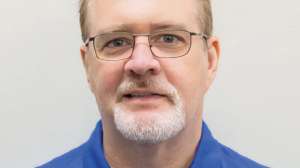
Forti Portiolli holds a bachelor’s degree in environmental sciences from Winthrop University and a master’s in environmental engineering from North Carolina State. She came to Charlotte Water after significant experience in laboratory analysis, environmental compliance, resource recovery and construction, along with design and planning for municipal and industrial wastewater systems while working for engineering consultancies.
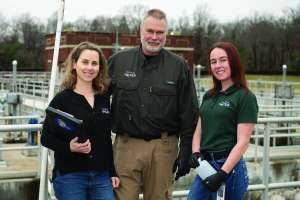
Her management colleagues are Garrett Smith, engineering assistant; and Taylor Treible, field investigator. Their roles include overseeing contractor Synagro, which handles day-to-day biosolids operations. Key members of the Synagro team are Todd Larson, area director; Steve Matchett, senior operations manager; Wayne Brady, operations manager; Adam Brigman, technical services manager; and James Porter, technical services specialist.

Time for a change
Charlotte Water has received significant recognition over the years, including being designated as a Water Resources Utility of the Future and earning a Water Disaster Preparedness award from NC One Water, an AWWA section and WEF Member Association. The treatment facilities have earned multiple Peak Performance Awards for permit compliance from the National Association of Clean Water Agencies.
Still, conditions at the utility’s treatment plants helped lend urgency to improving the biosolids program. “A lot of our facilities have aging infrastructure and are reaching capacity limitations,” Forti Portiolli says. “Since we were looking at major projects, we asked how else we could improve our systems.”
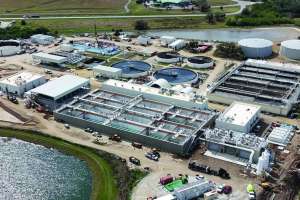
Besides the McAlpine plant, the utility’s water resource recovery facilities are:
- Irwin Creek WRRF, 15 mgd design
- Sugar Creek WRRF, 20 mgd design
- McDowell Creek WRRF, 12 mgd design
- Mallard Creek WRRF, 13.1 mgd design
A sixth facility, the Stowe Regional WRRF, is under construction and is expected to be online by 2027, with 15 mgd design capacity. At present, Charlotte Water has 124.2 mgd total treatment capacity and a total average flow of 84 mgd.

Producing biosolids
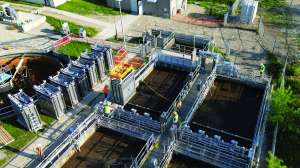
The Residuals and Biosolids Program has ISO 14001:2015 environmental management certification. Two of the treatment facilities dewater digested biosolids on centrifuges and two dewater on belt filter presses. Primary and waste activated sludge at 1-1.5% solids from the Sugar Creek WRRF are pumped via pipeline to the McAlpine Creek plant to be thickened, digested and dewatered there.
The utility has three water treatment plants that produce about 10,000 wet tons of residuals per year. These are managed in the same manner as Class B biosolids. The materials are stored, handled and hauled separately from the biosolids and are land-applied.
To achieve Class A biosolids, Charlotte Water has selected the Cambi thermal hydrolysis process. A design-build team is now working on the design of the facility, which is to be completed in 2030. It will be located at McAlpine Creek and will process biosolids from that plant and the Sugar Creek, Irwin Creek and Stowe Regional WWRF.
The Cambi process will be installed upstream from the anaerobic digesters. Thermal hydrolysis subjects the sludges to high temperatures and pressure, making the organic material easier to break down. “So even though we will be bringing more flow into the McAlpine Creek facility, we will not need to build additional digesters,” Forti Portiolli says.
In the process, primary and secondary sludges are dewatered to 16-18% solids and fed continuously into a pulper, which homogenizes and preheats the material to about 212 degrees F. This material is then fed into the reactors. Once the reactor is full and sealed, steam heats the contents to 320-350 degrees F at a pressure of about 90 psi. The process is typically set at 20-30 minutes per batch to ensure that all pathogens are killed.
From the reactor, the sterilized material moves to a flash tank that runs at atmospheric pressure. The sudden pressure drop substantially destroys cells in the organic matter. The end product is then cooled in heat exchangers and fed to anaerobic digesters.

Looking ahead
For the more distant future, the utility’s biosolids master plan includes the addition of a thermal dryer. “The thermally hydrolyzed cake and eventually the dried pallets can still be used on agricultural land, but we also want to make use of additional outlets available to us when we have a higher quality product,” Forti Portiolli says.
“We want to expand beneficial use of biosolids products into tree and turf farming, landscaping, land reclamation, DOT projects, public distribution and even try partnering with industry. Research shows that a dried product can be used in manufacturing bricks and other commodities.
“We are always actively pursuing opportunities to engage and enhance our knowledge and contributions to the biosolids treatment and management community.” To that end, Charlotte Water is a member of the newly formed Southeast Biosolids Association, and Forti Portiolli serves on its board of directors.
The biosolids program will by no means overlook the value of biogas: plans are to convert it to renewable natural gas (see sidebar). Other sustainability initiatives are in the works. “There is a big push away from creating waste to exploring how we can beneficially use our biosolids products,” says Forti Portiolli.
One near-future initiative is to resume reclaiming water from the Mallard Creek WRRF to irrigate golf courses and for use in boilers and chillers on university campuses. Another is to install the Ostara nutrient recovery process at McAlpine Creek to harvest phosphorus in the form of struvite crystals. “We have completed our design, we are procuring equipment this year, and in July 2025 we will start construction,” says Forti Portiolli.
She concludes, “We want to continue being a forward-looking utility, to lead the way, to be environmental stewards.”