Roseburg Urban Sanitary Authority has three solar arrays in development. One is to have two jobs: providing power and shade.
The wastewater treatment utility in southwestern Oregon, known as RUSA, received three grants from the state Department of Energy to develop solar arrays. All projects were designed with the help of energy solutions provider Ameresco.
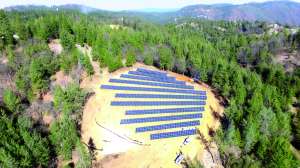
The smallest, a 40 kW system with a 186 kW battery storage system, is expected to provide all the power for RUSA’s administrative offices. The largest, rated at 900 kW, will fulfill 44% of the treatment plant’s annual power consumption.
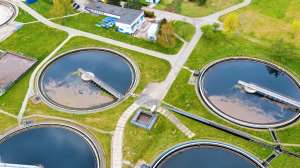
The third array with 400 kW capacity will float on an effluent pond that is part of a natural treatment system, developed for tertiary treatment from May to October when the receiving water is especially sensitive. It will provide 64% of the power to run pumps for the treatment system — and also keep the sun from excessively warming the effluent.
Jim Baird, utility general manager, says the 3.6-acre pond is too big to shade by planting trees on the shore, but that floating solar panels are a good alternative.
“When the system was designed back in 2008, they weren’t really concerned about how much solar energy would be transmitted in that pond,” he says. “But now we’re all interested in not adding heat and in how to dissipate heat. A floating array helps to meet two goals.”
The project was originally conceived as a ground-based array large enough to completely power the natural treatment system, but the decision to put it on the water raised the cost per kW, and the project was downsized slightly to stay within budget.
Baird expects a future solar project to provide the remainder of the power to pump effluent through the natural system, but it will have to wait for more grants or other funding sources.
Cooling and nutrient removal
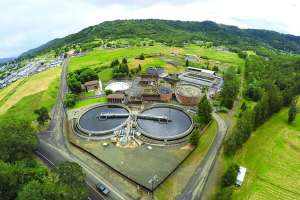
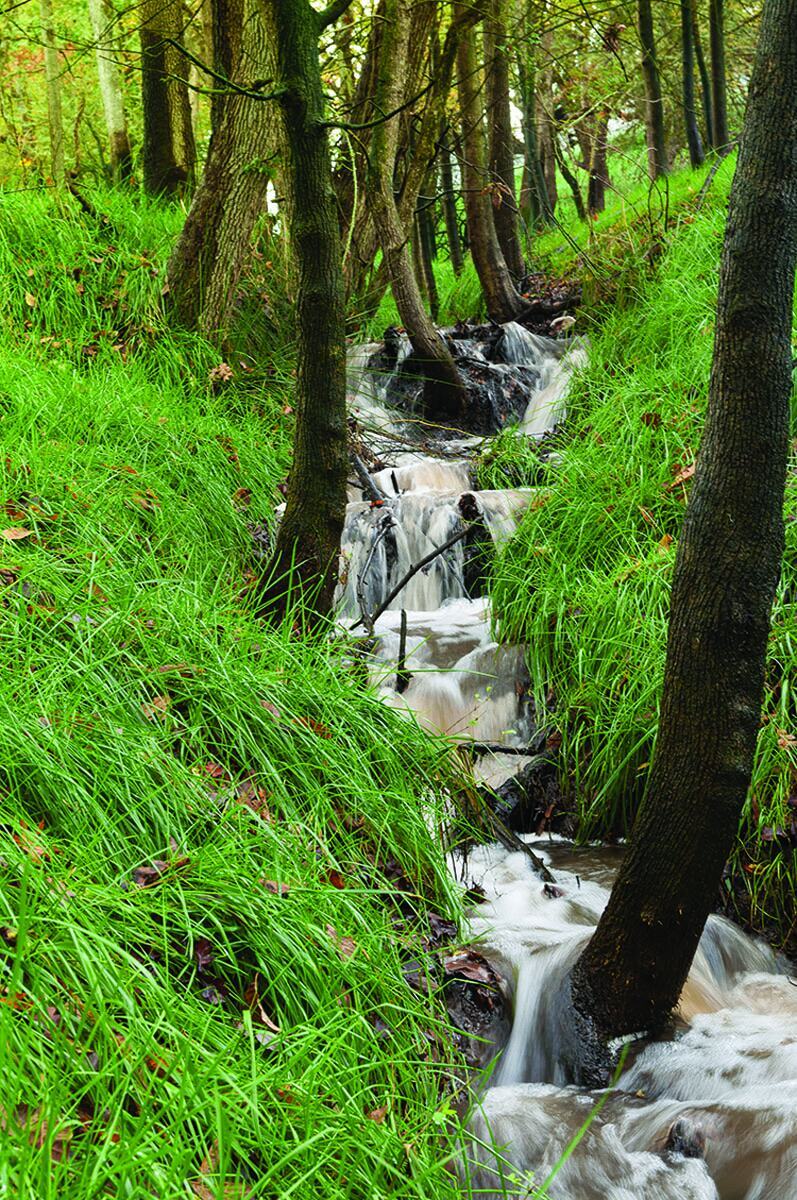
Roseburg’s natural system has operated since 2012. It consists of some constructed wetlands, some mitigated wetlands, an equalization pond and some forested and grass land. Effluent from the wastewater treatment plant is pumped through the wetlands to the pond, and then pumped up the hillsides where it is applied to the land through sprinklers and drip irrigation.
Water is applied at a higher rate than the plants need for irrigation because super-saturating the soil improves the phosphorus uptake. The water flows through the soil into Sylman Creek, a tributary of the South Umpqua River.
“It’s 340 acres,” Baird says. “We use the soils and wetlands to clean the phosphorus and nitrogen out of the system, as well as to provide cooling. We’re just moving some water around, and then Mother Nature takes over. We get remarkable cooling out of it. Without chillers or anything else, we are an average of 7 degrees C cooler than the receiving water.”
The system absorbs most of the phosphorus in the effluent. Baird estimates that the daily discharge from the plant (7.9 mgd design, 3 mgd average) contains about 100 pounds of phosphorus, but by the time the water gets to the river, it only contains three pounds.
“We see a marked increase in the quality of the receiving river,” Baird says. “Downstream from our discharge, we see a lot less algae. The farmers who have irrigation pumps have told us they’re not cleaning their screens nearly as much because of this reduction.”

A break on cost
The natural treatment system was only one of the options Roseburg considered when planning how to reduce the effluent’s nutrient content. One alternative was to build another treatment train at the wastewater plant, but that was too expensive. The natural system cost about one-tenth as much as the new plant: about $10 million versus $100 million. The natural system also costs less to operate.
Another possible option was to use all the plant’s effluent for irrigation and stop discharging to the river from May to October, the dry months in the northwest. That was rejected because the river needs the water. Although the plants in the natural system absorb significant effluent, about 1 mgd still flows into the creek and then into the river.
The system has two sets of pumps (Robbco, now owned by Wolf Pumps), one to move the effluent from the treatment plant about a quarter-mile to the wetlands, and another to disperse the water through the sprinklers and drip irrigation.

Battery backup
As for the solar array for the administration building, it includes a battery that will provide at least four hours of power in case of a utility outage. Baird says that will enable the plant to keep its GIS mapping system operating and facilitate efficient operation even during unusual weather events.
“We don’t have paper maps anymore, so our documentation about the size and location of the pipes and pumps and other data is all online,” says Baird. “If the server doesn’t have any power, then we can’t look at the map. The battery component is not for doing business with customers. It’s to extend our ability to access those maps in an emergency.”
The solar array for the office building will be ground-based because that is more economical than putting panels on the roof. The system to serve the wastewater treatment plant will also be ground-based. Baird says the treatment processes most likely won’t need to be expanded for the life of the solar arrays, so there’s no worry about using the space for solar panels.
“We have a whole lot of capacity left in the treatment works, even though the last upgrade was in 1984-85,” he notes. “We felt we could put in an installation that has a roughly 25-year life without hampering future folks’ ability to do a good job treating the wastewater.”
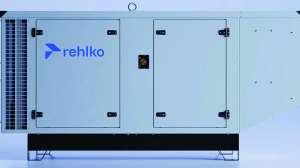
The larger array won’t need battery backup because emergency generators (Rehlko Power Systems) are in place: “We can’t rely 100% on solar, so we still have backup generators. Backup power is a necessity for our business.”
The solar projects are the latest in a long list of energy-saving and sustainability-boosting efforts for RUSA. Lights have been changed to LEDs with occupancy sensors. As pump motors have worn out, they’ve been replaced with premium efficiency motors.
The aeration basins were fitted with fine-bubble diffusers (Sanitaire, a Xylem brand) and turbo blowers (APG-Neuros). Beyond that, “I’ve been here 15 years and we’ve probably gone through three rounds of training with personnel to make them aware of things they can do to minimize power use,” Baird says.
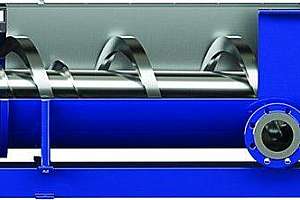
Most biosolids are dewatered on a screw press (FKC) and land-applied on farms as cake, although some farm customers still prefer liquid biosolids.

CHP? Not practical
RUSA uses biogas to heat the digesters and the treatment plant administration/operations building, but before deciding on the three solar projects the staff considered developing a combined heat and power system.
“It wasn’t a good fit, even when we looked at spending more money and developing a FOG receiving station,” Baird says. “That would create more gas, and it would be beneficial to our community because restaurants could have their FOG taken care of locally, but it never got to that financial threshold where it was a good decision.
“Based on some of the available funding sources, these solar projects quickly moved to the top of the pile. Even in the Pacific Northwest, we’re getting to that point where we may not have all the energy we’d like to have. If we can be better stewards and do some sort of on-site generation, we’re part of that effort to make a more resilient energy community.”