The U.S. EPA’s upcoming Lead and Copper Rule Improvements for drinking water set tighter deadlines and stricter reporting standards for utilities.
The rule’s purpose is to protect public health by minimizing levels of lead and copper, which enter drinking water mainly through corrosion of service lines and plumbing materials. A key component of the rule requires utilities to inventory and ultimately replace lead-containing services lines at homes, schools and businesses.
The relatively tight deadlines and the complexity of lead service line replacement can challenge water utilities of all sizes. To simplify the process, 120Water offers software platforms that help utilities inventory lead lines and track and verify progress on replacement.
The company’s PWS platform supports individual utilities’ replacement initiatives. PWS Insights takes that up a level, enabling entities responsible for two or more utilities to aggregate and analyze compliance data. Such entities include large contract operation providers, rural water associations, engineering firms and state regulatory agencies.
Both platforms enable users to quickly track progress and identify compliance gaps. 120Water representatives Brian Crow, chief product officer, and Gena Fiegel, senior public relations specialist, talked about the offerings in an interview with Treatment Plant Operator.
TPO: What in particular is challenging about compliance with the Lead and Copper Rule and the Lead and Copper Rule Improvements?
Crow: The biggest challenge utilities face is how rapidly the regulatory environment is changing, and the way information is being disseminated to help them understand how the rule is being implemented. We can help water operators understand what the regulation means, how to interpret it, and the rules they will have to abide by.
TPO: How would you characterize the compliance schedule?
Crow: Last October was the deadline for every water utility to submit a preliminary inventory of the lead service lines in their systems. A lot of utilities didn’t know that a perfectly acceptable answer at that stage was: Unknown. This is where we could help them comb through their records and reach the best understanding of what their service lines were made of.
TPO: What comes after that deadline?
Crow: By 2027, utilities must take their inventory and turn the unknowns into knowns. They are entering the verification phase. With the PWS platform, we can help them pull all their data together and truly establish the scope of the problem.
TPO: What differentiates your offerings from other such tools on the market?
Crow: This market segment didn’t exist six years ago. Our competitors for the most part are construction or engineering firms that work inside utilities, who then ask them for help in figuring out the rule. The Lead and Copper Rule provisions related to service lines dropped in quickly as a result of the Flint crisis, and many utilities didn’t know where to turn to get started. A big advantage we bring is that we normalize the data into a format that the EPA and the state agencies require. That enables the reporting to go seamlessly up to the regulatory level. Another differentiator is that we work across the entire country and so can bring best practices that we see among some 8,000 customers.

TPO: What are some of those best practices?
Crow: When lead is identified, there are a number of remediation requirements utilities have to meet. It’s not as easy as driving a tractor in, digging up the ground, pulling the lead pipe out and putting a new pipe in. We are able to share remediation best practices. Our platform also helps utilities send notices to customers to let them know they’ve been identified as at risk, or provide pitcher water filters to sensitive populations so that while the utility determines the best course for remediation, the customers have access to safe water.
TPO: How do utilities take inventory of their service lines?
Crow: In part it may mean going into the field, digging and laying eyes on the lines. But there are also statistical methods. For example, if a subdivision was developed in the 1990s, that was long after lead service lines were discontinued. So it would be perfectly acceptable to say there are no lead lines to those homes.
TPO: What is involved in collecting utilities’ data for your platforms?
Fiegel: We populate the database with data that exists inside the utility in different silos. Sometimes it’s in customer information systems; sometimes it’s in a GIS or a work order management system. We pull all the disparate digital and analog data together into one data format. That allows us to roll the data up to a higher-level dashboard view.
TPO: What is the value of the data that’s on the PWS dashboard?
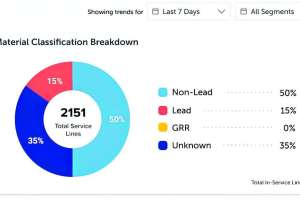
Crow: Inside an individual utility, they’re able to easily see progress toward their goal. Those in leadership positions can very quickly see where they stand against the requirements outlined in the EPA rule.
TPO: How does the PWS Insights dashboard data help those responsible for multiple utilities?
Crow: It helps them with reporting and with comparative analytics. Suppose you manage five water utilities and you need to determine where your areas of risk are relative to the 2027 goal the EPA has put in place. The dashboard gives you a quantitative look, in order of risk, at how your utilities are tracking.
TPO: How are these platforms offered to customers?
Crow: It is a cloud-based technology, and it is sold on a subscription basis.
TPO: How easy are these systems for utility personnel to learn and operate?
Crow: It’s very simple once all the data is loaded in. Coming straight into the dashboard, it’s very intuitive in terms of how to navigate, sort, order, print and contextualize the data.
TPO: Is there a sweet spot for this technology in terms of the size or type of utility?
Fiegel: Some 85% of all water utilities in North America have less than three employees. They don’t have the staff to determine where all their service lines are, and what is and is not in compliance. So they need a helping hand just from a resource perspective. On the flip side, the large utilities have so many service lines and so many potential lead issues that a system like ours helps them easily track it all and bring it together.