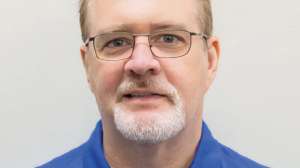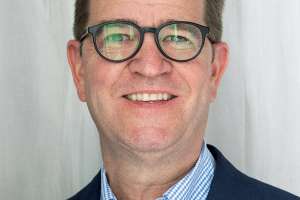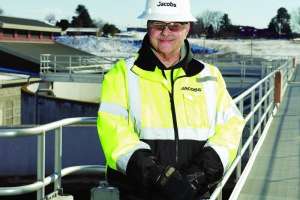
Paul Olson has a knack for wastewater treatment.
“I’m good at recognizing signs and symptoms, and how to correct them,” he says. With 32-plus years of experience at the treatment plant in Walla Walla, Washington, and now eight years as manager of the College Place Wastewater Treatment Plant, he knows the territory and how to fix things. Or, as he puts it, “I know where the pipes are buried.”
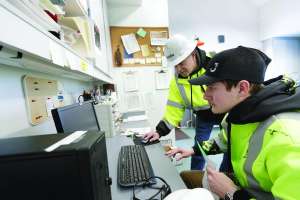
Diego Cruz, a College Place operator, says Olson likes identifying problems and finding solutions. “The Walla Walla staff called Paul for assistance when a broken influent pump started filling the basement at 1 in the morning,” he says. “Paul knew exactly what to do. I did my internship under Paul. He’s experienced and knowledgeable. He makes it fun and teaches us. Everybody loves coming to work here.”
Olson’s contributions to the clean water profession were recognized last year by the Pacific Northwest Clean Water Association, which presented him with a William D. Hatfield Award. His company, Jacobs, which operates both Walla Walla area wastewater treatment plants, nominated him as the firm’s operator of the year.
“I didn’t win that one, but I was blindsided by the Hatfield,” he says. Normally, he prefers to stay out of the limelight: “I like to keep my head down.”
Royce Davis, Olson’s manager at Jacobs, feels the Hatfield Award was well deserved. “As hard and as long as he’s worked, I was happy to see him get it,” Davis says. “He’s always there, always shows up. He sets a good example for the whole team.”
Olson grew up about 50 miles from Walla Walla where his father was a U.S. Forest Service engineer responsible for the water and wastewater plants in the Umatilla National Forest. “My dad encouraged me to give wastewater a shot,” Olson says. “Since he was paying the bill, I enrolled in the wastewater program at the Linn-Benton Community College, and in addition took some chemistry and engineering technology courses.”
After graduating with an associate degree in wastewater technology, he applied for a position with the Walla Walla plant in 1984. He didn’t get it, but when a second position opened up a week later, he interviewed again and this time was successful.
At the time, Walla Walla was a trickling filter plant producing water reused for crop irrigation. The plant (9.6 mgd design) has been converted to activated sludge with oxidation ditches. Olson learned the wastewater trade there, and became interested in the history of the operation and treatment plants in general: “Some of the tanks date back to 1927, with a number of upgrades starting during World War II,” he says.
In April 2000, the city hired the Jacobs engineering firm to operate its treatment facilities, and that alliance continues today.
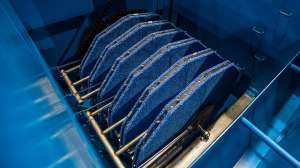
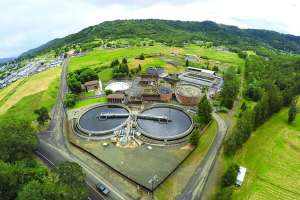
After his tenure at Walla Walla, Olson was named manager in 2016 at College Place, which has a sequencing batch reactor plant (Aqua-Aerobic Systems) rated at 2 mgd. The SBRs are aerated using three APG-Neuros blowers. The effluent discharges to an equalization tank and then passes through two disc filters (also Aqua-Aerobic) before UV disinfection (Nuvonic).
The plant serves just over 9,000 residents southeast of the central city, and average daily flow is 950,000 gpd. Like the Walla Walla plant, College Place produces high-quality effluent. It irrigates 110 acres of hay crops on city-owned land from May through October. A private contractor farms the land. In winter the effluent is discharged to Garrison Creek.
Olson’s staff members collect regular samples of soil, water and crops, which are then analyzed at the Walla Walla plant lab or at commercial labs. “The Walla Walla staff is responsible for all lab work for both plants,” Olson says. “At College Place, we are responsible for plant operation and maintenance, as well as lift station and collection system maintenance.”
Biosolids are dewatered using an Alfa Laval belt filter press and dried on drying beds. Natural Selection Farms, a beneficial use facility, hauls off the Class B biosolids.
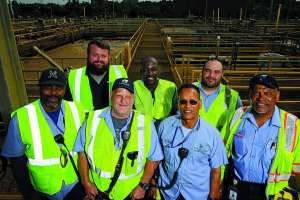
The operation is staffed Monday through Friday, 7 a.m. to 4 p.m. In addition to Cruz, operators include Class I certified operators Ian Grant and Greg Turner, as well as operators-in-training Brett Anderson and Taylor Turner. An operator and supervisor are on-call during off-hours and on weekends.
Olson and his crew are looking forward to a potential improvement plant effluent discharge. The state is reviewing plans for a 45 million-gallon reservoir that would accept treated water from the College Place plant from May through October. That would make things easier for the staff, since the plant would have no discharge directly to the creek during the low-flow season.
Looking back on his 40-plus years in the clean water profession, Olson has much to be proud of. His most memorable accomplishments involve the many plant upgrades and construction projects: “I’ve always worked well with engineers and construction contractors during the expansions and improvements we’ve made at both plants. I’m challenged with keeping the plant running and in compliance with construction going on all around.”
Olson’s knowledge can be critical to projects. He recalls one expansion where he informed designers of the existence of 8,200 feet of ductile iron pipe running from the treatment plant to the storage reservoir. The pipe crossed a river and two highways. “They thought that my information may have saved the project millions,” he says.
Robert McAndrews, College Place public works director, credits Olson for being a good communicator. “His reports keep me in the loop,” McAndrews says. “Paul is on top of things and is always responsive.”
With such a bank of experience, Olson has advice for those contemplating joining the wastewater workforce: “You need a little bit of chemistry, maybe a little bit of engineering and you need communication skills. I’m doing more writing and reports than I ever thought I’d have to.”
Beyond that, prospective operators need to be willing to take on tasks like mowing the grass, sweeping the floors, and cleaning the clarifiers, Olson points out. “It’s not for people with a big head, but they probably wouldn’t apply anyway,” he says. “You need to feel good about what you do.”
Now in his early 60s, Olson still feels good about what he’s doing: “I’ve thought about retirement, but I’ve told my boss, ‘I’m going to stick around until I get senile or you force me out.’”