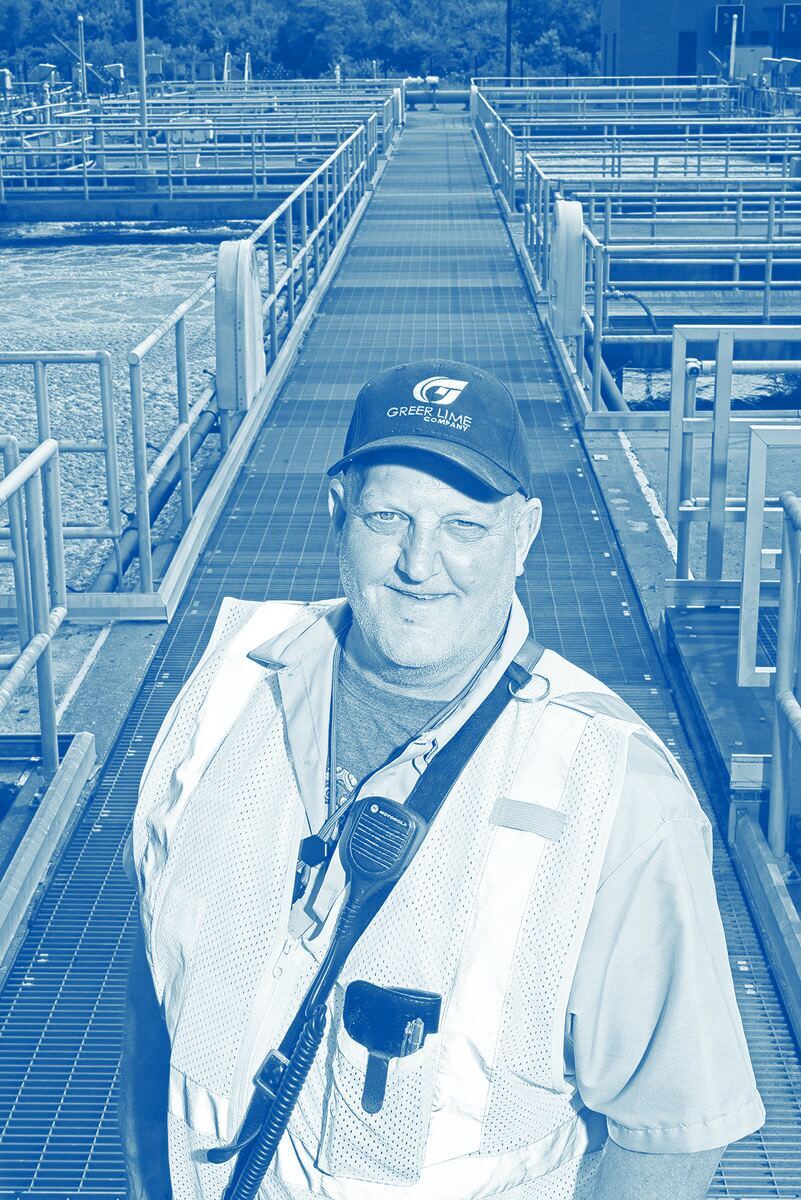
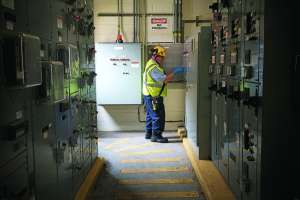
Colleagues applauded when Steve Wilcox announced he wasn’t ready to retire yet.
Wilcox, senior operator at the Arlington County (Virginia) Water Pollution Control Plant, took the four-year extension the county offers to team members who qualify for retirement. “It was a standing ovation,” Wilcox remembers. “They said they wanted to clone me and keep me around.”
No doubt that’s because Wilcox is an indispensable member of the Arlington County team. He has been there for 32 years serving as an operator while training others on his own day shift and night shifts. (The plant operates two 12-hour shifts).
“I like to help people, and I feel good when I can solve a problem,” he says. His teammates often call him Otto, after the super-helpful main character in the film A Man Called Otto, which starred Tom Hanks.
Last year, the Virginia Water Environment Association presented Wilcox with the William D. Hatfield Award. Even with all these accolades, Wilcox remains humble. “I am not sure I’ve done anything to deserve it,” he says. “I’ve just been here 32 years. I help everyone I can and fill in where needed.”
His colleagues feel differently. “He’s really someone everybody aspires to be,” says Brent Derr, supervisor of the plant’s day shift. “Steve is the most humble person I’ve ever met. The guy is a saint.”
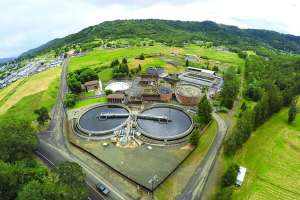
The Arlington County plant (40 mgd design, 20-21 mgd average) lies near Washington, D.C.’s Reagan National Airport and serves the cities of Arlington, Alexandria, Fairfax and Falls Church, Virginia.
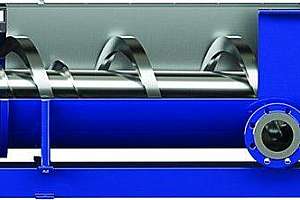
Flow comes through four interceptor sewers and passes through bar screens (Duperon) and Jones + Attwood cyclone grit removers (Ovivo). After primary treatment, solids are sent to gravity thickeners and then to dewatering on centrifuges (Andritz).
Primary clarifier overflow is injected with ferric chloride to remove phosphorus and then passes to activated sludge treatment for biological nutrient removal. Six 2.5 million-gallon parallel aeration trains with Roots blowers (Ingersoll Rand) operate on a four-pass mode.
Methanol is added before the secondary effluent flows through denitrification filters (Severn Trent). Filtrate is disinfected with sodium hypochlorite and dechlorinated with sodium bisulfate. Reaeration freshens the treated water before it enters Four-Mile Run, which flows to the Potomac River and ultimately Chesapeake Bay.
Secondary solids are dewatered with the primary sludge. The biosolids are stabilized with lime and hauled to approved land application sites throughout the state. A chemical scrubbing system (DWB Cor-Pro, using hypochlorite) controls odors. The plant uses a SCADA system (Rockwell) and an MP2 computerized maintenance management system (MVP One) for preventive maintenance. Both are being upgraded.

Wilcox is from Chicago. After high school he served 14 years as a noncommissioned maintenance officer in the U.S. Army, carrying out assignments at Fort Benning, Georgia, and in Korea, Germany, Honduras and elsewhere.
He didn’t know what he wanted to do after high school; his brother had enlisted in the military, and so he joined as well, thinking about becoming an MP. “But I was too short, so they sent me to the motor pool and I started to work on tanks and trucks,” he recalls. He rose to the rank of sergeant.
After he left the service, his father-in-law, who was day shift supervisor at the Arlington plant, suggested he give wastewater a try and capitalize on his experience in equipment maintenance and repair. He applied and was hired.
“He helped me get in the door,” Wilcox says. “I knew maintenance, but nothing about wastewater.” He worked hard to learn the profession — harder than anyone else because he didn’t want anyone to think he was benefitting from family influence.
“I showed up and asked questions,” he says. “I read books, I went to classes, I studied the Sacramento courses.” He earned his Class 1 (highest) Wastewater Operator certification in 2001. He worked the night shift for 25 years and moved to the day shift seven years ago. He fills in as supervisor when needed and on weekends is responsible for the entire operation.
Wilcox is more than a shift supervisor. While the county has its own maintenance department, Wilcox takes it on himself to fix things he sees that need doing. “Packing, seals, flanges, odds and ends,” he says. “On my shift, I hardly sit down. I’m always working on stuff. I like knowing that I got something done. It helps me as I teach and train.”
“He’ll stop whatever he’s doing to help someone out,” says Derr. “He hears a call on the radio, he always steps up. He’ll take on things himself. When people ask who worked on a repair or modification, and we tell them Steve did it, they say, ‘OK, it’s good to go.’”
Derr says, “If you ask our staff who’s the best operator they’ve ever worked with, they’ll say Steve. His military drive and his determination are extreme assets for us.”
Wilcox also spends his time bringing new people on board. “No question is too stupid to ask,” he advises recruits. And he emphasizes that it’s important to take the time to answer all the questions. He pays constant attention to his staff: “At one or two in the morning, I can see all the emails from all the stations. I know what’s coming.”
Ron Taylor, acting supervisor and shift supervisor when Derr is off, says Wilcox is the best there is at training: “He’s organized, detailed, motivated. He gets dirty with the staff. There’s no cutting corners. He gets in there in the thick of things until they know how to do the job.”
Wilcox believes in rotation of shift workers: “Everybody works the bar screens, as well as secondary and advanced wastewater treatment. We all work on the centrifuges, load the trucks, apply chemicals. We rotate every 30 days. We’re lucky to have Ron and Brent as our supervisors.”
The only things Wilcox has trouble with are computers and high-tech activities. “Oddly, my dad is really good at that and helps me out,” he says. It’s a minor flaw and doesn’t detract from the admiration and respect his colleagues pay him.
Derr observes, “If there’s something I can’t figure out, I call Steve. I wouldn’t have taken the supervisor job without him. He makes my day. He makes everybody’s day.”