Transporting dewatered biosolids (cake) is a considerable challenge that can become quite frustrating over time.
Two common transfer methods are progressive cavity pumps and conveyors. Each option has compelling advantages and potential drawbacks depending on the application. By understanding the nuances of these approaches, facility operators can discover the most effective solutions for managing cake with confidence in their specific sets of conditions.
Knowing the basics
Most applications require movement of biosolids cake from a press or centrifuge to another location for drying, other further processing, or hauling offsite. Either pumps or conveyors can move the cake from point A to point B, but a closer look reveals distinct differences in their space requirements and cost. While the products in each category differ, several basic features set them apart.
Floor area
Most cake conveyor systems depend on maintaining low angles for elevation changes or, ideally, require uninterrupted runs to seamlessly transport material to its destination. This can consume substantial floor space, for the conveyor itself or for the support structures needed to elevate the device. In the case of significant elevation changes, conveyors must be installed across considerable distances, complicating efficiency and expanding the footprint.
Here, pumps offer a substantial advantage: They require only the footprint of the unit. The piping can exit the pump and rise vertically if needed, enabling a clean overhead installation. This keeps the floor space uncluttered, leaves ample room for additional equipment and allows freedom of movement throughout the area.
Odor control
Conveyor systems often include open areas that can allow material to spill and odors to escape. For instance, an overstuffed auger may push material out from beneath thin covers while a belt conveyor may spill contents that remain on the belt after it is inverted at the drop point.
On the other hand, pumps have sealed piping systems that mitigate odor concerns and create a cleaner and more efficient environment. In outdoor installations, the closed pumping system prevents rehydration of cake from rainwater, maintaining the low water content achieved through dewatering.

Ownership cost
The cost of a system varies significantly depending on factors such as travel distance, elevation changes and the transfer method chosen. For straightforward, short runs without turns, conveyors are often more economical.
However, for larger setups, pumps might prove more cost-effective, especially where a conveyor would require elevation changes or intricate turns. Conveyors require a new drive system for each change in direction, and their cost increases with length. Pumping, on the other hand, is straightforward: The cost is based on price per volume at a given pressure.
Selecting pumps
Within the pump category, PC pumps offer benefits that include integrated feed augers, low pressure piping requirements, pulsation-free operation, low maintenance and affordable cost. Moreover, PC pump manufacturers are diverse, each bringing unique qualities and innovations to the table. When specifying a PC pump for a cake application, it is important to understand a few basic conditions:
- How the pump will be fed
- The cake’s dry solids content
- The transport distance, including all changes in direction and elevation
- The volumetric flow rate
PC pumps can be fed directly from the dewatering equipment, such as a belt filter press, screw press or centrifuge. If the pump needs to be installed at a much lower elevation than the dewatering device outlet, extension hoppers can be used.
It is best to keep the extension hopper walls as vertical as possible to keep the solids from sticking to the sidewalls. If multiple sources are feeding one pump, a short conveyor can be used to collect the material from the equipment and deposit it into the pump hopper.
Open-hopper pumps can also be fed from a silo or other storage structure. In this arrangement, it is important to use a live-bottom or auger-feed device to make sure the biosolids can be properly fed into the pump hopper. It is also beneficial to install a gate valve to isolate the pump from the silo during maintenance, although some pump designs include a built-in isolation feature for changing the major wear parts (rotor and stator).
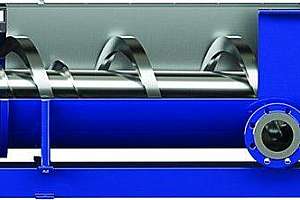
PC pumps are designed with an integrated auger that can be customized to handle solid content from 12 to 45%. It is essential to know the range of solids content so that the manufacturer can select the proper auger feed configuration.

Heavy solids
For high solids content (above 22%) some pump manufacturers use a separate device called a bridge breaker, which consists of two counter-rotating paddle shafts that break up large pieces and force the material into the auger element.
This requires a separate drive and additional shaft seals, so some manufacturers simplify the design with an integrated concentric ribbon auger to serve the same purpose. The ribbon auger is attached to the same drive shaft as the pump elements and rotates around the main auger. This keeps the material from bridging within the pump hopper and eliminates the additional drive unit and shaft seals required by the traditional bridge breaker.
Transport distance and piping configurations are critical to estimating the required pump pressure. Calculating pressure is difficult: dewatered biosolids do not behave like a typical Newtonian fluid, and therefore the Hazen-Williams equation cannot be used.
Typically, dewatered biosolids exhibit a pressure loss of about 2 psi per foot of pipe, but that can increase dramatically if the pipe is undersized for the flow rate, or if long-radius bends are not used for changes in direction. For example, a standard elbow can impart up to 100 psi of pressure losses. Therefore, for optimum efficiency, it is critical to use 4R or 5R elbows.
Lastly, an accurate estimate of volumetric flow rate is required to properly size the pump element. By understanding the flow rate, the manufacturer can suggest the optimum-sized pump running at the ideal speed for long life.
A properly sized PC pump running below 80 rpm and at less than 50 psi per stage can run for one to two years or more in this application without a rotor/stator change, depending on the solids content and abrasive nature of the cake.
Protecting the investment
While a PC pump will work well on its own in dewatered biosolids transfer, some accessories can protect the investment and ensure years of worry-free operation.
First, an overpressure protection device is recommended for any type of positive-displacement pump, including PC. A mistakenly closed valve on the discharge side can lead to extreme pressure, causing safety hazards and potential equipment damage. Also advisable is an isolation ring with a switch to shut the pump motor down in case of a pressure spike and so protect operators and equipment.
Second, most PC pump manufacturers offer a temperature-sensing element in the stator to shut the pump down in the event of running dry, which means loss of lubrication between the rotor and the stator.
Third, a boundary-layer injection ring is typically recommended at the pump discharge. Dilute polymer or water can be injected — not mixed with the biosolids but to coat the exterior of the plug that forms within the pipe. This reduces friction losses throughout the pipeline and helps allow for any errors in the pressure estimate. It can be installed and used only if necessary to reduce pressures and increase efficiency.
Finally, a level control system can be useful for applications where the feed of the pump is variable and automation of the system is desired. Load cells and radar have been used to estimate hopper level and adjust pump speed to match the feed rate from the dewatering equipment. The latest development in this technology uses lasers to monitor the fill level in the hopper and detect product dropping in from above.
About the author
Alicia Kadar (alicia.kadar@irco.com) is marketing manager and Westyn Bennington (westyn.bennington@irco.com) is a product manager with SEEPEX, an Ingersoll Rand business.