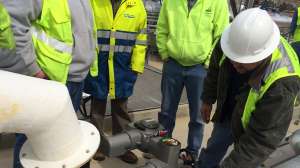
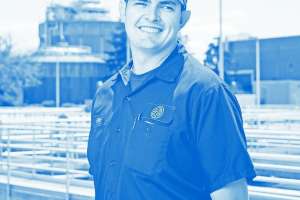
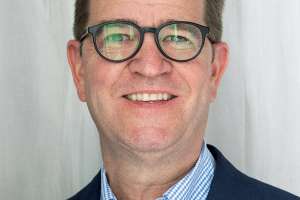
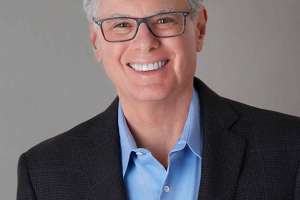
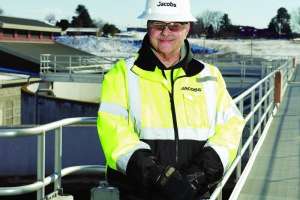
Roy Bradley isn’t one to coast on the job. He comes to work determined to make himself and his treatment plant better. Year by year. Day by day.
“There is always a way to improve,” says Bradley, lead operator at the Bend Water Reclamation Facility in Oregon. “I want to make a difference and have an impact on everything I do. That’s what motivates me. When I get to work I know I can help somebody. I can improve the plant. I can connect with a co-worker, whether about work or not.
“Learning and developing is something I really enjoy. I’m constantly doing research. For example, it could be trying to figure out how to improve dewatering. I’m always searching Google and professional articles. I network with other operators to find out what problems they have and what they’ve learned.”
To that end, he has taken tours of a number of treatment plants in Oregon, Washington, Nevada and Colorado. For his excellent performance and leadership of his team, Bradley was named the 2024 Operator of the Year by the Pacific Northwest Clean Water Association, South Central Operators Section.

Right at home
Bend, a city of 100,000 in the Eastern Cascades, is an ideal location for someone like Bradley, who enjoys fishing, archery hunting, bicycling and hiking. The high desert environment (3,500 feet elevation) provides 200 days of sunshine a year. The Deschutes River is a treasured local resource. “It’s really pretty country,” says Bradley. “The climate is middle-of-the-road. It doesn’t get super cold or super hot.”
Bradley grew up in Oregon and moved to the central part of the state while in high school. He earned an associate degree in water environment technology from Linn-Benton Community College and then took a job as the sole operator of the treatment lagoons and collection system for the Grand Ronde Sanitary District, a small entity in western Oregon.
After 18 months there, in 2016, he took an operator position with Bend; he became lead operator in November 2023. “I always thought of Bend as a final destination,” he says. “I didn’t think I would get here so quickly in my career.”

No stream discharge
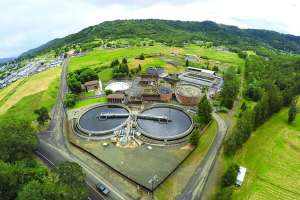
The Bend facility (8.5 mgd design, 6.2 mgd average) has a stable flow; low annual rainfall of 11 inches means inflow and infiltration is not significant. “At one point we were one of the fastest-growing cities in the country,” Bradley says. “We have seen a lot of new housing, but we haven’t seen a ton of increase in flow. What we have noticed is an increase in our BODs.”
The city has diverse industries discharging to the collection system, including breweries, pharmaceutical and semiconductor manufacturing, metal finishing and copper- and lead-forming facilities. These are covered by an industrial pretreatment program.
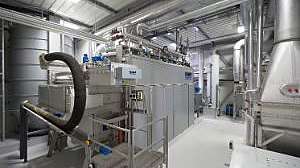
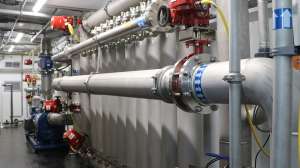
Influent comes to a lift station on the plant property. Three influent pumps (Flygt, a Xylem brand) lift the flow to the headworks with band screens (JWC Environmental). There is no grit removal system, although that may be added in the future, Bradley observes.
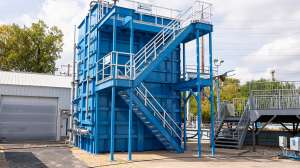
Preliminary-treated wastewater flows to three primary clarifiers and then to three integrated fixed-film activated sludge basins (Veolia) where nitrifying and denitrifying occur. The flow then proceeds to three secondary clarifiers, followed by UV disinfection (Trojan Technologies).
The discharge permit limits total nitrogen to an annual rolling average less than 10 mg/L. BOD and TSS limits are 1,000 pounds monthly average, 1,500 pounds weekly average, 2,000 pounds daily maximum.
Most of the effluent discharges to evaporation and percolation ponds. “It’s not considered a wetland, but it is a popular bird sanctuary,” Bradley says. “We have two separate ponds. We send effluent to one in the winter and one in the summer. It evaporates and percolates into the groundwater.”
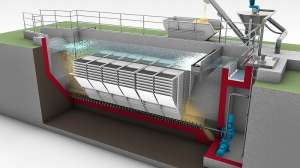
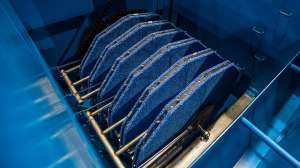
During irrigation season, a portion of the effluent (about 2 mgd) is treated in an AquaDisc filter (Aqua-Aerobic Systems), dosed with UV and sodium hypochlorite and supplied to a golf course for irrigation. “We sent 180 million gallons to the golf course in 2024,” says Bradley.

Smooth transition
For Bradley, the transition to lead operator was not difficult. He had to adjust to spending more time in the office. “That forced me to be more efficient with computer software programs and other administrative functions where I was lacking in experience,” he says. “Other than that, because of the great team I work with I haven’t faced many challenges.
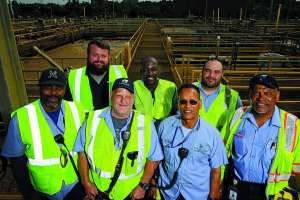
“I’ve worked with my team members for a long time, whether I’ve trained them or been trained by them. When I started, the most senior team member other than our operations supervisor had three years here. We were all pretty new to the industry and new to the plant. I like to say we’ve grown up together.” The team includes:
- Chris Miccolis, facility manager, and George McConnell, operations supervisor
- Operators Ethan Parent, Sam Borgognoni, Adam MacGeorge, Josh Lucero, Louis Kraaz and Alan Lawyer
- Lance Finney, mechanic lead; mechanics Marc Mickey, Mike Stanton and Coty Powers; and Ed Rogers, maintenance specialist
- Warren Packebush, electrician; and Tim Carlson, instrument and control technician
- Cally Whittman, laboratory program manager; analytical chemists Matt Hansen and Stefan Dangona; and lab technicians Jim Billington, Daniel Weisz and Hallie Stolte
He counts Miccolis, McConnell and Finney as mentors: “I wouldn’t be where I am in my career without them. I work with great people. We’re having a good time. We’re working as a team. We have upper management that allows us to be involved in things like Operations Challenge. That makes a major impact on my career.”

Seeking knowledge
The Operations Challenge has been a source of learning and inspiration for Bradley, who helps coordinate the regional competitions as a member of the PNCWA Operations Challenge committee. He’s also the captain of the Bend team, the Wizards of WAS, which took eighth place in Division 3 at the national competition in 2024. The other team members were Stanton, Billington, and field sampling technicians Nick Jeness and Matt Sanders.
Through the challenge, Bradley has learned about aspects of the profession like maintenance and electrical troubleshooting, while expanding his network of operators around the state and the region. That has delivered practical value.
For example, “We just did a digester cleaning project here. Through the Operations Challenge, I was able to talk to other operators and learn how they did it. There’s no generic digester and no generic plant. There’s no standard manual on how to take this large piece of equipment down that’s full of explosive gas. That networking piece was huge.”

Embracing the culture
Although fully dedicated to his career, Bradley did not originally seek it out: “I didn’t grow up thinking I wanted to treat wastewater for a living or even really knowing what it was.” He did know he wanted a career in some aspect of biological or natural resource science.
He discovered his college’s water program through an acquaintance and earned his associate degree regarding it merely as a way to get a start in the working world. But from his first job with the Grand Ronde district (where he now serves as operator of record), “I fell in love with the career. It ended up being what I like, and I have a passion for it.
“It’s everything I was looking for. You never know what to expect from day to day. Some days I’m working in the office, or doing lab work, running experiments. Sometimes it’s operating heavy equipment and moving biosolids. Other times I’m working on a pump with the mechanics.”
He buys into the One Water concept that is central to the Bend Water Services Department: “One Water means every piece of Water Services has an impact on our community and environment. Every gallon of water is valuable, whether it is cleaned for consumption, captured and treated as runoff and returned to the river, or treated as wastewater and returned to the groundwater.
“Every piece of the water cycle is important to our water resources as a whole, and every person in our community has an impact on our one water source.”
While well satisfied in his current role, Bradley aspires to further growth in his profession. “A big reason I have been able to advance in my career is the support of my wife, Cheri,” he observes. “She has sacrificed a lot of weekend plans, been woken up in the middle of the night by countless alarms and brought dozens of meals to me when I’ve been working late. She has been my biggest supporter.
“My next step would be to manage the staff here or at another plant. I’ll continue working on ways to improve efficiency here. There will be projects like facility upgrades where I can be more involved in decision-making.
“If I’m at this plant for the next 20 years, I want to make sure it’s a place where we can keep being sustainable, keep improving our effluent quality, keep improving how we use our water and biosolids, and hopefully improve the environment.”