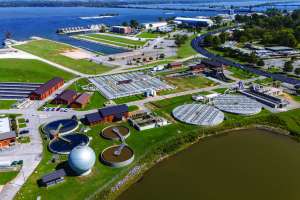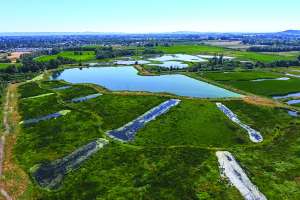
Clean Water Services in western Oregon needed to add capacity. So instead of adding another treatment plant train, the utility built a 100-acre wetland.
The Fernhill Wetlands cool effluent flowing to the Tualatin River, helping to protect seasonally migrating salmon. The site has also become a community attraction that draws in an average of 700 visitors a day, many of them birdwatchers.
Jared Kinnear, water reuse manager for the Hillsboro-based utility, says the wetlands scored on the triple bottom line — economy, environment and community. The project cost about half what a plant expansion would have required, and it delivered benefits that traditional treatment facilities could not match.
“We converted former sewage lagoons into a natural treatment system,” Kinnear says. “So we recognized a quite large environmental benefit. And then there were community benefits with trails and other amenities we put out there. It became apparent pretty quickly that it was a good project for us.”
“The No. 1 pollutant we deal with is temperature,” Kinnear says. “I always jokingly say we humans like warm showers and the salmon in the river like cold showers. We have to be very careful with the temperature of the water we discharge because the Tualatin is a slow-moving, fairly small stream. We built the Fernhill Wetlands to essentially help cool the water down and to do some polishing of nutrients.”
The utility’s four water resource recovery facilities all discharge to the Tualatin River west of Portland. Previously, during five months each year, the state Department of Environmental Quality required warm effluent from two of those plants to be piped to a facility farther downstream for discharge where the river is larger.
It took several years to turn the abandoned sewage lagoons into functioning wetlands. The first step was to drain and excavate the lagoons and install 2,400 feet of piping and 15 control structures.
Meanwhile, the utility grew native plants in nurseries and collected seeds. Ultimately 750,000 plants were put in and 3.2 billion seeds were distributed. Kinnear, a wetland ecologist who worked as a consultant before joining Clean Water Services, insisted the plants be given time to mature, but the wastewater engineers were skeptical.
“They looked at me like I had three heads,” he says. “I explained that we were using living organisms to do the treatment, and they needed to become mature enough to do the work.” He prevailed, and the plants were given two growing seasons to get established before the wetland was used for treatment. Construction was finished in 2014, and in 2017 effluent from the treatment plants began flowing through the wetland and into the river.
“It was a really interesting project where wetland science, restoration ecology and wastewater engineering collided,” Kinnear says. “The team we put together and the respect we all had for each other’s disciplines really showed in the finished product.”
The effluent from the treatment facilities at Forest Grove (2 mgd average) and Hillsboro (3 mgd) flows through the wetland from May through October. It takes about five days for the effluent to reach the river, during which the temperature is reduced by about 1 degree C. “That’s a big difference,” Kinnear says.
Evaporative transpiration provides some of the cooling, and shading from the plants helps keep the water from warming up during the day. Summers are hot in western Oregon, but the nights tend to be cool. “If we get a warm June, when we’ve got 17 hours of daylight, that’s where we can struggle a little bit,” says Kinnear. “But as we get later into July and August when the days are shorter, we see a lot more cooling.”
The wetlands also remove nitrogen and phosphorus, although those nutrients are already within permit limits when the effluent leaves the treatment facilities.
“At the end of the wetlands, we’re seeing zero nutrients, which is great,” Kinnear says, “The water also picks up a lot of good algae, good bacteria, native plant seeds and macroinvertebrates and things that are good for the river. It has become a more naturalized water as opposed to just coming right out of the back of a treatment plant. I feel like when the water comes out of the wetlands, the river is very, very, thankful.”
At a flow of 5 mgd, the Fernhill complex has about 55 acres of surface water about one foot deep on average. The flow can be increased by raising the water level; the design capacity is 18 mgd.
Even a natural treatment system requires management. A crew of landscapers maintain the trails and upland areas to keep undesirable plants under control. Treatment plant staff members manage the control structures in the wetlands.
The property is attractive to resident and migratory birds and other types of wildlife, unfortunately including some that are nuisances. For example, carp enter the wetland from the river when it floods; they disturb the bottoms of the ponds and increase the water turbidity. Nutria, an invasive, non-native species of muskrat-like rodents that feed on the plant roots, are a bigger nuisance.
“I have the best nutria habitat in Washington County,” Kinnear says. “I have to manage them quite a bit or they will eat all my plants.” The management tool is bullets: Special agents from the U.S. Department of Agriculture hunt the nutria at night when the wetlands are closed to the public.
Kinnear hasn’t found a good way to manage the carp, but they raise the turbidity more in spring than in August and September when the river is the most sensitive. “They’re a pain,” he says. “They cause us consternation in May and June, but by early fall, they’re not very active, so our Total Suspended Solids numbers look really good then.”
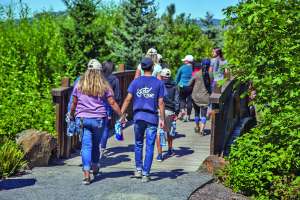
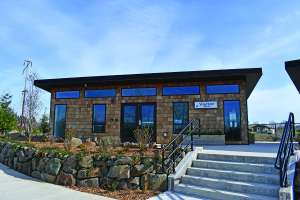
The Fernhill Wetlands are open seven days a week, dawn to dusk, except for about 21 days a year when the access road is flooded. Amenities include parking, a visitor station, a restroom, drinking water and several miles of trails. The 700-acre property is popular with birdwatchers, and it draws school groups and people who appreciate the natural environment.
“It is a functioning wastewater treatment facility, but for visitors it presents like a park, so that’s a huge opportunity for us to engage folks,” says Ely O’Connor, education and outreach manager for Clean Water Services.
“On a nice sunny day in February, you’re going to see over 2,000 visitors, because people have been cooped up inside and they really want to get out. If it’s a 100-degree day in August, you’ll see far fewer than that. It’s not 700 people every day, but over the year, that’s the average.”
During winter the treatment facility effluent flows directly to the river. Waterfalls in the wetlands that help aerate the water are turned off to conserve electricity, and that often disappoints visitors. “For them, it’s aesthetic, but for us, it’s operations,” says O’Connor. “We don’t run the waterfalls if we don’t need to aerate the water because that’s a cost.”
Panels inside the visitor station detail how the wetlands treat the water, but there aren’t many educational signs along the trails. “We want to be mindful of educating people, but also not having a lot of interference,” O’Connor says. “We do plan to have a limited amount of interpretive signage, but I feel pretty strongly that we want to do it without interfering with people being able to connect with the water or the wildlife.”
Visitor surveys have convinced her that the essential message is getting through: People say they understand that water is being cleaned at Fernhill, even if they don’t necessarily know how. “Getting people to understand that is a win,” O’Connor says. “For them to understand at least that water is getting clean there, I think that’s perfect.”