
At the Dry Creek Wastewater Treatment Plant, every team member has a building.
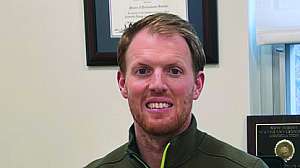
That is, each operator is responsible for keeping a building clean and tidy. That includes Shannon Bailey, plant superintendent. “I clean the operations building, which is the control room and the offices for our maintenance supervisor and myself,” says Bailey.
“When you see somebody walk out of a building and pick up a piece of trash that was dropped, or they pick a weed out of a flower bed because they’ve seen me do so, that’s the attitude we want. When people see you being a part of what they’re doing, they’re more apt to want to build on that. Instead of a top-down mentality, it’s a we’re-all-down-here mentality. We’re all trying to make the best effluent we can make. I know that sounds cliché, but we really live that.”
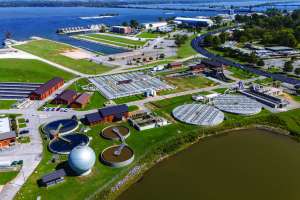
The Dry Creek plant, in Decatur, Alabama, has a design capacity of 36 mgd and treats an average 21 mgd, consisting of nearly two-thirds industrial wastewaters. A $90 million upgrade to the headworks began in fall 2024. The facility received a 2023 Plant Excellence Award from the Alabama Water Environment Association as well as a Best Operated Plant Award from the Alabama Water Pollution Control Association (awarded to facilities with flows greater than 10 mgd).
Decatur (population 58,000) is home to a wide variety of industries: chemicals, specialty films, carbon fibers, aerospace, dairy products, poultry processing and others. An industrial pretreatment program helps monitor and regulate those flows. “Our removals for TSS and CBOD are 97-99%,” says Bailey.
Wastewater arrives from a collection system that includes 18 lift stations. Five influent pumps (Flygt, a Xylem brand) deliver the flow to the headworks with an AquaGuard self-cleaning fine screen (Parkson Corp.) and a Schreiber Grit & Grease removal system (also Parkson).
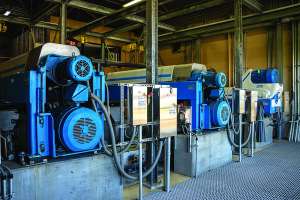
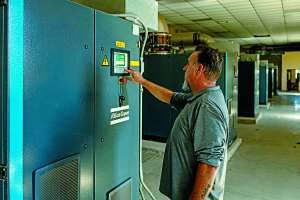
The flow enters a basin for freshening with coarse-bubble aeration and then passes by way of a Parshall flume and a splitter box to four square and two round primary clarifiers. Primary-treated effluent proceeds to five aeration basins with fine-bubble aeration (Sanitaire, a Xylem brand). Air is delivered by seven high-speed mag-drive turbo blowers (Atlas Copco).
“We regulate the mixed liquor in the basins,” says Bailey. “We keep it around 3,000 mg/L. We also have mechanical thickeners, which are concrete basins with Envirex drives [Evoqua]. We take the supernatant and send it to the anaerobic digesters along with the primary and activated sludges.
After four square and two round final clarifiers (drives by DBS Manufacturing), the flow goes through chlorine contact basins followed by dechlorination with sulfur dioxide before discharge to Wheeler Lake.
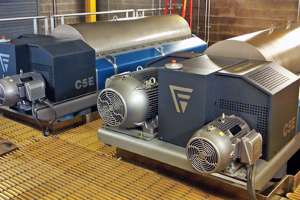
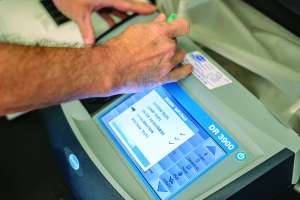
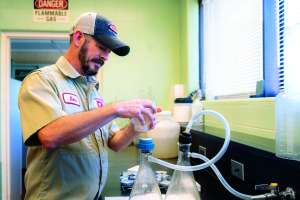
Biosolids are dewatered on three centrifuges (Andritz) from 2-3% solids to 26-27% and sent to landfill. The plant also dewaters the city’s water treatment residuals on a Volute press (PWTech); that cake is landfilled separately. The plant has an in-house laboratory that runs tests for pH, dissolved oxygen, TSS, CBOD and nutrients.
The upgrade just beginning will replace aging equipment and improve performance. “We are actually upgrading the headworks and influent pump station,” says Bailey. “It’s been 1988-90 since we had a headworks upgrade.”
The plant team worked with Garver Engineering and Ardurra Engineering on the project design. The changes will include a coarse screen upstream of the influent pumps.
“COVID changed things for us at the headworks,” says Bailey. “We saw a lot of rags and masks, and so we had a lot of pump pullings that we didn’t have years ago. The screen will catch a lot of the bigger things that come in.” There will also be a new Parshall flume and a new splitter box for the primaries, and PISTA Grit system (Smith & Loveless). Black Dog Analytical performed a grit study during the design phase.
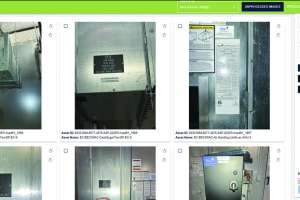
Meanwhile, equipment maintenance is supported by a computerized maintenance management system. “When we first implemented that several years ago, I was always big on hearing my father say, ‘Garbage in, garbage out,’” Bailey observes.
“I spent one winter loading up O&M manuals so our guys have the ability when they’re in the field to use their laptops and pull up those books. We put in what size belt this equipment takes, what oil it needs, what regular maintenance it requires.” Maintenance is concentrated in the lower-flow summer months: “We have good communication between our operators and maintenance people. There’s no dissension between them.”
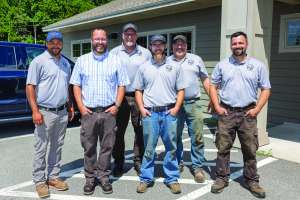
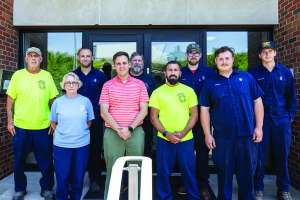
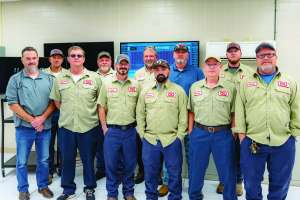
Besides Bailey, the Dry Creek plant operations team includes Frank Murphy, Kevin Register, Mike Sons, David Vinson, Michael Love, Javian Conley, Jeff McGuire and trainee Jordan Alvis. On the maintenance side are supervisor Mark Jones and his crew, including Adam Bolding, Ryan Halbrooks, Danny Jones, Joshua Walker and Jimmy Bizzell. Rick Young and Jeff Miller are electricians and instrumentation specialists.
Supporting those professionals are Sharlene Whitmer, water resources supervisor; Billy Strobel, water resources engineer; and Tonia Hargett, environmental technician.
Bailey has been with Decatur Utilities for 21 years; he previously owned an upholstery shop.
He started with Decatur in a maintenance role, moved on to maintenance supervisor, and became superintendent four years ago. He takes pride in his team members’ longevity: “Usually when people leave the plant, they are retiring. We’re always looking to optimize things. It’s pretty neat to watch a group of people who buy into it like I do.
“I try to hire people who have a sense of wanting to do something good. We’ve got a great bunch of people who don’t just perform a function. They’re in the plant and are active. Jeff Miller, our electrician and instrumentation specialist, retired last year. I hired Rick Young, who I had worked with for several years; he serviced our methane compressors. He’s 55, which is an unusual age for starting over, but he fit right in, and now he’s just like a 20-year employee.”
Bailey strives to form relationships with vendors that go beyond ordering spare parts or grease, or chemicals: “I like to get to know people. How’s your family? How’s this and how’s that?”
Closeness with team members and suppliers pays off in times of crisis, like the aftermath of a tornado that hit the Dry Creek plant in January 2023. “Maintenance supervisor Mark Jones and I came in early,” Bailey recalls. “We knew there was going to be bad weather. When we saw it getting worse, we had everybody go to our designated shelter in the basement of the WAS/RAS building and made sure all were accounted for.”
The tornado made a direct hit, blowing the doors open on the building and lifting the roof off. Some clarifier lids were blown across the parking lot; some had landed in the river. As soon as the storm passed, “Our guys went out like ants,” Bailey recalls. “The generator did its thing. The storm missed it by about 50 feet.
“The building that houses the motor control center for the headworks pumps was partially gone. We covered it up. We were systematic about how we dealt with everything. Processes that had stopped, we got back online. You can’t shut down a wastewater plant — that’s not a luxury we have. So we got everything going.”
Meanwhile Bailey called the owner of a roofing company: “I said ‘Look, I need somebody here tonight.’ He brought a trailer with plywood and some membrane material to get us dry that night. They worked until one or two o’clock in the morning. That’s the kind of people I try to do business with. That’s where relationships with vendors pay off.”
The storm hit on a Friday, the day before Bailey’s daughter’s wedding reception at an event center next door. “We were setting up tables that Friday night at the event center while I had roofers putting an emergency patch on our building,” says Bailey. “It was something I would never want to go through again, but it was really cool to see our team in action.”
Bailey is quick to praise the city leadership for the treatment plant’s success. “We have a great utility board that helps us with the big decisions,” he says. “We’ve got a good management team. They’re real supportive. They come to the plant and when I’m in the office we talk about things.” Ray Hardin is Decatur Utilities general manager and Gary Borden is operations manager.
“Our water resources manager, Tom Cleveland, who’s over both the water and wastewater plants, I visit him every day,” says Bailey. “There’s constant communication. It takes management, it takes good team members and it takes good leadership to make it work. It’s not Shannon who’s doing all this. I’m there to see that we get everything we need to make sure the plant runs great.”
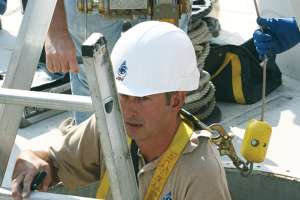
Safety is a major priority for Bailey and his team; the facility won a 2020 George W. Burke Jr. Award from the Water Environment Federation for its safety program and record. “We have a 10-year safety record without an incident or accident,” says Bailey.
“We don’t want our people doing anything that would put them in jeopardy. If I ask you to do something and you’re not comfortable with it, I want to know. I’ll show you a safe way to do it, or we’ll have somebody else do it. That’s my main thing: our team members going home safe.”
As for Bailey, he’s a member of the Alabama WEA and the AWPCA, where he served on the board for three years. Two years ago he received the AWPCA’s Bolton-Crockett-Beck Award for career achievement.
“At the banquet I was telling my wife, ‘One day I’m going to do enough to get that award,’” he recalls. “When it turned out that I won the award, I was speechless. It was surreal. It’s cool when your peers recognize you, but it’s less an accolade for me than a recognition that I’ve got a good team. The award really belongs to all of us.”
For the future, Bailey expects a focus on nutrients: “We just renewed our permit this year, and we’re required to monitor our nutrients.” PFAS regulations will be another issue, although the plant team has been testing for those substances quarterly for more than 10 years. “We are ahead of the curve on PFAS,” Bailey says.
His advice to others in the clean-water professions: “Love what you do. And build a network. I’ve got a network of superintendents in North Alabama and we talk weekly. I get calls: ‘Hey, I’ve got this going on. Have you ever had that happen?’ It’s the camaraderie, being open to communicate instead of locking yourself in a corner.”