Sometimes the greatest career opportunities are seized for reasons that have nothing to do with personal ambition.
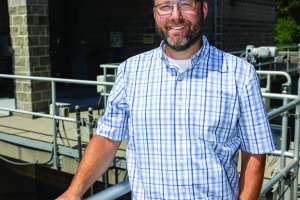
A prime example is the career journey of Nate Brown, utilities superintendent with the Peterborough (New Hampshire) Wastewater Treatment Facility.
He joined the public works department 24 years ago as an entry-level laborer. Since then, he has risen through the ranks with hard work and lots of certified training to oversee the town’s sewer system, wastewater treatment plant and drinking water system.
And he is good at his job — that’s why he was one of only seven people to be recognized as a 2023 Wastewater Treatment Plant Operator of the Year for New Hampshire from U.S. EPA Region 1.
Before going to work for Peterborough, Brown was sorting priority mail at Emery Worldwide Airlines on the night shift. “I had a young family, and they were up during the day and I was up at night,” Brown recalls.
“I would try and force myself to stay up during the day, but even though I was making a ton of money working there, I just knew that wasn’t sustainable physically and mentally.” He saw a newspaper ad for a job at Peterborough. The hours, pay and benefits all looked good.
“When I went to the interview, all the guy asked was if I would mind carrying a pager once every four weeks and be on call. And I was like, ‘Yeah, I’ll do that.’” As for the job change leading to an award: “Honestly, I can’t take credit for it myself. It was a group effort for the whole team here at the plant. As much as I’m in charge, I feel like we all work together as a team.”
Brown was born in Nashua, New Hampshire, in 1975. He grew up with his family in Milford 11 miles down the road. “My father repaired equipment for a forklift company, and my mother stayed at home,” he says. “I have one older brother and one younger brother, and my sister is the youngest.”
Brown graduated from Milford High School in 1994. Not wanting to go straight to college, he took some classes while working at a company that made transducers for fish finders and speed sensors for personal watercraft.
“That was a ton of fun,” says Brown. “I loved it because a lot of people there were my age. We’d play street hockey after work once a week and we’d go to a bunch of concerts. But it was factory work, and I had already progressed pretty much as far as I could go.”
He moved to Peterborough and worked for Emery Worldwide for a year and a half before signing on with the town. On arrival for his first day, a town employee told Brown to follow him in his car. “So I’m driving and I was like, ‘Man, did I make a bad choice?’ I didn’t know that I was working for the wastewater department.
“I get there and right off the bat, I meet super nice guys. Everyone was really welcoming. I loved the work. And it was something different every day. From there, I just progressed. I got every license that I could. The town would send people to classes, so I took them up on everything.”
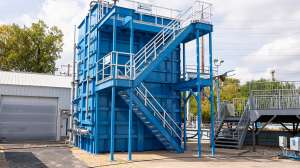
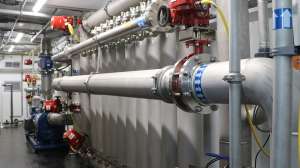
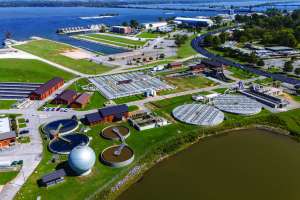
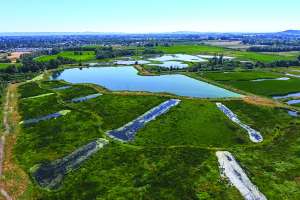
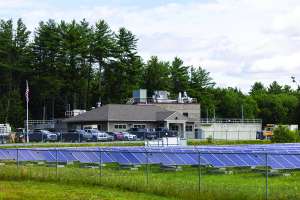
The Peterborough Wastewater Treatment Facility processes 0.62 mgd. Wastewater delivered from the collection system’s last pump station runs through a Muffin Monster grinder (JWC Environmental) and then is pumped to the treatment plant.
The flow passes through a step screen with wash press (Vulcan Industries) and then an aerated grit chamber fed by a Roots rotary-lobe blower. There, ferric chloride is added to remove lead and phosphorus.
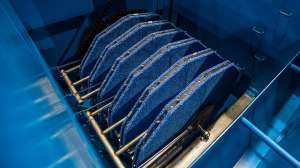
Next, the wastewater is treated in two sequencing batch reactors (Aqua-Aerobic Systems), which are decanted into a post-equalization tank. There chlorine is added for disinfection. “Then it goes through a magmeter (Endress+Hauser) and is piped to a dechlorination tank where sodium bisulfite is added before discharge to the Contoocook River.”
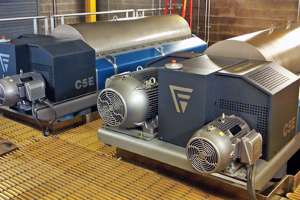
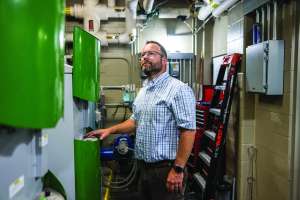
Other plant equipment includes peristaltic chemical-feed pumps from Blue-White Industries, a Vogelsang rotary lobe pump; a ProMix polymer mixing unit (ProMinent); a Met-Pro odor-control unit (Rogers & Morgan) actuator; and an FKC rotary screen thickener and flocculation tank (FKC Company).
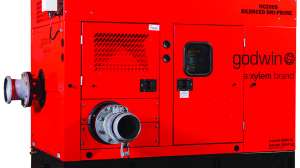
“Most everything is Hach for our probes and analyzers,” said Brown. “We have two Caterpillar generators for backup power, and we use submersible pumps (Flygt, a Xylem brand) for pulling out the sludge out of the SBRs.” The plant also takes in septage in a Raptor receiving station (Lakeside): “We have enough storage capacity to accept and process up to 60,000 gallons of septage daily.”
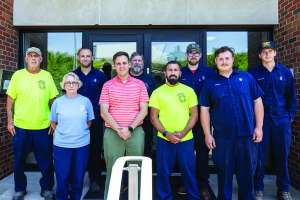
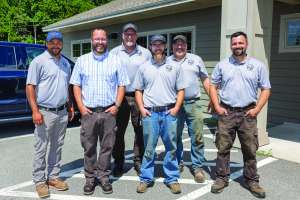
Brown runs Peterborough’s clean-water plant with five team members. “Everybody does everything, including myself, and up to and including cleaning toilets,” Brown says. “We don’t have a janitor, so we’re the maintenance crew.”
Jamie Jarest, chief operator, has a Grade 3 Wastewater Operator license and a Grade 2 Water Treatment and Distribution license. “Pete Bergeron is our jack-of-all-trades,” says Brown. “If you need something built, he’s the guy.” He has Grade 2 Wastewater Operator and Water Distribution and Treatment licenses.
Anthony Carland (Grade 1 Wastewater) is pretreatment coordinator. Newer team members Tim Jarest has Grade 1 Wastewater and Water Treatment and Distribution licenses; Nathan Limric has Grade 2 Wastewater and Grade 1 Water Treatment and Distribution.
Brown believes in sharing the workload with his team members while helping them improve their skills and reach new levels of certification. “I don’t have any secrets,” he says. "I’ll show anybody everything. I make spreadsheets so if something were to happen to me, someone could just jump in my position and figure out what I’ve done.
“I also encourage everyone to get whatever license that they can or that they want to. And New Hampshire has a really good manager training school. I’ve had three guys go through that. They both moved on, and they are superintendents at different wastewater plants.” Two have moved on and are in superintendent positions at different plants, and Jamie Jarest is still there as the chief operator.
Like any wastewater plant manager, Brown has dealt with his share of emergencies. He has also experienced some lucky breaks and great teamwork that helped him cope with them.
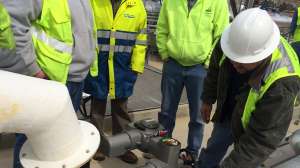
For instance, a crack developed in the main pipe going from the last pump station to the treatment plant, and Brown was due to go on vacation the next day. “The stars must have been aligned because I found a contractor that could dig it up and repair it immediately,” he says.
“I also called a pump company. It just so happened they had their trucks loaded with pipe about to go to another job, but they could bring it up here instead because we needed it. Now it really was a pain to put that pipe together. It was like 2,000 feet from the pump station out to the treatment plant. But everyone stayed to help the contractor get the repair done, and we had the water back on by 11:30 that night.”
The teamwork, the fun of working with his crew, the importance of treating Peterborough’s wastewater properly — all that motivates Brown to keep doing what he’s doing. “I think I’ll stay here; I mean, as long as they’ll keep me,” he says. “All these other guys who work for different towns or different companies, I hear their problems, and I don’t have those problems here. I get a ton of support from the Town Hall, and from the select board.
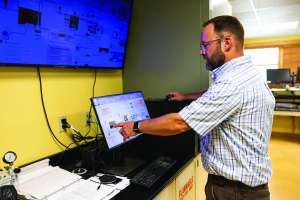
“Plus Peterborough’s a pretty green community: We just purchased a fully electric truck, which is working out great for us. We have solar panels helping to power our plant. And we do most everything electronically using iPads and iPhones. I love my job and where I work, so I see no reason to be anywhere else.”