Wastewater spills and sanitary sewer overflows cost municipalities multiple billions of dollars per year in cleanups, repairs and property damage.
Many of these events can be avoided or at least mitigated if utility personnel receive warnings. That’s the principle behind Metasphere smart water sensors offered by water solutions provider and pump manufacturer Grundfos.
In 2023 Grundfos acquired Metasphere and its line of telemetry and analytics technologies for water networks. The smart sensors, used overseas since 2006, but new to the United States and Canada, can help municipalities, real estate developers and homeowner associations prevent overflows in sanitary, storm and combined sewers.
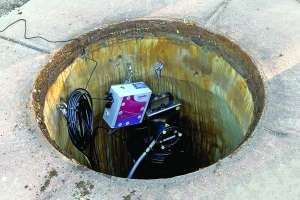
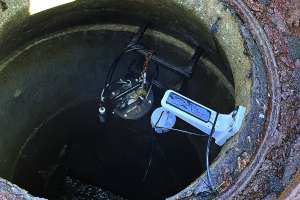
The sensors are deployed in manholes. Before an overflow from a manhole occurs, the sensors detect a rise in the water level and automatically send alerts to utility personnel. The devices can fit in the palm of a hand and are mounted securely to the wall of a manhole. They can then be removed easily to change their location.
Once installed, sensors can be programmed quickly with a tap of a magnet. They use advanced radar technology to measure water levels accurately. Jack Canfield, market development manager with Grundfos, talked about the technology in an interview with Treatment Plant Operator.
TPO: What is the motivation for bringing this technology to the North American market?
Canfield: The aim is to help reduce or eliminate SSO, which are ultimately a risk to public health and safety for anyone who happens to walk into a spill, especially during flooding. This technology will predict and ultimately help prevent SSOs from occurring.
TPO: What differentiates this technology from other offerings in the marketplace?
Canfield: For one thing the sensors are extremely small. Some units on the market are large enough so that if one were to fall into the collection system, such as into an 8-inch line, it would cause an SSO by lying on the bottom of the pipe. Our units are about the size of a Solo cup, so if one were to fall, which it won’t because it’s mounted on a sturdy bracket, it would pass through the collection system and could be retrieved at another manhole.
TPO: Is there an advantage in how the units communicate data?
Canfield: They communicate through cellular. A SIM card installed in the unit can use any cellular network. The utility doesn’t have to do any kind of setup. They simply initiate the sensor using a magnet and it automatically starts communicating with the nearest cellular tower.
TPO: In basic terms, how does the technology work?
Canfield: Every 15 minutes the device sends a radar pulse that bounces it off the bottom of the manhole and back. A signal representing the water level is then sent by a small antenna via SMS cellular service to a dashboard where users can view a map of all sensors across the collection system. They can monitor conditions 24/7. If a storm or clog is causing the manhole to fill up, the device automatically sends alerts, giving the utility time to send a team to address the issue.
TPO: How does the utility monitor conditions at the manholes that have sensors installed?
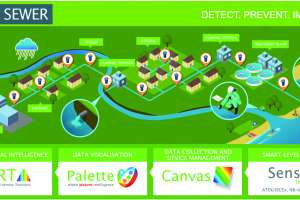
Canfield: The sensors automatically come with our ArcSewer platform, which has all the algorithms built in along with some AI capability. It tracks real-time data and plugs it into graphical measurements that show when the user should look into dispatching teams in response to potential SSOs. It also tracks and holds the information as historical data, so if last year there was an overflow at a given location, the utility would know in advance to prepare.
TPO: How are utility team members notified of potential SSOs?
Canfield: The system sends a text message or email alert to the people installed into the system as users. It also plots the information onto ArcSewer. Staff members can bring that platform up and it will tell them what is going on in the manhole, so they can dispatch people accordingly. The ArcSewer platform lets users load pictures of where the monitored manholes are. It also plots the locations on Google Maps so that crews responding can get instant directions.
TPO: Where in the collection system would sensors typically be deployed?
Canfield: The typical approach is to put them in upstream manholes upstream from manholes where SSOs have occurred. If one of those monitored manholes begins to fill up, they know there is going to be an issue downstream. That gives the utility ample time to dispatch people to address the problem. Sensors also can be installed in manholes outside a lift station to indicate whether the pumps are fully functioning or are having issues.
TPO: How easy is this technology for plant personnel to install and operate?
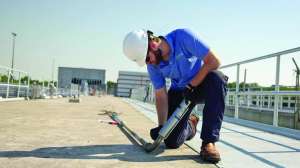
Canfield: It is extremely easy. The installation takes about 15 minutes, using two bolts to attach the mounting bracket to the manhole. All of the brackets and materials are H2S resistant. The dashboard is very easy to navigate. With every device a utility purchases or puts on subscription, we include an A to Z instruction manual on how to set it up. Or we can send one of our channel partners to set it up for them.
TPO: What maintenance do the sensors require?
Canfield: They are maintenance-free. If the users don’t alter the pre-determined time between radar signals, the battery life expectancy is five years without any disruption in service. After the five years, we can change out the battery or, if need be, replace the sensor.
TPO: What sizes of utilities is this technology best suited for?
Canfield: It is suitable for utilities of any size. Any utility can afford it. We want it to be available not just for large metropolitan utilities but for small communities as well. We have support available to help any utility at any time. We have no supply issues, so utilities that order the products will receive them without delay. We can fill even large orders with short lead times.
TPO: Where are some places where these sensors have been used successfully?
Canfield: The sensors have been in service since 2006 in Australia and in the United Kingdom, where about 80,000 units are installed. In the United States we have pilots going in progress in Tennessee and central Florida where the technology is working perfectly.