Florida is both rich and poor in water resources.
It’s nearly surrounded by oceans and gets abundant rainfall, but faces seasonal droughts that stress water supplies for drinking and irrigation.
Hillsborough County Utilities’ five water reclamation facilities play key roles in keeping the waterways clean and seeing communities through the long dry spells typical from January through May.
The largest plant, the 30 mgd (design) Northwest Regional Water Reclamation Facility, uses a five-stage Bardenpho secondary treatment process followed by deep-bed sand filters that produce reclaimed water for golf courses and residential properties.
The plant was recognized with a 2025 Outstanding Wastewater Treatment Facility Performance Award from the Florida Water Environment Association. It also received 2021 and 2025 FWEA Earle B. Phelps Awards in the advanced treatment category for outstanding performance and professionalism.

Feast and famine
Florida’s water supplies are affected by seasonal rainfall and a major influx of new residents. During the dry season, roughly October to May, aquifers are stressed and supplies are stretched thin; reclaim water helps meet the demand. In the wet season at times, there is an overabundance of water.
The county draws potable water from the Florida Aquifer and from desalination plants and surface water sources operated by Tampa Bay Water. Northwest plant operations are strongly connected to water supply concerns.
The plant is permitted for up to 4 mgd of deep-well injection to recharge the aquifer and limit saltwater intrusion; the actual amount averages about 1.5 mgd. In the wet season the remainder is split about 50/50 between discharge to Tampa Bay and reclamation; in the dry season about 90% is reclaimed.

Removing nutrients
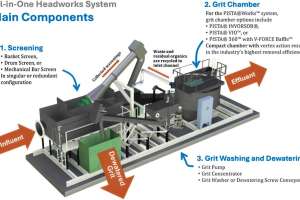
The Northwest plant was built in 1990 with 5 mgd design capacity. It was expanded in 2008 to 10 mgd and in 2020 to 30 mgd. Influent passes through coarse (6 mm) and fine (3 mm) perforated screens (Hydro-Dyne Engineering), followed by a PISTA Grit system (Smith & Loveless). The headworks has a trickling biological system and carbon scrubbers for odor control.
“Then everything makes its way to our flow equalization tank, which enables us to stabilize the flow through the plant,” says Gregg Rollo, plant manager. “That allows us to continue our process during the evening when flows otherwise would be comparatively nonexistent.”
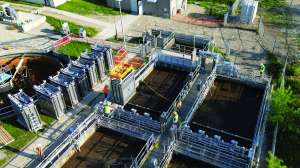
The flow is then diverted to 10 Bardenpho ditches with 200 or 250 hp surface aerators (WesTech Engineering). The process includes fermentation, pre-anoxic, aeration, post-anoxic and reaeration stages. “Bacteria are the heavy lifters, working day and night to break down the nutrients,” says Rollo.
“Phosphorus can’t be broken down, so we use trickery to convince the bacteria to take the phosphorus with them. By controlling the air in each stage, we control what the bacteria do. Give them air and they break down ammonia and pick up phosphorus. Take away air and they convert nitrates to nitrogen gas.”
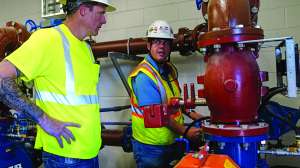
Toriano Ayers, shift lead, observes, “The reaeration phase is powered by Ovivo submerged turbine aerators paired with Universal [Blower Pac] 15 hp blowers. The system provides coarse air bubbles, but a mixing blade cuts that air up and turns it into fine air. It aerates the water really well before the secondary clarifiers.”
ORP sensors (Hach) throughout the ditches help control the aerators to optimize dissolved oxygen. Hach also provided dissolved oxygen and turbidity sensors and Nitrax and Phosphax analyzers for nutrients. ProMinent Fluid Controls supplied pH and chlorine sensors.
The secondary effluent is conveyed to 20 deep-bed filters (Severn Trent) backwashed with air from AERZEN blowers. The filtered water flows to the chlorine contact chamber before surface discharge, well injection or delivery to the reclaimed water distribution system.
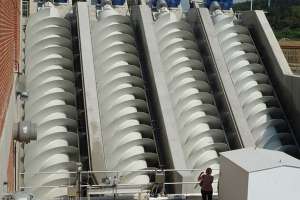
Waste-activated sludge is dewatered to about 20% solids on screw presses (FKC) and centrifuges (Centrisys/CNP). Contractor Merrell Bros. hauls off the dried material for conversion to commercial fertilizer.
Helping to avoid problems in the collection system is a location provided by the industrial pretreatment team where residents can bring in used cooking oil instead of dumping it down the kitchen drain. A contractor then recycles the oil.

Saving water
The Northwest plant is challenged by the county’s measures to save potable water; reclaimed water is available mostly in newer areas. The conservation initiatives are broad-based and backed by enforcement.
Conservation programs took hold in the early 2000s as the population began to spike. A key component is restriction of lawn watering, such as allowing residents with even or odd house numbers to water on different days.
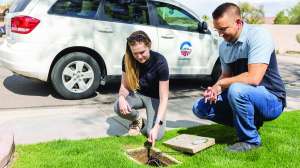
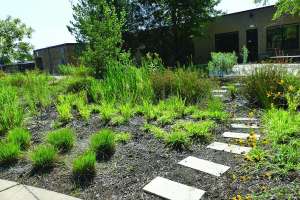
“We have a lot of accidental over-irrigation,” Rollo says. “People call complaining that their bill is too high. When we check on them, we find they’re watering for three hours, two nights a week, putting unnecessary potable water on their lawns.” The county also encourages residents to replace traditional lawns with what the utility calls “Florida-friendly landscaping.”
Water-saving measures also include rebates under Tampa Bay Water’s Water Wise initiative. Customers can earn rebates for replacing high-flow water fixtures, sprinkler systems and appliances with more efficient versions. The county’s water rates are structured so that those who use excessive water pay more and those who conserve pay less.
“All these water saving measures create an unintended issue where the influent to our facilities contains higher cBOD, TSS, ammonia, TKN and other pollutants,” Rollo observes. “For instance, here at Northwest, before 2016 our TKN averaged 45 mg/L; now we average 53 mg/L, while our flows have stayed relatively about the same. Other variables can always affect influent strength, but one known variable is the water-saving devices.”
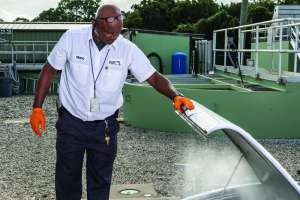
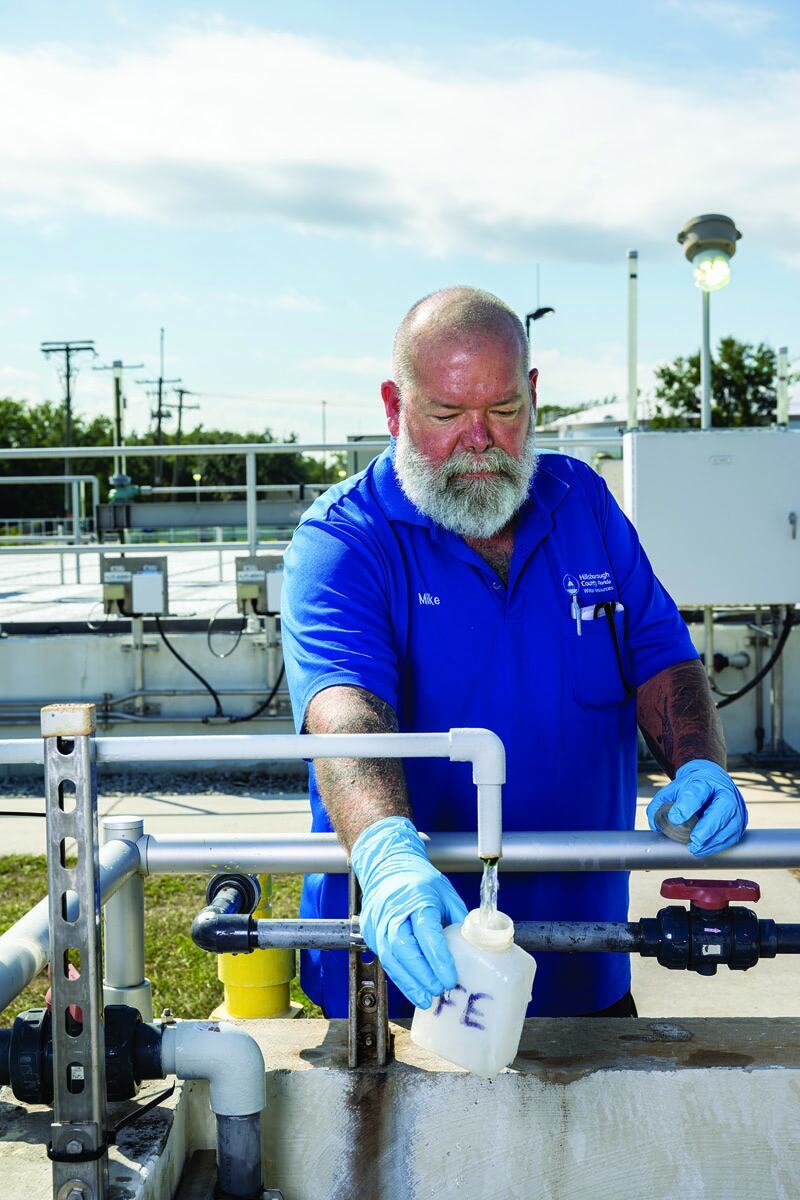
Ayers adds, “Thankfully, our facility is large enough to accommodate changes in influent composition. Our operators test for nutrients every four hours and make changes to our aeration basins as needed.
“Leadership keeps a close eye on those changes and determines if anything more is needed, like adding another basin, changing wasting rates or altering flow patterns.” Influent data also helps the staff make sound decisions when renovating plants or building new ones.
Making it work
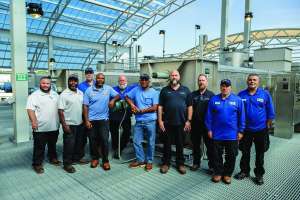
A large and complex facility like the Northwest plant requires skilled and experienced operators. The county strives to attract well-qualified people and retain them through solid compensation packages and professional growth supported by ongoing training.
Team members not previously mentioned include Dewey Jackson, plant supervisor; Jim Conley, shift lead; plant operators Orlando Bacon Jr., Robert Burchfield, Ron Henderson, Abel Lloret, Tony Lorenz, Judith Quintana, Rafael Serje, Tracy Shawver, Mike Smith, Dervin Vitte and Luis Zacarias; and operator trainee Earl Fullenwider.
Team members receive full insurance and retirement benefits, generous paid time off, credit union membership and tuition reimbursement for continuing education.
“The county is building a mentorship program for team members who want to move up in their careers,” Rollo says. “We have a tiered pay scale that helps motivate operators to advance their licenses. They receive significant pay raises as they obtain higher license levels. A Class A license is required if they wish to move up the ranks. The pursuit of CEUs helps maintain their motivation to train and learn when they progress beyond Class A.”
Rollo and Ayers note that the Northwest plant has built a culture of high morale that includes perks like pizza parties and a Christmas potluck.
Ayers observes, “The camaraderie here is very good. Everybody is eager to do their part. I’m impressed with our team, all three shifts. I enjoy working with everybody. I commute 40 miles one way to work with a winning team, and we will keep winning.”
Promising future
Plans now on the drawing board indicate that things will only improve for the Northwest facility. “We’ll be making slight improvements to our dewatering facility,” Rollo says. “Moving forward, we’re going to focus on the operators.
“They’re going to get a maintenance facility that also includes operations, so those two sides can work more closely together. A new administration building will enable us to bring in outside instructors for classes. It will include an observation deck overlooking the facility. We’re in a good place and ready for future growth in the northwest service area of Hillsborough County.”