Headworks systems are more critical than ever as wastewater treatment plants are challenged to manage wipes and safeguard new and more advanced processes downstream.
For small and medium-sized municipalities, designing cost-effective headworks and navigating complex construction can be especially daunting. Here, preassembled all-in-one headworks can offer a significant advantage.
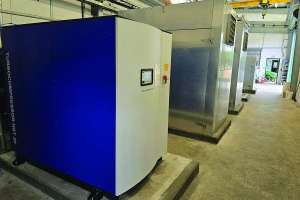
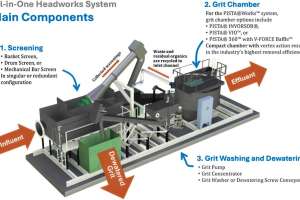
These compact packages provide complete, efficient and durable solutions. The most advanced all-in-one solutions combine the three key headworks components — screening, grit removal and grit washing — in a fully integrated system.
Preassembled and pretested, these stainless steel skid-mounted units arrive on the job site by truck, ready to install. They give utilities access to advanced headworks technology with timely, on-budget installation and smooth operation.
Multiple advantages
All-in-one headworks offer benefits across the wastewater treatment spectrum. Engineering firms that serve rural facilities don’t need to invest to stay current with the latest grit removal technologies or to design intricate headworks for applications they may rarely encounter. Contractors benefit from simple installations that save time and reduce construction risks.
Meanwhile, utilities are assured of state-of-the-art solutions that are dependable and easy to maintain. With proven designs and integrated controls, these systems offer predictable performance and streamlined operation.
Essential components
Three components in preassembled headworks enable efficient and effective treatment of wastewater.
Screening
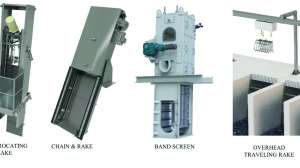
Packaged headworks typically include one of three types of screen:
- Basket screens use ultra-high molecular weight brushes and are an economical option, but they come with higher operational costs.
- Drum screens, designed with perforated plates, are versatile and can be used for coarse and fine screening.
- Mechanical bar screens, made with stainless steel bars spaced at 6 mm, are considered a workhorse for larger plants. Higher capital cost is offset by low long-term operating cost.
Fine screening is often necessary to safeguard sensitive treatment processes like membrane bioreactors, whose membranes can be damaged even by small objects, such as toothpicks. For fine screening, basket and drum screens offer openings as small as 2-3 mm. Bar screens are better suited for coarser applications.
Grit chamber
Innovative technologies have significantly enhanced grit removal efficiency and performance. Advanced systems induce a forced vortex flow pattern that sweeps grit hydraulically along the floor toward the center opening to a lower collection/storage hopper. This enables high removal efficiency for particles as small as 75-100 microns. Such designs minimize energy consumption while significantly reducing wear and tear on pumps and mechanical systems.
Grit washing and dewatering
Advanced washing systems yield with only 3-5% putrescible organic material and less than 10% water. Cleaner grit reduces equipment wear and blockages and, for plants with total nitrogen limits, increases BOD, reduces reliance on external carbon sources.

Evaluating options
All-in-one headworks can be tailored to address factors including flow rate, effluent quality, installation cost and maintenance effort and expense. Manufacturers should provide a range of options for each key component to ensure that the system aligns with the site-specific requirements.
Specifiers and end users should be able to select from basket, drum and mechanical bar screens. Grit chamber designs should offer choices for enhanced removal efficiency and for adaptability to suit different flow conditions and downstream treatment processes.
Grit washing and dewatering solutions should include a robust grit pump to handle the transport of grit slurries, paired with a highly efficient grit concentrator. This process stage needs to be configurable to optimize performance for each installation. High-efficiency options, such as a grit washer or dewatering screw conveyor should be available to ensure dry, clean grit with less than 5% organic content and a 95% grit retention rate.
Design flexibility
A compact design is only part of what enables a grit system to integrate seamlessly into a site. Equally important is its ability to integrate with existing infrastructure. Bypass and redundancy features are useful for streamlining maintenance and significantly reducing downtime.
One desirable feature is a manual bar screen bypass, a built-in solution that ensures seamless operation even during routine maintenance or unexpected screen failures. By switching to the manual screen, operators can avoid shutdowns and maintain system efficiency.
Some customers choose redundant screens to ensure continuous operation during maintenance or equipment failures, eliminating the need for a manual bar screen. In addition, incorporating a grit chamber bypass enables maintenance of grit removal equipment without disrupting overall plant operations.
These features are especially valuable for smaller plants with limited staff, as they prevent major disruptions, ensure consistent performance and allow for ongoing maintenance without compromising functionality.
Another key to headworks efficiency and performance is component compatibility. A well-designed all-in-one system ensures seamless integration of grit removal, screening, grit chambers, pumps and washers or classifiers. When components are performance-matched, efficiency is enhanced. For example, a grit chamber operating at 95% efficiency ideally should be paired with a similarly efficient grit washer.
Packaged solution
An effective all-in-one headworks should provide a complete, integrated solution that is easy to install and operate.
Well-designed systems come equipped with essential safety components such as platforms, handrails, ladders and emergency-stop mechanisms integrated with the design. This reduces the need for engineering firms or contractors to design and install these features separately. It also reduces liability concerns and ensures compliance with OSHA regulations.
Integrating all components into a single PLC-based control panel streamlines operations, eliminating multiple, separate systems. A user-friendly graphical user interface and multilingual support minimizes complexity, simplifies training and improves troubleshooting efficiency.
Factory wiring and UL certification simplify installation. Preinstalled conduit and electrical components further ease the process by eliminating the need for contractors to embed conduits in concrete or manage extensive on-site electrical work.
All-in-one headworks offer transformative benefits. By simplifying design, streamlining installation and delivering advanced solutions, these systems ensure that projects are completed on time and within budget.
Built for ease of operation and maintenance, they combine efficiency with economical operation for the long term. By reducing complexity and enhancing performance, they save time, mitigate risks and provide high, sustainable performance for lasting success.
About the author
Rich MacGregor is a senior technical writer with Smith & Loveless.