Electricity can account for up to 40% of a wastewater treatment plant’s operating budget and a significant share of a municipality’s total energy bill.
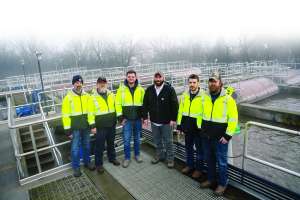
Accordingly, many cities are focusing on saving energy and improving environmental performance. In Grandview, Washington, treatment plant superintendent Dave Lorenz and his crew did exactly that. Their efforts recently culminated in the form of a check for $146,964 from the local power company’s energy-saving incentive program.
The check was based on annual savings of some 620,000 kWh, enough to power about 55 homes. The energy savings came from adding mixers to the city’s lagoon treatment system instead of relying solely on aerators.
The mixers distribute oxygen in the water column much more efficiently than aerators. With the energy savings along with revenue for treating wastewater from the area’s food processors, Lorenz expects the facility to be revenue-neutral in two years, and after that revenue-positive.
Grandview, in south central Washington along the Yakima River, is a hub for fruit and vegetable processing: apples, cherries, grapes, hops, asparagus, corn, wheat and more. Major companies operate processing and cold-storage facilities that employ many of the community’s 11,000 residents.
Changes to the wastewater treatment plant over time have reflected the needs of the growing region and best practices for wastewater management. In 2000 the state Department of Ecology required the city to move from spray fields and land-application to a U.S. EPA NPDES permit in order to reduce secondary pollutants in groundwater and enable discharge of UV-disinfected effluent to the Yakima River.
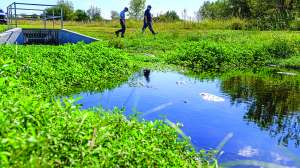
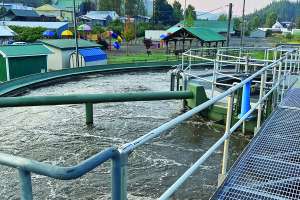
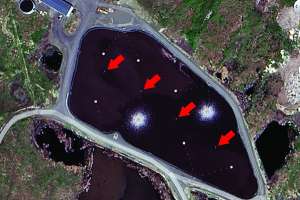
The city installed an 18 million-gallon aerated and lined lagoon that included eight 75 hp splash aerators (600 hp total) to generate and distribute dissolved oxygen. To keep the water suspended and circulating, Lorenz ran four aerators at a time, two on the east end and two on the west end, alternating the other four every 24 hours.
For a time, four aerators met the lagoon’s oxygen requirements, but increased flows from a growing population and from the food processors — 60% of the load — added to the facility’s BOD and TSS loads.
In addition, a six-week harvest season beginning late September increased the industrial discharges by 1 mgd, adding to the 1.5 mgd average flow and requiring all eight aerators to operate.
“As our flow increased and BOD and TSS loading grew, the eight existing aerators no longer fulfilled the function of oxygenating and mixing the water,” says Lorenz. “We didn’t really need to add that much more oxygen; we just needed additional mixing to have the solids come in contact with aeration. We thought we needed four more aerators for an additional 300 hp.”
However, a study from consultant Cascade Energy identified an alternate solution. “Our job was to calculate energy savings, estimate the potential Pacific Power incentives and encourage the city to invest in an energy efficiency upgrade,” says Craig Phillips, senior engineer.
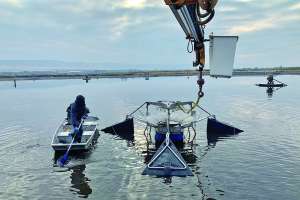
Cascade recommended adding four energy efficient mixers to take over the mixing function. That enabled the treatment facility to turn off half the aerators and save significant energy. “We were able to put in mixers with the 600 hp of aeration we already had,” says Lorenz. Within a few days of operating the four utility-powered GridBee and sun-powered SolarBee mixers, along with four aerators, Lorenz knew he could shut off 150 hp of aeration.
Aerators are reasonably efficient at creating DO but inefficient at distributing it. That makes it expensive to operate aerators just for mixing. For 10 months of the year, the Grandview facility requires 80-90 hp to produce DO and 200-225 hp to distribute it. In harvest season it requires 250-300 hp for DO production and the same 200-225 hp for distribution.
“Not only have we reduced the need for four additional aerators,” says Lorenz. “We are now operating only two, one on each end of the lagoon.” The aerators are run alternately for 12 hours; the mixers run 24 hours.
“I’m excited about what has happened here,” Lorenz says. “I knew that we would save some energy by not adding four aerators, but I was surprised we could cut our aeration needs in half — go down to two aerators instead of four.” Another advantage to the mixers is that they are maintenance-free. “There are no bearings to grease; no monthly and annual maintenance.”
The city expects the mixers to pay for themselves in two years from energy savings. Factor in the $147,000 incentive check and the payback is closer to one year. That savings will help pay for a future update already being planned.
Adding two more 18 million-gallon lined lagoons will allow the facility to discharge all effluent to the river and mothball six existing unlined lagoons, completing compliance with the state mandate. With that update, Lorenz expects that, with mixing, the aerators will run every four hours instead of every eight hours.
“The biggest success of adding mixing to this project is dollars; the money we will be saving over the life of the facility,” says Lorenz. “Energy prices will increase, but we will continue to save on that cost.”
Harvey Hibl (harvey.hibl@ixom.com) is a mechanical engineer and regional manager with Ixom Watercare.