PFAS treatment poses special challenges in that the work is not over just because these “forever chemicals” are removed from the water stream.
After their removal, the question remains: what to do with the PFAS-containing granular activated carbon, ion-exchange resin or membrane filtration reject water. Increasingly, attention is turning to methods that destroy the PFAS, converting the chemicals to harmless substances. That is the approach taken by PFASigator technology offered by Enspired Solutions, a women-owned business in Lansing, Michigan.
The process uses a proprietary chemistry that the company says is proven to mineralize PFAS in solution. Photo-activated reductive defluorination chemistry is coupled with UV light to stimulate a reaction that disassembles the PFAS molecules.
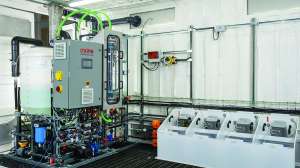
The equipment is modular, compact and mobile. It is designed to be deployed and operated downstream of a process that concentrates PFAS in solution. The company says it destroys PFAS at a cost comparable to existing capture and disposal options.
The technology operates on site in a variety of circumstances that include a pH range of 3 to 12 and aerobic or anaerobic conditions. Denise Kay, company CEO, talked about the treatment method in an interview with Treatment Plant Operator.
TPO: What was the motive for developing and introducing this technology?
Kay: There is a growing need to reduce the mass of PFAS in the environment because of how it’s affecting drinking water sources and human health. Our technology destroys the PFAS instead of capturing it and moving it to a different location. It is also a very energy-efficient technology.
TPO: How did you devise this method of treatment?
Kay: It uses a chemical reaction specific to the destruction of PFAS that we identified in the scientific literature. We discussed the status of the technology with the publishing authors. They had a U.S. patent and were looking for someone to license it for commercial purposes.
TPO: In basic terms, how does the treatment process function?
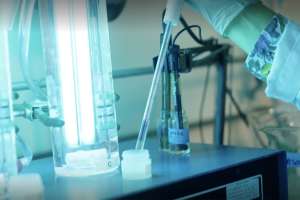
Kay: An aqueous solution containing PFAS is fed into our machine. We add reagents and expose the solution to UV light, which catalyzes a chemical reaction that breaks the carbon-carbon and carbon-fluorine bonds in the PFAS molecules and reduces them to nontoxic forms. We can run a secondary reaction in the same reactor to break down the reagents we added.
TPO: What are the end products from the destruction of the PFAS?
Kay: The PFAS are broken down into water, fluoride ion and nontoxic simple carbon compounds such as acetic acid, which is vinegar. The end product can be released to a wastewater treatment plant.
TPO: Is this a standalone treatment technology?
Kay: It is intended to be one component in a larger water treatment system. We have found that it pairs very well with a technology called foam fractionation. If you take water containing PFAS and pass bubbles through it from the bottom, the PFAS creates a foam on the top. The PFAS is now in the foam and the water is relatively PFAS-free. The foam quickly collapses down into a liquid, a PFAS concentrate, which then goes into our machine.
TPO: How would you describe the capacity of your treatment units?
Kay: Capacity is very site-specific. However, generally speaking, the system will handle 50 to 150 gallons of PFAS concentrate per day.
TPO: How does that translate to the total volume of PFAS-containing water treated?
Kay: We look at how many orders of magnitude, meaning tenfold decreases, we need to achieve and what PFAS compounds are present. Most foam fractionators can easily achieve a thousand-fold concentration, or 5,000-fold, or some say up to a million. So for example, if PFASigator is paired with a foam fractionation system doing a thousand-fold concentration, and is taking in 50 gallons of concentrate per day, then the total system flow is 50,000 gpd.
TPO: How do you scale up to the flow required for a municipal water treatment plant?
Kay: Our equipment is modular. Units can be deployed side by side or in series. Importantly, foam fractionation is also site-specific. For any site there needs to be treatability testing, on both the foam fractionation and PFAS destruction sides. Then we can scale a system that is appropriate for the site.
TPO: How is the technology delivered to the end user?
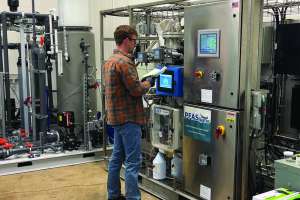
Kay: It is an equipment purchase. The equipment is about the size of two large refrigerators, so it’s a small footprint and relatively easily mobilized. Our approach is to sell or lease the equipment to the customer and train them to operate it. We also require a subscription to supply the reagents and the end user license for the intellectual property.
TPO: How has this technology been proven for commercialization?
Kay: It started with peer-reviewed scientific publications, which were quite rigorously done. We took the concept from bench scale and developed commercial-scale equipment, which we have tested with funding from the Department of Defense on up to 10 concentrates from various defense facilities. We’ve also completed our first field pilot trial in Grand Rapids, Michigan.
TPO: What was the nature of the input stream in that field pilot?
Kay: It was PFAS-contaminated groundwater at an industrial facility. We were pumping groundwater, putting it through foam fractionation and destroying the PFAS in the foamate. We were able to achieve the criteria the client had to meet to send the end solution to the wastewater treatment plant. In Michigan, wastewater plants are being regulated on the amount of PFAS they can release to surface waters, so they are going upstream to identify who is releasing PFAS and requiring them to address it.
TPO: What makes this technology energy efficient?
Kay: There are various technologies that destroy PFAS by different means and to different extents. Many require very high temperatures and pressures. Our system functions at atmospheric pressure and standard temperatures, around 40 degrees C. The energy from the UV light stimulates our reagents to release electrons, which react with the PFAS. We have a direct transfer of energy from the light to PFAS destruction without having to heat up or pressurize water. Another basis for energy efficiency is that there are two chemical processes to destroy PFAS: oxidation and reduction. We use reduction, which is far more energy-efficient.
TPO: What is involved in operating this technology?
Kay: The equipment is automated. Operators watch by way of a remote screen for any alarms that the system isn’t functioning as expected. Every 30 days the system requires a replenishment of the reagents and calibration of the fluoride probe. Operator feedback is that when they look at the equipment, all of the components of the reactor are familiar, from existing water treatment technologies. For example, there is an automatic fluoride measuring system of the kind used in drinking water treatment. A primary part of the reactor is UV lighting similar to a water disinfection system. So it all looks familiar to operators.