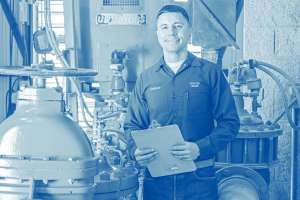
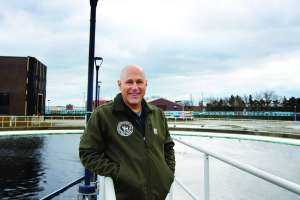
Wastewater treatment is a family affair for Dale Grudier II.
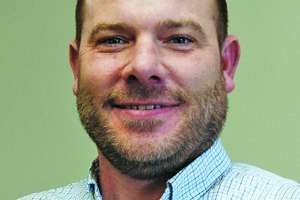
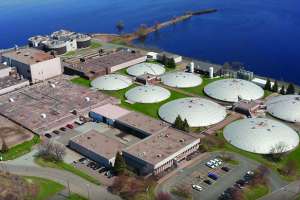
Now director of operations and maintenance at the 40 mgd Bergen Point treatment facility serving Suffolk County Sanitary District 3 in West Babylon, New York, Grudier got his start by going out on sewer calls with his late father back in the 1970s.
He joined the Suffolk County Department of Public Works in 1985, helping operate the scavenger waste facility. Today he holds a 4A (highest) Wastewater Operator license and oversees a staff of 100.
His wife Donna is also an operator, in charge of the treatment plant at the New York village of Northport and president of the New York Water Environment Association.
Now his daughter Deanna is studying for her operator’s license after starting out as an operator at another of Suffolk County’s 26 wastewater facilities. She likes the profession and noting the similarity of the relationship Dale Grudier had with his father (see sidebar).
The Suffolk County Sewer District No. 3 collection and treatment system serves a densely populated area on Long Island, immediately east of New York City. It comprises more than 1,500 miles of sewers and keeps growing as new housing projects around the county are connected to the system.
The plant itself is a basic activated sludge process, operated in the contact stabilization mode. Originally designed for 30 mgd, it was built in the 1970s and brought online in 1980. It has since been expanded to 40 mgd, and plans are to expand to 50 mgd in the near future.
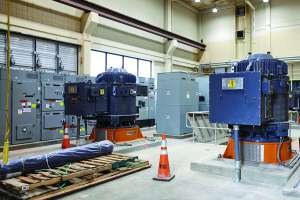
“We have eight influent pumps (Flowserve), capable of going up to 180 mgd,” says Grudier. The headworks include three Infilco Degremont climber bar screens (Veolia Water Technologies) and an airlift grit system (Walker Process Equipment). The plant has three of these systems, and they are rotated to keep them free of clogging.
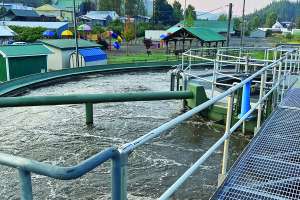
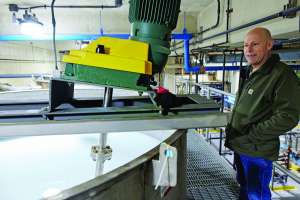
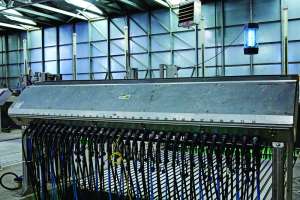
Eight primary tanks follow, and the overflow passes to 12 aeration basins equipped with fine-bubble diffusers (Aquarius). Treated water settles in a cluster of six circular clarifiers. The flow then passes through a four-channel UV light disinfection system (Trojan Technologies) before discharge to the Atlantic Ocean. “We have four large effluent pumps (Flowserve) to pump against the tide,” Grudier says. A small portion of the effluent is chlorinated and used around the plant.
Suffolk County recently finished a project to replace its outfall, boring a new 3-mile tunnel under the Great South Bay to replace a concrete line that was showing signs of rupturing. “The original line was trenched across the bay and environmentally we couldn’t do that again,” explains Grudier.
The solids operation has been updated as well. An old multiple-hearth furnace was shut down in 2004, and the county has been beneficially reusing its biosolids ever since. The solids are thickened on gravity belt thickeners (Alfa Laval) and dewatered on Ashbrook Winkle belt presses.
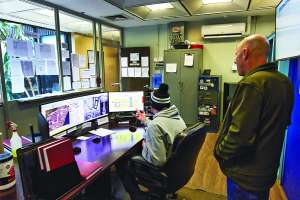
“Everything’s trucked out of here,” says Grudier. The material goes to landfills where there is a biogas recovery requirement, to mine reclamation or to composting sites. All electrical lines are directed to a SCADA system supplied by iFIX (GE Digital). “Howden provided the program to run our activated sludge process which ties into our SCADA,” says Grudier.
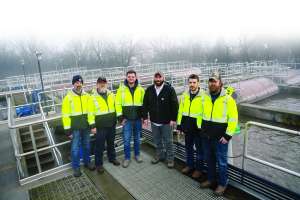
Grudier is responsible “for pretty much everything that goes on here. Every time I got promoted, I got another swath of responsibilities.” Four managers report directly to him: George Mueller, director of operations; Jon Waring, director of maintenance; Felipe Gonzalez, collection system supervisor; and administrative staffers Dawn Peterson and Cheryl Goldman.
“We have a strong support team,” Grudier says. Getting and keeping operators and mechanics is his biggest challenge, and pay is the biggest issue: “We just lost an operator to the next county where a private company is operating the treatment system. The pay is better there.”
Grudier implemented pay increases about a year ago, but the issue remains at the crisis stage.
Finding the right kind of people is also difficult. “This is a new generation,” Grudier says. “We need the kind of person who says ‘I’ll be there’ when the phone rings at midnight.” Prospective operators have to work hard to pass tests and gain certification. A varied skill set is needed, too: mechanics, hydraulics, housekeeping, math, biology, chemistry.
“There are distractions today, and cellphones,” says Grudier. “Training is everything. We’re coping as best we can. We have our up-and-comers but right now we’re down six operators. It takes a special kind of person.”
Grudier is exactly that kind. Following his family background and his time in the scavenger waste area, he transferred to the main plant as a trainee. He began taking courses that led to his license in 1988. He spent 14 years operating the multiple-hearth furnace. He made time to earn an associate degree in mechanical technology at Suffolk County Community College. He has completed NASSCO certification training and is pursuing collection system certification.
After the hearth furnace was shut down, Grudier took other positions, and by 2009, he was operations crew chief on the 11 a.m. to 7 p.m. shift. He was promoted to director of operations in 2017. When the director of operations and maintenance retired, Grudier took that position and also became responsible for the collections system.
He received the William D. Hatfield Award from the New York WEA in 2022. He has served on the Long Island Utility Operations and Maintenance Committee and is operator representative to the NYWEA board of directors and the Governance Council, where he was instrumental in educating members about the viability of the Professional Operator credential.
Outside the office, Grudier is a martial artist and holds a fourth-degree black belt in judo. He enjoys mountain bike racing, camping and relaxing with his wife and their children.
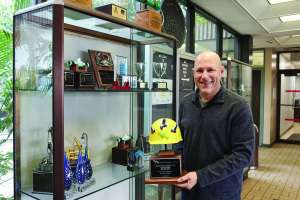
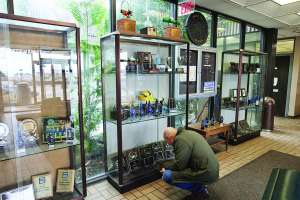
Nothing marks Grudier’s career more than his involvement with the Operations Challenge, which brings operator teams from around the country together to demonstrate their skills and compete for top honors. “It’s like a brotherhood,” he says. “Everyone is into it, all together. It helps operators see other professionals, it involves all disciplines, it builds more pride among operators in what they do, and it takes away old stigmas about the profession.”
For 10 years, Grudier was a member of the Long Island Brown Tide team. That enabled him to go out and educate the community about the importance of wastewater treatment. The team appeared on a TV station in Buffalo after the challenge was held there. Though no longer a member of an Operations Challenge team, he now judges local and national competitions.
He remembers his days as a competitor fondly: “It was a great learning experience. You’re a team, and you cover the ins and outs of equipment. In the safety event, you learn the proper procedures. You work quickly, but especially in the lab event, you need to take the time to be exact. You don’t want penalties.”
“You make a commitment to practice twice a week, and then every day leading up to the competition. When I was involved, I wanted to practice even more.” Traveling around and meeting other operators was also rewarding: “You form connections, operators you can call and consult with if you needed to. It instills pride in our profession.”
Grudier is most proud that several New York chapters have entered the competition. The state had four teams at the nationals in 2022. “Our younger operators are doing well,” he says. “We’re trying to promote the contest to chapters that don’t yet participate.”
Grudier can tell when a plant is sponsoring an Operations Challenge team, because that facility invariably looks sharp and operates well. That’s important to him: “People generally don’t know it, but it’s amazing what we do here.” He treats it like family. Because it is.