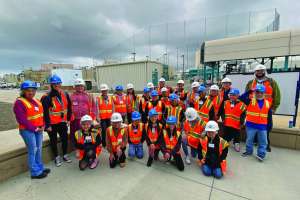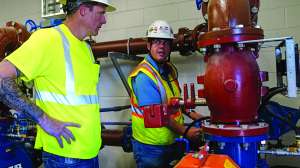
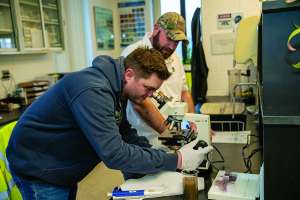
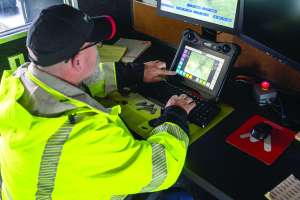
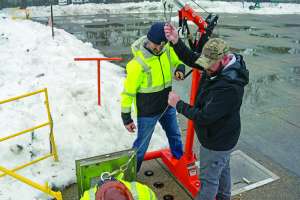

The award-winning safety record at the wastewater treatment plant in Hanover Park is partly a result of planning and training.
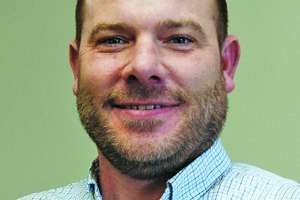
But Chris Rebone, wastewater superintendent, says the workplace culture also plays a big role.
“I’m proud to say that safety is an aspect of our work culture here that I greatly appreciate,” Rebone says. “For everyone, from the newest employee to the mayor, that it is in the forefront of our minds.
“We are firm believers in quality of work, not quantity. We know the job is going to get done. If it takes 10 more minutes to complete a task, it takes 10 more minutes because that means it’s done right, and done safely.”
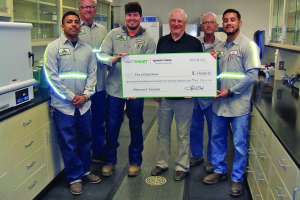
As of September 2023, it had been more than six years since the plant had a lost-time incident. Hanover Park received a 2023 George W. Burke Safety Award from the Illinois Section of the Central States Water Environment Association. The facility was also recognized as the Plant of the Year from the Illinois EPA for 1994 and 2013.
Rebone thinks training and planning have a lot to do with that record. “We’re constantly re-honing the skills that we already know and that I’m proud to say we are incredibly good at,” Rebone says.
“On top of that, village-wide, we require every employee to complete two to three online safety courses every month. We select classes based on the time of year. So we have defensive driving in summer, and winter safety in the snowing months when we’re plowing.”
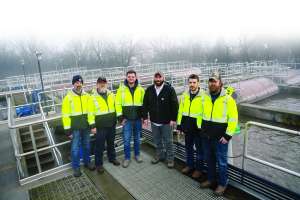
In addition to Rebone, the team members at Hanover Park Sewage Treatment Plant No. 1 are plant operators Lance Winterland, Scot Lichtenberger and Mike Klaus, and equipment operator Jim Hedman. T.J. Moore is public works director.
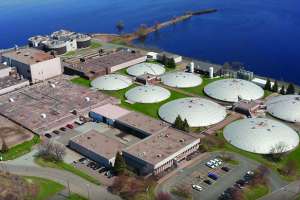
The plant was built in 1970 and upgraded in 1985 when nitrification and excess flow facilities were added. In 1997 it was consolidated with Sewage Treatment Plant No. 2, which was converted to a pump station. The village straddles two counties. Plant 1 serves the portion in DuPage County, and the part in Cook County is served by the Metropolitan Water Reclamation District of Greater Chicago.
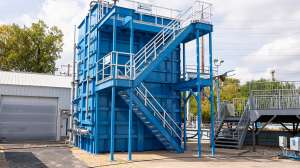
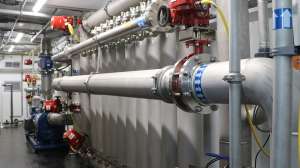
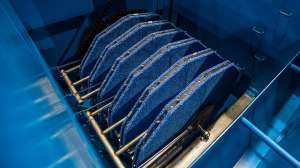
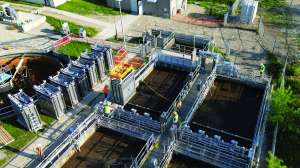
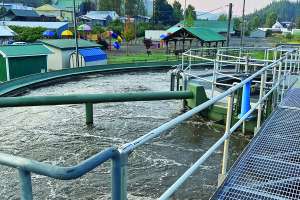
At Plant 1, influent goes through screening (Muffin Monster grinder, Headworks bar screen) and a PISTA grit chamber (Smith & Loveless), and then to a three-pass Orbal oxidation ditch (Evoqua Water Technologies, part of Xylem). The influent is mixed with return activated sludge in the outer ring. The second ring is an anoxic zone, and the Envirex inner ring is aerated (also Evoqua).
The flow then enters three 348,000 Tow-Bro secondary final clarifiers (also Evoqua). From the clarifiers the flow goes through a post-aeration tank to increase the dissolved oxygen before UV disinfection (Trojan Technologies) and discharges to the West Branch of the DuPage River.
Besides day-to-day plant operation, there are seasonal chores, some (such as jetting and televising the sewer lines) handled by the regular staff and some (such as lining sewer pipes) handled by contractors.
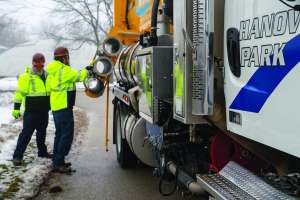
“In summer, we are out in the field jetting and televising all the sewer lines in our town,” Rebone says. “We maintain 96 miles of sewer, so about a month before we know we’re going to hit the busy season, we start practicing, going back over pretrip inspections on the Vactor truck. We lay out and inspect all the equipment. That gives us a chance to identify deficiencies and order replacement parts.”
Sometimes Rebone brings in a manufacturer’s representative to review proper use of the equipment, or sends some team members to manufacturer-sponsored refresher courses. But even with regular training reviews and safety courses, situations develop, such as breaks in sewer lines, that involve working very long hours, a safety hazard of its own.
“Emergencies happen, and overtime occurs, but we have rules in place,” Rebone says. “An employee cannot work more than 16 hours in a 24-hour period. If they do hit that timeframe, they have to be off the clock resting for eight uninterrupted hours. There’s no emergency that could happen where that person would come back into work. They’re home, recuperating, getting ready for the next day.”
The treatment plant team coordinates with other city departments to provide relief for those working long hours in emergencies. “All supervisors get together and game plan if we know it’s going to be a long day or we’ll need multiple crews,” Rebone says. “We have a common goal: Get the job done correctly and get everyone home safe. I can tell you that every supervisor in public works is following the same belief.”
Hanover Park’s plan-ahead style is evident in the handling of high-flow events. Since Rebone arrived in 2020, the plant has had no overflows despite numerous heavy rainfalls. One reason is that storage capacity was effectively increased by adjustments in plant operation.
Rebone says, “One of my first goals was to take a good look at the process and how we were operating, looking for efficiency gains. I realized that we didn’t need to have every available tank full. We could handle the capacity just in certain areas. Then when we have weather events, we reduce the number of callouts — people having to come in during a storm — because we created compensatory storage within the plant.”
The staff has avoided overflows by anticipating problems likely to occur in a heavy rain or high wind event and making sure each team member has a step-by-step procedure to follow. “When we know we’re going to have a high rain event, we make our changes as a group,” Rebone says. “We walk through so everyone knows what changes have been made.
“Everyone’s on the same page, and we have the plant set up so that if there is a call for a high tank level or a high flow rate, it will only require one person to come in. Then any changes needed as a result are done through the system. There’s no physical, hands-on interaction. They’re communicating with me when they get in, during the changes being made, and when they leave to go back home.”
There are written standard operating procedures for high-flow events. Each pump station has a list of the top five problems likely to occur, and the operator has a step-by-step procedure for every one. The strategy was tested in August 2023 when heavy rains and high winds hit the area. Plant 1 made it through without any overflows.
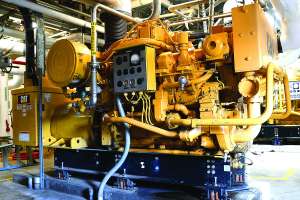
“The staff did an amazing job preparing our standby generators for use during expected power outages,” Rebone says. “We had two outages and were able to use the generators to keep two lift stations in operation. We leaned on experience and had set up an initial response crew with a backup crew on standby if needed. For those events we only needed one crew.”
Hanover Park’s emphasis on training is about to reach a new level. The village is developing a new training facility on the site of the former Plant 2.
“At the public works facility, we actually dig out and deploy the trench box and go through the procedures for that,” Rebone says. “We’re working to develop a training area at an offsite location where we plan to install different-sized pipe.
“That will enable us to train team members to operate the heavy equipment, to dig and deploy the trench box, and actually see it hands-on, seeing it go in. Then they can enter safely and start becoming proficient on installing repair clamps and new pipe.”
The former plant site has lots of space and is used for multiple purposes, including providing space for people to keep beehives. In 2024 it will also be used for training, so the treatment staff can continue their streak of injury-free work. Other village employees will also use it.
“That will be public works-wide,” Rebone says. “It will provide training opportunities for everyone.”