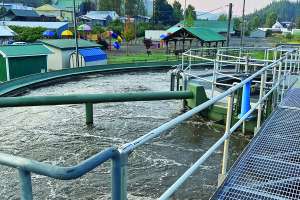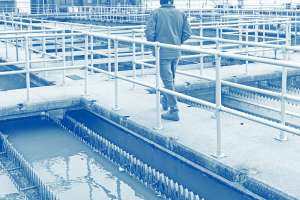
Raw sewage comes in warm to the Western Lake Superior Sanitary District due in part to some large industrial facilities.
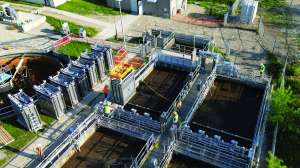
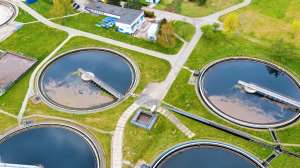
That’s fine with the operators of the district’s 35 mgd (average) wastewater treatment plant, which serves Duluth, Minnesota. “Because we are a biological system, there is an advantage to the heat that comes in.” says Marianne Bohren, executive director. “The treatment system handles that very well.”
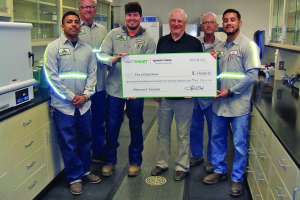
The heat in the effluent drew the attention of the city of Duluth, which received a $700,000 grant from the U.S Department of Energy to assess using some of that heat for buildings in a nearby commercial district. “If the heat can be captured and used for a higher purpose, that’s great,” says Bohren.
The plan being studied is to connect heat exchangers to the effluent stream and to warm water in a closed pipe that would run 1.7 miles away from the plant and back. The heat in the loop would be amplified with one or more heat pumps. More than 200 buildings could potentially connect to the pipeline loop, which would be buried under a street to be reconstructed in 2026.
Mindy Granley, chief sustainability officer for the city, says, “If you’re going to do district energy, you might as well put those pipes in the ground when you have the street open.” Doing that would make the project less expensive, but there are dozens of details to address in deciding whether the project makes economic and environmental sense.
“The funding we received is only for analysis and design,” Granley says, “So the first step is to ask: Will this work? Is it affordable? And is it desired by the community? That’s what the grant will help us do: Design it, analyze it, put some cost estimates together and work with community, including the businesses along the pipeline route to see if it’s desired or not.”
Working with the consulting firm Ever-Green Energy, the city expects to go building by building along the path of the heating loop to see which ones can use the heat easily, which would have challenges, and which may not want to connect at all. Most of the buildings along the loop are commercial or multi-family residential.
“Part of the process is to analyze the buildings themselves,” Granley says. “When we wrote the grant application, we had 27 letters of support from businesses that are excited about the prospect of geothermal, because they’re looking to stabilize their heating costs over time.”
Among many issues, the study will assess how potential changes in the temperature of the effluent might affect the heating district.
“Maybe these industries that are contributing heat to the effluent will find a way to recover their own heat and reuse it,” Granley says. “Then they wouldn’t be sending it to the district anymore. We’re having the consultants model it if all these industries are running, or if they are not running.”
There are also seasonal variations in the effluent temperature. Carrie Clement, manager of operations and maintenance at the district, says the effluent normally ranges from 75 to 90 degrees F, but in spring when snowmelt enters the flow, it can drop into the 50s.
The project could still be feasible with effluent temperatures at the low end of the range, says Ken Smith, CEO of Ever-Green Energy: “That is still a very good source of thermal energy. Of course if we’re going to use it for heating, higher temperatures are better. But in the Upper Midwest, typically where we see ground loops and ground-source heat pumps, they’re operating on the order of 55 degrees.”
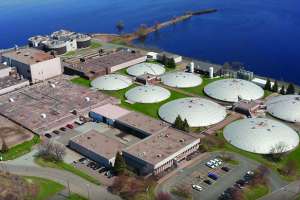
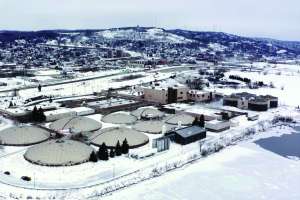
Although the district has no need for the effluent’s heat after it leaves the treatment plant, the regional wastewater and solid waste authority does have concerns about the space required for any additional equipment needed. The plant is on the banks of the St. Louis River near where it flows into Lake Superior.
“We have a very limited footprint,” Clement says. “When we do capital improvement projects now, we’re often looking for how we are going to fit them in. We have future projects, too. If there is to be a heating system, it can’t interfere with our current and future processes.”
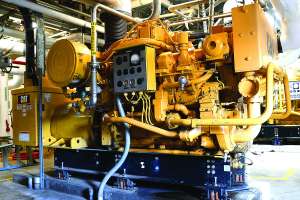
In fact, the district is already in the middle of a capital project. Since 2000 the plant has been using biogas from its digesters for heat. In 2024, three new Jenbacher engine-generators will be installed to use all the biogas for power production as well.
Smith thinks there are ways the district heating equipment could be fit into the wastewater treatment plant without interfering with the wastewater treatment process. “There are lots of ways to do it,” he says. “We’ll just have to pick the best solution. First, we don’t want to disrupt the process. Then we’re going to look at the most cost-effective and efficient location to put it in.”
District Executive Director Bohren points out that heating buildings off the treatment plant campus is outside the district’s traditional mission: “We’re a regional wastewater treatment facility, but we certainly encourage this project to be evaluated as to whether it’s workable.
“We do heat recovery internally and have the opportunity to do more, but all the heat that’s coming in is more than we would ever use on site,” she says. “So, if there’s a way to make this work, we’re as interested as anybody. We’re cautiously optimistic, but we need to know what it looks like and how it interacts with our cost structure, our operation and our space. Those details are not available yet.”
Granley realizes that many questions need answers before the project can get a green light.
“It’s a big idea with lots of moving parts,” she says. “Who’s going to run the system? What are the rates going to be? Who is going to reimburse whom? Where will the heat exchangers go? Where will the pipes go between the wastewater treatment plant and the neighborhood?
“Funding from the Department of Energy helps us explore what the project showstoppers are and what the benefits are to our carbon-reduction goals and to the businesses. Can we reduce carbon and stabilize costs for energy? If we could do both, that would be pretty cool. But how does it work? That’s what this money is about, to explore those questions and de-risk the decision on whether to move forward.”