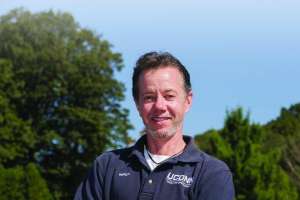
Rian Savage will tell you there are definite advantages to operating a major university’s clean-water plant.
For one, as within the university itself, research and innovation are actively encouraged. At the University of Connecticut Water Resource Recovery Facility, Savage and his team take that to heart.
“The crew and I have adopted an unconventional way of thinking about the plant and the process,” says Savage, plant superintendent and chief operator. “We’ve been willing to try different things and see if we can get a better result.
“We’ve been nearly 100% successful on the innovations we’ve tried. And for those that haven’t worked out, we’ve noticed well in advance, so that we never came anywhere near a permit violation.”
The work hasn’t gone unnoticed. Savage received a 2024 Wastewater Treatment Plant Operator of the Year award from the U.S. EPA Region 1. In 2016 he was named the New England Water Environment Association Operator of the Year for Connecticut.
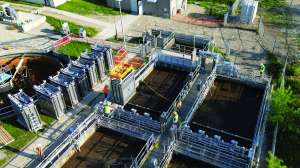
The secondary treatment plant, built in 1996, also serves the surrounding town of Mansfield. It uses an Eimco oxidation ditch process (Ovivo) and has a design flow of 3 mgd with 7.2 mgd peak capacity. Average flow is 1.3 mgd during the school year and 0.75 mgd during summer when the campus population drops sharply.
“This is a really nice facility,” Savage says. “We’ve had people on tours say, ‘This doesn’t seem like a wastewater treatment plant; it looks more like an administrative building.’ That’s a huge compliment and a tribute to our team. We have very little odor. That’s because of process control and keeping the place clean, keeping things hosed down.”
Savage, a native of Chaplin, Connecticut, started work life as a plumber and eventually was employed by the state in 2005. In 2008 he was transferred to the university’ water resource recovery facility where, he says, “My career blossomed.”
He was able to transfer a share of course credits he earned as a plumber’s apprentice toward his wastewater operator licensing. He advanced quickly to Class IV (highest) through hands-on experience, Sacramento courses and community college studies as needed. He became assistant plant superintendent in 2012 and superintendent in 2019. Today the plant team includes:
The wastewater collection system includes 28 lift stations. Influent first passes through a pair of 3 mm STEP SCREEN units (HUBER Technology) and a grit chamber, from which Gorman-Rupp pumps feed a grit classifier (also HUBER).
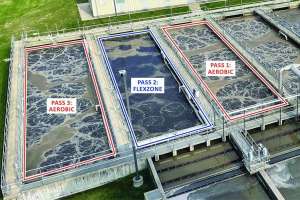
The wastewater then enters an anoxic zone with a 25 hp mixer (Philadelphia, an SPX Brand), followed by two aeration tanks, each with two 75 hp surface aerators (WesTech Engineering). The treated water proceeds to two secondary clarifiers and then disinfection with sodium hypochlorite, dechlorination with sodium bisulfite and discharge to the Willimantic River.
Solids are delivered from the secondary clarifiers at 1.1-1.8% solids to two Q-PRESS screw presses (HUBER), which yield cake at 17-19% solids. That material is hauled to the South Meadows Incinerator at Hartford.
Savage took on the superintendent role with limited process control experience. “I found out on a Thursday that my predecessor was moving on, and on Friday I was in charge with an assistant,” he recalls. “I had book knowledge, but hands-on process control wasn’t something that I knew.
“The numbers coming from the lab are a language that tells you whether you’re going in the right or wrong direction based on your permit. After looking at those numbers for a while, I was able to understand what they were saying.”
To help him along, the university enabled him to work for six weeks with two engineers from the Woodard & Curran consulting firm, Paul Dombrowski, chief technologist and senior principal, and Amine Hanafi, technical manager.
“It was a back and forth collaboration,” says Savage. “They helped me understand what I was looking at and whether I was looking at it in the right frame of reference. They would say, ‘We understand you’re going to do X; watch for this and this.’
“Those six weeks gave me the base knowledge of what I was doing, what I was looking at. Then I just had to learn where the plant liked to be in terms of solids retention time and other parameters, and how it fluctuated when the students were here and when they were not. That was a really great gift the university gave to me.”
Since then, Savage and his team have used innovative approaches to improve solids handling, nitrogen removal efficiency and more.
On the solids side, the facility has no digesters, and for a time it was a struggle to send waste activated sludge from the clarifiers to the screw presses with the required minimum of 1% solids. The team accomplished that by changing clarifier operation.
“We usually run two clarifiers,” says Savage. “When we come in the morning, we take our solids sample, and then we shut off the return activated sludge pump in one clarifier, and leave it off for about an hour. By turning off the RAS pump, we thicken the WAS mass in the bottom of the clarifier, so our WAS solids concentration increases.”
After an hour, they put the RAS pump into the manual mode, and the RAS and WAS pumps pull from the same clarifier sump. The RAS pump then operates at 25 gpm for the duration of wasting. Once wasting is complete the WAS pump shuts off and the RAS pump is restored to the automatic mode.
“That’s the process we’ve come up with to get the needed solids concentration to our screw presses,” Savage says. “Our average solids content to the presses is 1.3%.”
The team also fine-tuned aeration to improve nitrification-denitrification, enabling the plant to earn credits for the past five years from the state Department of Energy and Environmental Protection’s Nitrogen Credit Exchange Program.
The inside loop of the racetrack-style oxidation ditch is fully aerated with setpoints maintained by two Hach SCH 200 controllers, while dissolved oxygen in the outside loop is restricted to 0.25 to 0.30 mg/L. Besides optimizing nitrogen removal, the process cuts operating costs during summer, when the 75 hp aerator in the outside loop is shut down and a 4 hp sludge mixer (Flygt, a Xylem Brand) keeps the mixed liquor solids suspended.
Aeration adjustments also come into play as the students return to the campus in fall. A fact of life for a university treatment plants is seasonal “feast or famine” in influent loading, Savage observes.
“The students come and go in a matter of a couple of days,” he says. “Before they come in for the fall semester, we may be running influent ammonia at 7-11 mg/L, BOD at 67-88, TSS at 100-110. They start arriving on a Friday, and by Monday the influent ammonia goes up to 38 mg/L, TSS averages 179, BOD around 150-160. The process isn’t ready for that, and we have to prep the plant.”
In the past the team added MicroC (EOSi) for BOD augmentation, plus urea to enhance nitrifying bacteria and magnesium hydroxide for alkalinity. After three years of experimenting, they arrived at a method to prepare the plant with only minimal chemical addition.
“Instead of having higher aeration on the inside loop and lower aeration on the outside, we aerate the whole tank,” says Savage. “We sacrifice our denitrification for about seven days. Then we cut the air back slowly and bring the plant back to where the inside aeration is higher and outside aeration is lower, and our ammonia stays under permit levels.
“We’ve been able to do that for two years, saving $90,000 to $92,000 per year on chemicals. The only chemical we need to add is magnesium hydroxide, and that is less than 100 gallons for the whole week.”
In these and other process adjustments, Savage takes a methodical approach: “I go at things practically, and I go very slowly. I set up a certain plan and its execution and see whether it works, moving things slowly with not a lot of variables.
“Our crew does really well with that. A lot of good ideas came from them when I was put in the superintendent’s seat. I like to hear people’s ideas. We cross-train our team, so that even our Class I operators have lab experience. We train our people up so they have the opportunity to attain higher-level licenses.”
Savage enjoys working in the university environment: “We do a lot of tours here because we’re an educational facility. I like the fact that working for a college, we’re allowed to make the cleanest water possible, instead of just running at our permit level.
“I like to fish, and I like the idea of putting clean water back into the environment. That’s really what drives me.”