Wipes continue to cause issues for clean-water agencies’ collection systems and treatment facilities.
An effective way to handle those wipes, and other durable debris in the wastewater stream, is to capture and remove them at the point where they enter the collection system. That’s the idea behind the Dual Auger System from Duperon Corporation.
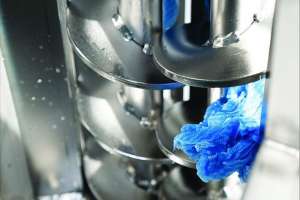
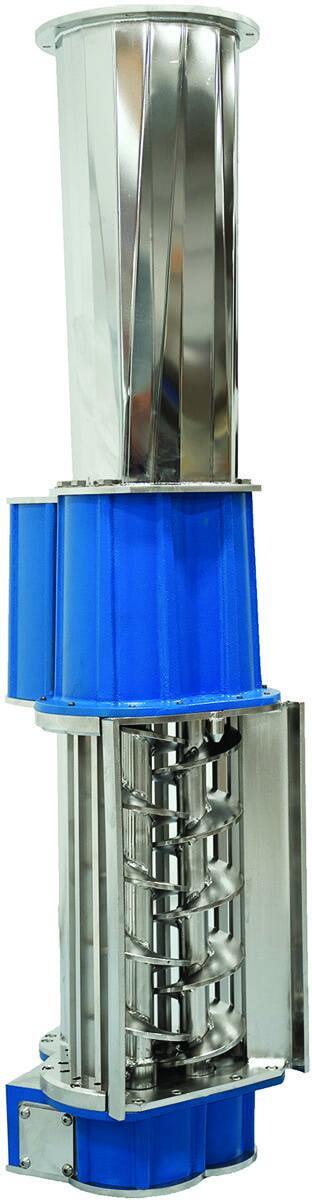
The manufacturer calls it a simple, compact screening and conveyance device designed to remove the majority of wipes in lift station wet wells and manholes. The unit includes two vertical counter-rotating augers driven by an electric motor, completely sealed in an upper housing.
As screenings are captured, a discharge chute extends vertically to compact, dewater, lift and store debris. The solids are held in the chute or discharged to a bin, fully contained for odor control and aesthetics. The device is fully submersible and is compact to fit in tight spaces
With the units in place, operators do not have manually unclog pumps or use grinders that send macerated debris downstream. They can be deployed at high-ragging applications that in addition to municipal systems include nursing homes and hospitals, prisons and industrial plants.
Steve Lanczak, product owner, and Cynthia Camburn, marketing manager, talked about the device in an interview with Treatment Plant Operator.
TPO: What was the motivation for bringing this product to market?
Lanczak: We were seeing issues in wet wells with certain debris, such as wipes, balling up in collection systems and fouling pumps. Based on our observations, there wasn’t what we would call an ideal product that would act like a headworks screen and capture everything. That is how we came to design the Dual Auger System.
TPO: What differentiates this offering as a solution for dealing with problem debris?
Lanczak: One advantage is that we don’t use brushes on the augers to clean the screens. Over time, brushes wear out and can create a maintenance headache. Another advantage is that our unit is submersible, instead of having the gear train and motors at the deck level. We cut a lot of cost and complexity by having everything in one compact package.
TPO: Why do customers find this technology preferable to grinding?
Camburn: The Dual Auger System actually removes debris that has a tendency to foul pumps, instead of just chopping it up and having it reweave downstream.
TPO: In basic terms, how does this device work?
Lanczak: The devices are installed in wet wells throughout the collection system to protect pumps behind them. Wastewater enters the inlet of the machine and flows through the augers and the bar screen. Troublesome items that would cause a pump to foul are captured by the screen. The augers then rotate, traverse the material up the bar screen and compact it in a housing at the very top of the unit. The screen passes down into the wet well and is pumped out. We have an overflow trough so that in rain events where the whole wet well floods, we can bypass the unit to avoid damage to the rotating parts and the bar screen. Once the wet-weather event stops, the device returns to normal operation.
TPO: What happens to the debris that is removed and compacted?
Lanczak: The debris is stored in the chute at the top of the unit where it gets more dry time. It sits in the chute, and as more debris comes through, it gets pushed up until it eventually discharges into the waste container.
Camburn: Users can plan to have a vacuum truck and remove the material in the chute, so no emergency maintenance required.
TPO: What is the advantage of having two augers?
Lanczak: We’ve found that with two augers we can get much better compaction of debris. We also have a much easier time handling troublesome material without damage to machine components. We may get a clump of something like a grease ball or a rag ball, or even a two-by-four, and those augers will chew it up and eventually convey and compact it.
TPO: How easy is the technology to install?
Lanczak: It was designed so that field representatives can install it. We don’t have to send one of our people to set it up. The biggest item is to have an electrician on hand to wire it up. From there, instructions in our O&M manual detail the entire process for installing the unit in the wet well. As for operation, it is simply plug-and-play.
TPO: What routine maintenance is required?
Lanczak: It’s grease maintenance for the transmission every three years. It is a very low-maintenance design.
TPO: How is energy efficiency achieved in this unit?
Lanczak: We use a 0.5 hp motor that does not run at full load all the time. Every site runs 24/7, but using lower horsepower can save some energy.
TPO: What kinds or sizes of facilities is this technology product best suited for?
Lanczak: Our sweet spot is in lower-flow applications. We can handle a maximum of 1.5 mgd for short periods, and that is where most of our installations fit. We are somewhat limited by the flows we can handle, but not by our geometrical dimensions. We’re well-suited for customers who have really hard spots to fit into. We can fit spaces as small as 17 inches in diameter.
TPO: How was this product proven reliable and effective before its commercial release?
Lanczak: We installed an alpha unit in a wet well, ran it for a long time and took lessons learned from that machine. Our first commercial installation was in Schuylkill, Pennsylvania, and that unit is still running strong today. The changes we made from that original design continue to prove out.