Twenty years working in an office were enough for Carrie LaFond. She needed a change.
“I grew up on a small farm, and so I was used to being outside in the environment,” she says. Her job in accounting at a construction company never brought satisfaction. Contemplating alternatives, she recalled back in 2004 working part time at a small lagoon wastewater treatment plant in Benson, Vermont.
“My husband Paul had been in wastewater and the municipal sector for most of his career, and there happened to be an opening in the next town, Fair Haven,” LaFond says. “I saw that a couple of times they had tried to fill the position and it hadn’t worked out, so I put my name in, even though I didn’t have my license. And I got hired.”
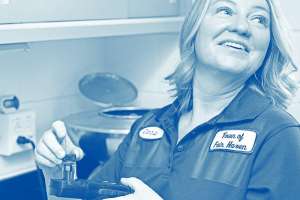
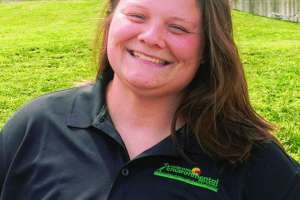
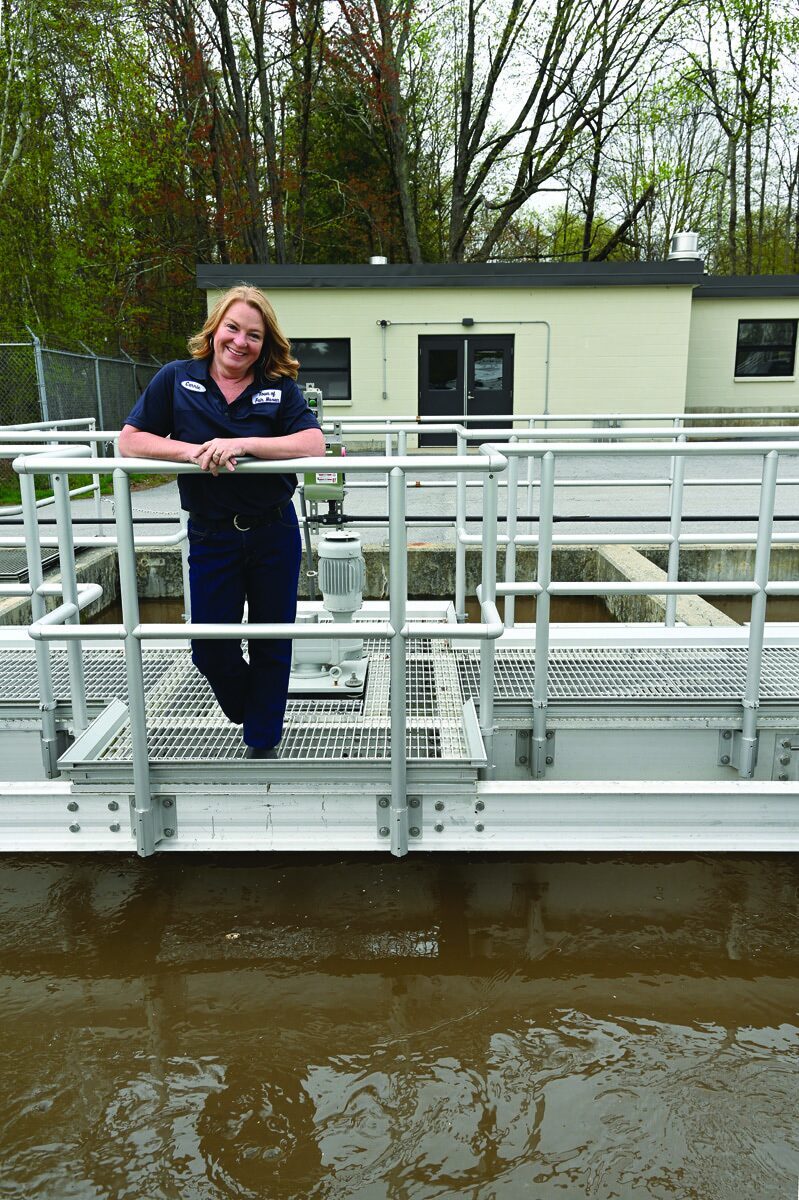
That was in 2020. Today, she is chief operator at the Fair Haven Wastewater Treatment Facility and couldn’t be happier with her career. She is also the winner of a 2024 Operator of the Year award from the New England Water Environment Association.
Easy transition
LaFond, born in Benson and a graduate of Fair Haven Union High School, slipped easily into her clean-water career. Because the Fair Haven plant is rated Grade 2, she needed at least a Grade 2 license to qualify as chief operator. Her time at the lagoon plant counted toward the required hours of experience, and so she was able to take and pass the Grade 2 exam after just one year.
At the time she was hired, chief operator Peter Laramie was about to retire. “He agreed to stay on for eight hours per week and train me,” LaFond says. She now works with Dale Whittemore, assistant chief operator, and reports to Joe Gunter, town manager.
When she started, the plant had an oxidation ditch process and 0.5 mgd design and 0.25 mgd average flows. “In 2021 we went to aeration tanks,” she says. “Our design flow didn’t change. It was basically a refurbishment, but it touched almost everything.”
The $6 million project added a fine screen and new grit system to the headworks, increased lab space and added an office, installed SCADA, replaced the return and sludge transfer pumps and upgraded the garage and the chemical storage area.

Nutrient removal
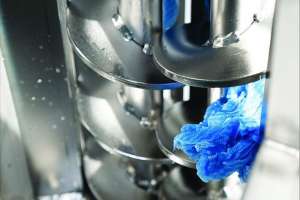
“We maintain five pump stations, and probably half our flow is gravity fed from the upper part of town,” says LaFond. Influent first passes through the fine screen and a vortex grit system (Aqua-Aerobic Systems). The flow then enters a series of three selectors with top-mount mixers to boost biological phosphorus removal.
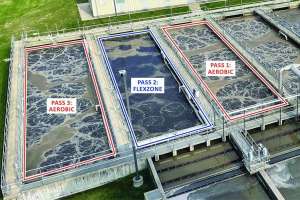
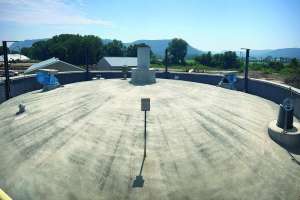
Two aeration tanks follow. “When we have low flow, we can take one tank out of service,” LaFond says. “In the aeration tanks we have a fine- and coarse-bubble system. We run the basins on an air cycle (AERZEN blowers) so we can nitrify and denitrify. We set a program that tells the air how long to come on, and then we give it a rest period.
“We do that based on the season. We know the dissolved oxygen holds stronger in winter, so we have to put less air in. We balance how we run the aeration system based on the nitrogen series lab testing that we do every day.”
After aeration, a splitter box divides the flow to a pair of secondary clarifiers. “At any time, we can have one clarifier or both in service,” says LaFond. Return activated sludge can be sent to the selectors (such as during flood flows or upon receiving a toxic slug of influent) or to the aeration basins. Clarifier effluent is chlorinated and discharged to Castleton River, which is part of Lake Champlain Basin.
Waste activated sludge thickened with polymer and sent to a holding tank, which is decanted periodically, before being trucked to the Rutland Wastewater Treatment Plant at a minimum of 2% solids. At Rutland the material is dewatered and sent to landfill.

Results matter
LaFond’s satisfaction comes in large part from seeing her daily accomplishments: “Every day I come in and I get to see an end result. I start my morning and I can clearly see what we’re getting in and what we’re putting out.”
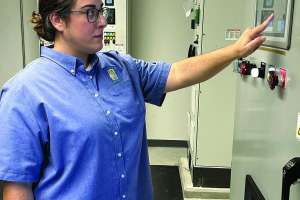
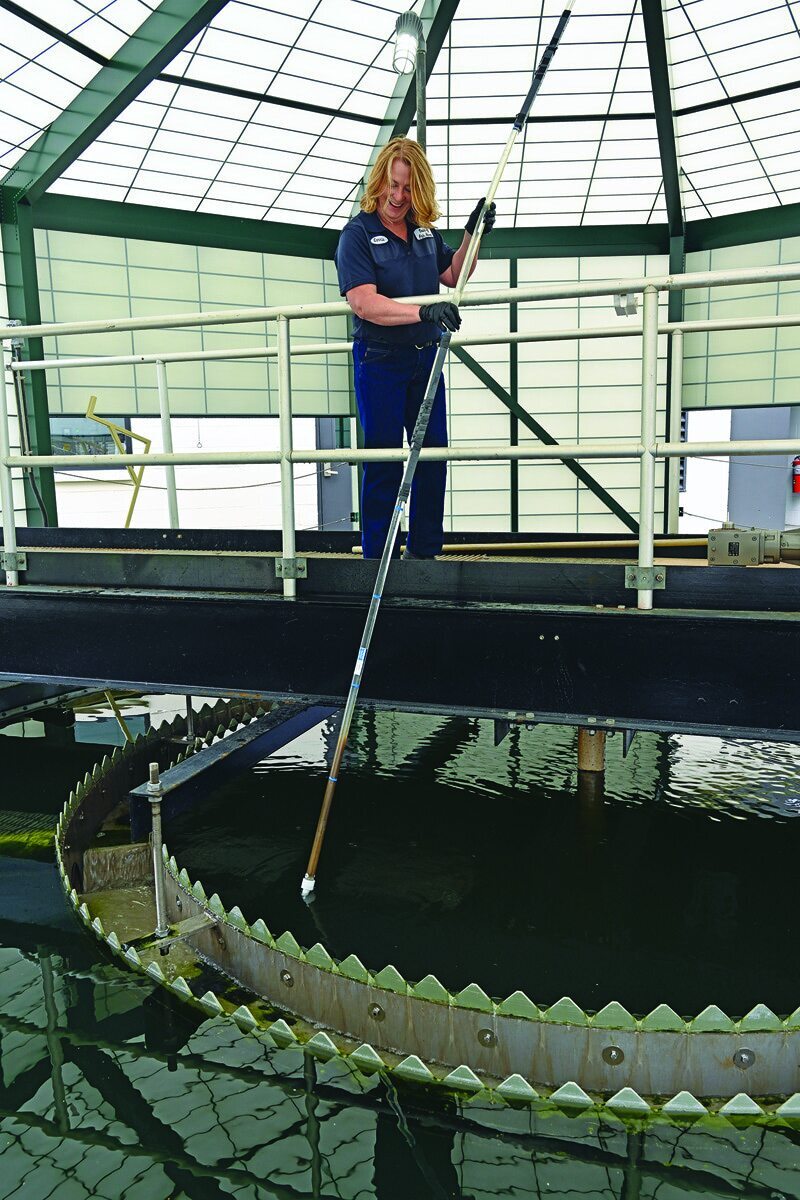
She and Whittemore stagger their day shifts slightly to expand the hours when the plant is staffed. She arrives at 5 a.m., does her daily rounds, and then runs the nitrogen series of lab tests. “I run an ammonia, a nitrate and a nitrite, a turbidity and a PO4,” she says. “Right then and there, we can tell if we need to adjust our air or not.”
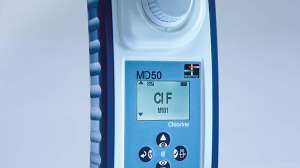
Whittemore reports at 6 a.m. and checks the pump stations on the collection system. After that the two conduct the lab tests for permit compliance: “We run chlorine residuals, pH and a settleometer test on the mixed liquor. We spend the rest of the day doing our basic maintenance.”
That includes meticulous housekeeping. “One reason I won the NEWEA award was that the engineers came in a couple of years after the plant was completed, and they said, ‘Carrie, it looks like we barely walked away from it. It looks brand new and clean.’ We keep a very tight, clean ship here.”
Equipment maintenance is tracked manually with a logbook and a calendar. New O&M manuals were created when the plant was refurbished. “Some equipment, like our Aerzen blowers, gives us maintenance reminders,” LaFond says. “The rest we just do based on a schedule.”
The new SCADA system (LCS Control Solutions) monitors the entire plant and controls dissolved oxygen in the aeration basins. “We have remote access to SCADA, and we also have a Verbatim alarm system (RACO),” says LaFond. “We can log on to SCADA and see what the alarm is. At times it’s something very common that I don’t have to go in for. The SCADA access also gives an indication what we’re coming into — do I need to call another person in to meet me?”
Promoting careers
While succeeding in her career, LaFond sees challenges in recruiting a new generation of operators. “The high schools have pushed so long for kids to go to college that no one has started out in these basic-level fields,” she says. “Our wastewater workforce is aging out, and it’s a real concern.
“For the last two years, I’ve gone to job fairs at the high school and pushed wastewater. As a result, we’ve had a number of plant tours. We had a student here on a work-study plan during his sophomore year, in a program called Flexible Pathways.
“He received math and science credit, and because we had him from his sophomore year until he graduated, he was able to sit for his Grade 1 exam, which he passed, even before he had his high school diploma. He had good grades, he put in his time, and they let him take his test.”
The student moved on to Southern Maine University where he is studying to be a firefighter, and LaFond hopes he will return: The typical firefighters’ three-days-on, four-days-off schedule would mesh with the Fair Haven plant’s schedule of four 10-hour shifts per week.
Meanwhile, the city continues its tour program, welcoming high school students, adult groups and grade-schoolers, even a group in grades K-3. “We had a great time,” says LaFond. “We took them through and explained the process. We did a penguin walk through the plant. They all wobbled through like little penguins.
“We set up a microscope and let them look at our biology. Our student operator was here at the time. He did some tests for them, like a chlorine residual, so they saw the magic of the solution turning pink.”

Touting potential
LaFond talks up clean-water careers while she pursues her own professional growth. She is a member of the Vermont Rural Water Association’s Job Recruitment Board and gave a presentation on recruitment and retention at its 2023 conference.
She’s also a member of the Green Mountain Water Association and NEWEA. She takes training through all three associations to earn CEUs and to prepare for her Grade 4 operator exam, which she intended to take in fall 2025. In the longer term she would like to earn her Grade 5 license and, upon retiring, possibly teach classes for Vermont Rural Water.
“One benefit of this profession is that you can start as an operator, and it can lead to huge things,” she says. “My husband started as a plant operator and became commissioner of the Office of General Services for Schenectady, New York. I’ve seen operators at small plants become lab technicians. They can go into sales or become engineers. The sky’s the limit.”
She would like to see more women explore the water professions: “If you love the environment, if you enjoy making a difference and you’re passionate about math and science, then this is a good field for you.
“Some women might be scared away because we do maintenance on equipment that some might think they don’t have the ability to do. But as long as you get the training you need and you’re in a supportive environment, it works. I’m 5-foot-3 and weigh 145 pounds. I’m not going to lift a 100-pound pump, but there are tools to help us do that.
“One reason I’m so excited about being here is we’ve made an environment that’s nice to come to. I have plants everywhere. We play music. We try to be flexible on schedules. I love what I do and I try to make sure everyone else loves what they do around me. We spend more of our waking hours at our jobs than we do it home. So we try to make it a place where it’s nice to come and hang out.”