Aging sodium hypochlorite feed pumps were causing headaches for operators of the Ontario Water Treatment Plant.
The six skid-mounted single-diaphragm pumps had run reliably for years but were becoming obsolete, observes Dustin Mosher, supervisor at the plant, in Oregon along the Snake River at the Idaho border.
“The rebuild kits recommended every year cost $1,800 to $2,000,” he says. “And as our flows increased, we were running the pumps harder and harder. That was creating more leaks in the feed lines out into the plant.”
Pulsation is inherent to single-diaphragm pumps, and the skids were equipped with backpressure valves, check valves, pressure-relief valves and pulsation dampeners to mitigate the issue. Still, “We had routine after-hours calls when tubing would snap off and we’d be pumping chlorine to nowhere,” Mosher says. “Repair and maintenance costs were getting too great.”
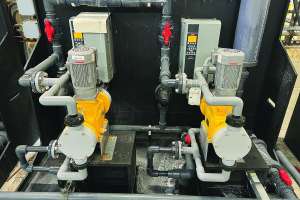
To solve the problem, the Ontario team replaced the old pumps with six dual-diaphragm pumps designed to operate without pulsation. The pumps were easily installed on the existing skids in late 2023 and have performed flawlessly since then, says Mosher.
Two processes
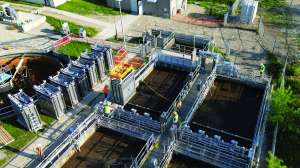
The Ontario plant supplies its home city of 12,000 residents and the Snake River Correctional Institute, treating a mix of water from the river and shallow groundwater wells. Treatment is required to reduce iron and manganese, remove sediment and color, and control taste and odor.
The main plant treats up to 6 mgd with conventional flocculation and clarification. A newer plant completed in 2006 produces 4 mgd in three packaged Trident high-rate settling adsorption clarifiers (WesTech Engineering). The flow from both plants goes through mixed-media filters (Leopold, a Xylem brand) after sodium hypochlorite disinfection.
The six existing hypochlorite pumps were mounted on three skids, one dosing all three WesTech adsorption units and the other two each dosing the flow to one conventional clarifier. The new Tacmina Smoothflow pumps were supplied by industrial distributor Motion.
Motion representatives learned about the pumps in early 2023 during a Tacmina presentation at a training program in Chicago. Mike Lee, a pump specialist in Motion’s Salt Lake City office, recalls, “I was not able to attend but quickly learned that those pumps would be a perfect fit for the Ontario plant.” The Ontario team went through a bid process that led to selection of the Tacmina pumps based on price and additional considerations.

Added advantages
“We were looking for pumps that had a compact footprint, easier maintenance and affordable cost,” Mosher observes. “We were able to mount them on the existing skids with minor plumbing adjustments. The old pumps were sitting horizontal, left to right; the new ones are mounted north and south. We just had to change one fitting and they fit right into our skids.
“That was one of the few parameters we gave to vendors. We didn’t want to have to replumb the whole system. We achieved ease of installation and lower cost, and we ended up getting a lot of benefits on top of that.” Mosher calls the absence of pulsation “a surprise benefit. We weren’t expecting to alleviate that problem so much.”
Lee observes, “With pulsation, you don’t get the smooth, continuous dosing that is needed. Another thing is that if the pulsation dampener is not tuned correctly, the piping will shake and rattle. That’s really hard on the piping and the pumps.”
Mosher says the new pumps operate quietly: “We don’t even hear them pumping. There is no pulsing. You can’t even feel it in the pipe. The pumps are on all the time. We don’t have downtime, so they are continuously running, and new setup is incredibly smooth.”
Innovative design
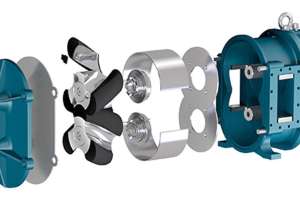
The Smoothflow pumps use a single-head, single-cam structure in which two diaphragms face each other to suppress pulsation. This contributes to highly accurate chemical delivery. The fully sealed structure with no shaft eliminates leakage, according to the manufacturer.
With minimal wear on parts, the pumps maintain their original performance for an extended time and require minimal expense for replacing consumables. “They are super easy to work on,” says Lee. “When you replace the check valves and check valve seats, you just pull them apart, put the new ones in and twist everything back together. It’s really easy to replace the wet-end components in these pumps.”
The Ontario plant generates sodium hypochlorite on site, and the relatively dilute solution (about 0.08% chlorine) requires fairly high-volume pumping. The pumps are rated to deliver up to 158 gpm.
Mosher states, “The dosage is based on flow and is controlled via SCADA. All six pumps are operated through a variable-frequency drive. We make adjustments based on the strength we want, but the pump speed fluctuates based on influent flow to the plant.”