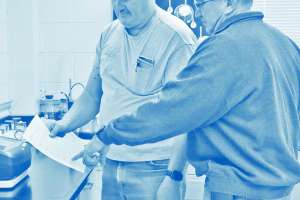
The Central Valley Water Reclamation Facility has seen multiple upgrades over the years. So have the people who operate the plant.
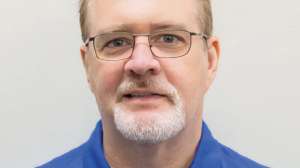
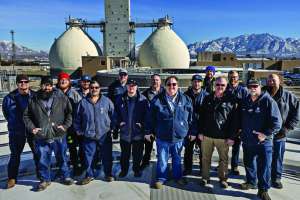
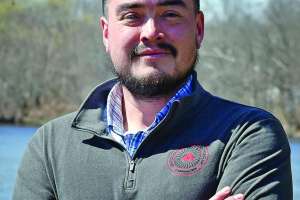
Phil Heck and Sharon Burton would gladly tell you that constant staff coaching, development and license advancement account for the plant’s excellent performance and the numerous award plaques that adorn the office walls and shelves.
It’s an approach that respects each person and gives them ownership of the facility and its operations. “I like when people are engaged and look at their role as a profession, not just a paycheck,” says Burton, plant superintendent and winner of a 2023 William D. Hatfield Award from the Water Environment Association of Utah.
“Teamwork is one thing that drives my management style,” Burton says. “Anything I can share, I want to share. The more information each person has, the more valuable they become as team members. It’s about involving them, inviting them to give their opinions. Just because we’ve done something one way for 30 years doesn’t mean we have to continue doing it for the next 30 years. I like to open the discussion. Sometimes we get really great input and we can take that and run with it.”
The organization’s people focus starts with screening of potential new hires, says Heck, general manager: “We hire based on personality, what they are like as people. We want them to learn and develop the skills, but it’s more important that they fit in and are someone we want on our team. That is crucial to how we all get along and support each other.”

Major facelift
The interlocal government-owned Central Valley plant (75 mgd design, 50 mgd average) is in South Salt Lake City, in the north-central part of Utah’s Salt Lake County. Commissioned in 1988, it serves a total of 615,000 residents in its home city plus Murray City and five improvement districts. A $525 million upgrade and rehabilitation project includes modernizing equipment and processes to meet a 1.0 mg/L total phosphorus limit soon to be imposed by the state Division of Water Quality.
Construction began in 2018 and is to be completed in 2027. Integral to the project is an upgraded biological nutrient removal process that will replace six trickling filters with four biological nutrient removal tanks containing anaerobic, anoxic and aerobic zones, along with return activated sludge and waste activated sludge selector tanks.
Completed components of the upgrade as of early 2025 were interceptor line rehabilitation, upgrades to two of seven digesters, sidestream nitrogen and phosphorus removal processes, upgrades to headworks equipment, new headworks and solids process odor control system, a new water reuse building, new cogeneration engines and digester gas system, two additional secondary clarifiers, and replacements of primary and secondary clarifier launders, weirs and collection arms.
Remaining projects besides the BNR process include a new solids thickening and straining building, new covers and upgrades for three digesters, new belt presses and centrifuges, and biosolids storage and digestion process upgrades. The upgraded facility will have 84 mgd capacity to accommodate growth. Deeply involved in all this are:
- Operations supervisors Josh Hunsaker, Darin Morris and Shawn Groberg, biosolids supervisor Michael Earl, and cogeneration supervisor Zackery VanWormer.
- Process coordinators/specialists Aaron Britton, Dustin Gloor and Brady Adams.
- Direct responsible charge operators Anthony Rizzuto, Jonathan Porter, Neal Lancaster, Sergio Barffuson, Brent Nielsen, Chad Fryrear, Wade Hamblin and Bradley Bryant.
- Assistant general manager Brandon Heidelberger, P.E., chief engineer Bryan Mansell, P.E., electrical engineer Navneet Prasad, maintenance manager Chris Reilly, IT and data service manager Jake Crookston, laboratory director Edward Harrison, and safety manager Isaac Talbot.
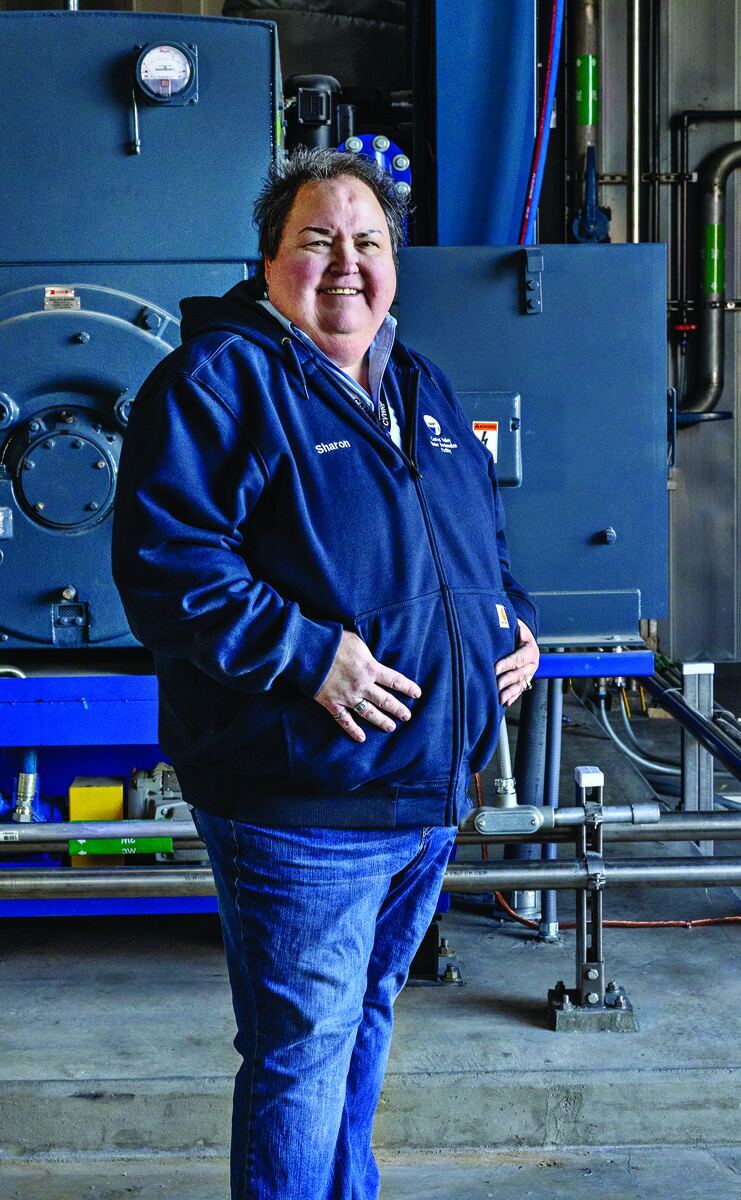
Focus on people
Burton and Heck built their people-centered approach from widely different backgrounds. Heck holds a doctorate in environmental science and engineering from the University of North Carolina at Chapel Hill and a master’s in sanitary and environmental engineering from the University of California Berkeley. Before joining Central Valley in 2014, he had a 27-year career as an engineering consultant.
Burton, who came on board in 1993, owns a master’s in organizational leadership and a graduate certificate in human resources management, both from Southern New Hampshire University. She started at Central Valley in the warehouse and in facility maintenance, then worked her way up step by step, taking her current role in 2023.
“I really love what I do,” she says. “It’s the best thing I’ve ever done professionally. I’m very proud of what we do here. We do more in a single day than anybody understands in removing pollution and protecting the environment. I love the outdoors, and I’m an avid fly fisher. Clean water is critical, and protecting that resource was the No. 1 thing that lit the fire in me.”

Building the culture
As superintendent, Burton has responsibility for 65 of Central Valley’s 100 team members. She and Heck have embraced the Arbinger Institute approach to building high-performing leaders and teams. Heck observes, “It’s a program based on psychological research about how people interact and are motivated. It helps foster communication and relationships so that people feel comfortable and have the tools to engage with each other and move through conflict.”
Burton is among Central Valley leaders who have gone through the institute’s program and have become in-house trainers. “It has really taken our culture to a new level,” she says. “In a nutshell, it’s about seeing our team members as people, recognizing that everyone has their own needs, challenges, desires and aspirations.”
As an example, in days past, a team member who habitually showed up late to work might simply be scolded and written up for discipline. Under the Arbinger approach, says Burton, a supervisor might say, I notice you’ve come in late a few times this week. Is everything OK? Is there anything I can help with?
“It gets you to think about the person and how what’s going on outside of work affects what goes on inside,” Burton says. “I often hear new employees say, ‘I’ve never had a company treat me so fairly, understand me and care about me as a person.’”

Reaching new levels
Heck notes that Central Valley has been through a wave of retirements: “In the 10 years I’ve been here, probably 75% of the staff has changed over. We’ve hired a lot of people as operator trainees with no experience, and we’ve had to train all of them up.
“Sharon was our training supervisor before her current position. She put on a lot of the training courses. We invited other plants in the state to send their operators over, and we provided their training as well.”
Once on board, team members have access to a step and grade program that offers promotions and wage increases. Burton observes, “We encourage them to pass all the way through to Grade 4 licensing. As long as they have a satisfactory performance evaluation, meet all state’s requirements, pass the test and get their unrestricted certification, they can move up to the next level of pay and grade.”
The plant pays for training; team members are reimbursed for the cost of exams once they pass. Those not yet certified to Grade 3 can enroll in the American Water College online operator training program. “For the last two years, we’ve had roughly 30 people in it,” Burton says. “We give them time during the week to study. It’s internet-based so they can access it from anywhere. We’ve seen great success with that.”
Team members are also reimbursed at 75% for the cost of higher education, provided the courses are relevant to their roles at the facility. They are encouraged to attend national, state and regional conferences. For a number of years, a Central Valley team has won the state Operations Challenge competition and has advanced to the national competition.

Treating the flow
The operations team manages a process that apart from the new BNR component is similar in character to the original scheme. “The main treatment sequence has stayed the same,” Heck says. “We’ve gone through each of the facilities and upgraded the processes within them.”
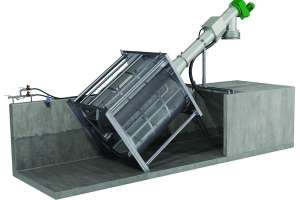
Influent splits into six channels with quarter-inch bar screens (HUBER Technology), followed by a highly automated process (also HUBER) for collecting, washing and compacting the screenings and conveying the material to roll-off containers, which are then trucked to landfill.
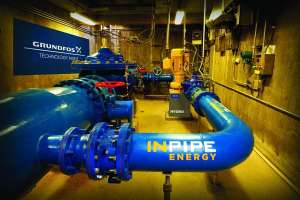
After screening, six 50 mgd influent pumps (Worthington and Flowserve) deliver the water to four aerated grit tanks. The settled grit is removed by WEMCO Model C pumps (Trillium Flow Technologies) and sent to HUBER Coanda grit washers. The grit is conveyed to the same containers as the screenings.
The flow then passes through 10 110-foot-diameter primary clarifiers with Eimco mechanisms (Ovivo). Gorman-Rupp pumps send primary sludge and scum to an equalization tank. Strain presses (HUBER) remove hair and solids not captured in the screens before delivery to the anaerobic digesters.
The primary effluent passes through three of the original six trickling filters into six aeration basins operated in series, and then to 12 secondary clarifiers. Final effluent is disinfected in Suez Aquaray 3X UV systems (Veolia Water Technologies) in four channels with vertical low-pressure, high-intensity lamps.
“We discharge into Mill Creek, a small tributary of the Jordan River, which delivers water to the Great Salt Lake,” Heck says. “Our effluent is about 95% of the flow in Mill Creek. The river is an urban watershed. It has low dissolved oxygen and other issues, so there is a big effort to improve the water quality.”

Recycling ethic
Resource recovery — of biosolids, biogas and water — is a key component of plant operations. Waste activated sludge goes through gravity belt thickeners (soon to be replaced by Centrisys/CNP centrifuges) and then is mixed with the primary sludge.
Two egg digesters provide first-stage digestion, followed by five conventional second-stage digesters. Sidestream phosphorus removal (MagPrex from Centrisys/CNP) follows digestion. “We aerate the material to strip carbon dioxide and add magnesium chloride to precipitate struvite,” says Heck. “We’re not harvesting the struvite now; we’re just leaving it in the biosolids. We could decide to harvest it in the future.”
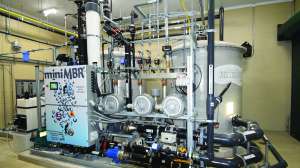
After the MagPrex process the material is dewatered to 18% solids on belt filter presses. The filtrate goes to AnitaMox sidestream nitrogen removal (Veolia Water Technologies). There anammox bacteria in a biofilm on plastic discs in a reactor remove ammonia in the wastewater, and the treated filtrate is returned to the primary effluent stream.
About 80% of biosolids are land-applied by a large farm operator. The rest are converted on site to Class A compost, marketed in bulk or in bags to landscapers, home gardeners and others as Oquirrh Mountain Compost.
Biogas is burned in a combined heat and power system with four 1.8 MW engine-generators (Jenbacher). “We produce a little over 24 million cubic feet of digester gas monthly,” says Burton. “We burn pretty much every bit of it. It’s really cool that we can use our methane to generate a portion of the electricity we need and heat for the digestion process. It’s a full circle approach.” The biogas is blended about 50-50 with utility natural gas.
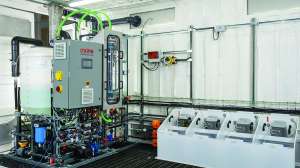
Plant effluent is partially recycled. “We own a nine-hole golf course next to the plant and provide reuse water for it,” says Heck. “We take a portion of effluent after UV, put it through disc filters [Aqua-Aerobic Systems], add sodium hypochlorite and pass it through a second UV system [also Suez/Veolia].” The reuse system supplies about 1 mgd for golf course irrigation as well as water for in-plant purposes including washdown and engine cooling. The average reuse flow is about 6 mgd; peak capacity 12 mgd.
With a commitment to resource recovery, an upgraded and modernized facility, and a highly trained and dedicated team, the Central Valley Water Reclamation Facility is positioned for a future of excellence.