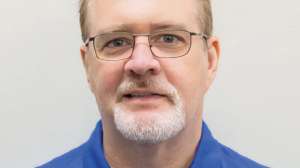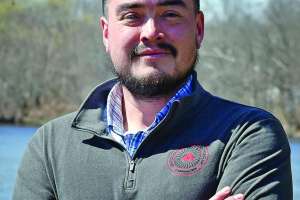
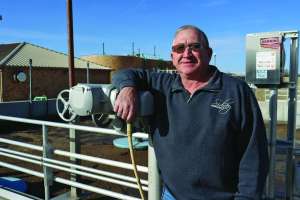
Todd Sukup was working from sunup to sundown at a food distribution warehouse in his hometown when a friend tipped him off to a water meter reader position with the city.
Motivated to find a better work/life balance and spend more time with his young family, he applied and got the job. That was 1993. Over his 32-year career, Sukup ascended to water treatment plant operator and finally to wastewater superintendent in Sidney, Nebraska.
His decades of dedication to the profession and his incalculable volunteer hours with the Nebraska Water Environment Association earned him the association’s 2024 William D. Hatfield Award.
While now known as an avid NWEA volunteer, he at first was reluctant to get involved.
“At my first conference, I only went to be an attendee,” he recalls. “I’ve always been one of those that doesn’t mind helping if I get approached, but usually hangs back.
“Then, a couple of members from what is now called the Nebraska Wastewater Operators Committee approached me about sitting on a panel session at the Heartland Conference that summer. Thinking of a way to get out of it, I asked them to call my boss and see if it was OK with him.” As it turned out, it was OK, and being a panelist quickly evolved into joining the committee, and Sukup has been involved there ever since.
“I was on that committee for a few years and became the vice chair and chairman,” he says. Once the chairman stint ended, he became Operators Division delegate to the NWEA executive board. After a couple of years, he was asked to be a director-at-large for that board, and in 2016 he was named president.
What started as a mission to represent western Nebraska in the state’s wastewater community grew into a commitment that built Sukup’s reputation and career: “I did a good 12- to 15-year volunteer stint with NWEA. It was one of those things that when you’re finally done, you step back, take a breath, and go ‘Wow!’”
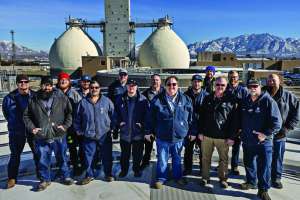
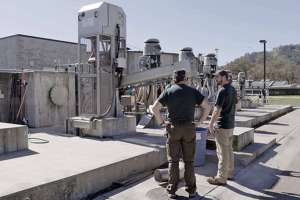
Sidney straddles the borders of Nebraska, Colorado and Wyoming. Sukup and operators Floyd Ogden and Jason Houk run the wastewater treatment facility to serve the city’s 6,500 residents and protect water quality in Lodgepole Creek.
“Jason does about 90% of our lab work and helps with maintenance,” Sukup says. “When we have plant issues, he helps with that, too. Floyd is newer to the team, so he handles a lot of the day-to-day operations and preventive maintenance. We’ve been slowly introducing him to lab work as well, but with a three-person staff, it can be hard to find the time to cross-train.
“Everybody basically has to be interchangeable, apart from the superintendent duties, so that we can fill in when someone goes on vacation, stays home sick or has family members to care for. It can be challenging at times to make sure everything gets accomplished.”
The crew operates an uncovered sequencing batch reactor system despite western Nebraska’s notorious weather; team members navigate the operational challenges of that environment. “Manufacturers and salespeople tell you how their equipment should run under certain conditions,” Sukup says. “But we’ve had to learn how our equipment operates when it reaches five degrees. We have it pretty well figured out now.”
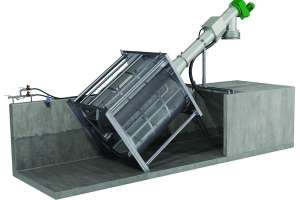
The plant is designed for 1.16 mgd dry-weather flow; average flow is 0.55 mgd. Influent enters the headworks through a 1/2-inch multirake bar screen (HUBER Technology). From there, it passes through a grit removal unit (Thomas Conveyor & Equipment Company).
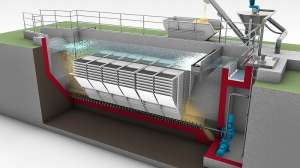
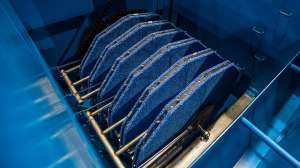
Then the wastewater is pumped up to a two-basin AquaSBR system (Aqua-Aerobic Systems), which handles the entire biological process and decants and wastes into sludge holding tanks.
Biosolids are treated in an aerobic digester and dewatered on a 2-meter belt press. Biosolids cake is taken to the Sioux Army Depot and given to a farmer to apply to his wheatfields.
The effluent is discharged to Lodgepole Creek, which ends up in Colorado and flows into the South Platte River. “The discharge permit includes ammonia and total nitrogen limits, and the SBR runs pretty self-sufficiently for those,” Sukup says.
As part of his dedication to NWEA, Sukup regularly attends industry conferences where he and fellow operators share experiences at their plants, how they deal with upsets and equipment failures, and what is and is not working. “When I started attending some of the conferences, I began to meet very interesting people from other communities and build strong relationships with a lot of people around Nebraska,” he says.
“I’ve learned things from attending the sessions, but you can learn a lot more valuable information by drinking a beer and talking shop with other operators who have already encountered some of the situations you’ve had or may run into.”
Between volunteering, attending conferences and dedicating himself to his plant, Sukup has accumulated some of the highest honors in Nebraska’s wastewater industry, but he’s the last to boast about it.
“I’ve been on the NWEA Safety Committee for years and never nominated myself or the plant for any awards. I’ve always felt that if our work was good enough, people would see that and nominate us once we earned that recognition. Winning the Hatfield Award was very personal to me. To see that somebody put my name in the ring meant the world.”
In 2008-09, Sukup received the Bruce Bates Service Award to recognize his chairmanship of the Nebraska Wastewater Operators Committee under NWEA. He is also a member of the Select Society of Sanitary Sludge Shovelers, which recognizes outstanding service and dedication to the NWEA.
Even while taking on more association leadership positions, he has remained involved in operations and safety committees: “After all that volunteering, you think to yourself, ‘This is good; I don’t have to do anything for a while.’ But then you miss being involved and the relationships you’ve made. So now I’m trying to get back into more involvement again.”
Despite his 32 years with Sidney and his volunteer work, Sukup shows no signs of stopping:
“I’m only 55, so I still have a ways to go before retirement. That said, I have one grandchild in Sidney and another in central Kansas who I want to spend more time seeing. I also want to play more golf with my wife in the summertime.”
With new regulations soon to come and equipment reaching end of life, the plant continues to keep Sukup, Houk and Ogden busy. “We’re upgrading the bar screen soon as well as our grit washer, which has met its useful life,” he says.
Another big project will replace three Fairbanks Nijhuis influent pumps (Pentair), which are from the original plant built back in 1987, with more energy efficient units. Due to a recent reclassification of Lodgepole Creek as a recreational water, Sukup expects the discharge permit to require disinfection when renewed in 2028.
“It’s one of those nice unfunded mandates that we get to be involved with,” he says. “But that’s the way it goes. We’ll be looking for grant money or some kind of funding to install a disinfection system. We may implement it earlier to anticipate what’s coming.”
No matter what future projects arise, Sukup is proud to be active in the Sidney community and in NWEA. “When I first started, I was just looking for a job for family reasons,” he recalls. “I ended up with a career that I really enjoy. Being able to clean the water, put it back in the stream, and help Mother Nature out has been enjoyable. I’m happy with what I do.”