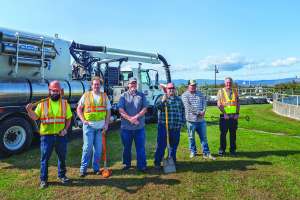
The Las Gallinas Valley Sanitary District has been an early adopter of power generation at its wastewater treatment plant.
The district, which serves about 30,000 people in San Rafael, California, began operating a biogas-fueled combined heat and power system in 1983 and installed a large solar array on its property in the early 2000s.
But being first on the road has hazards: The pathfinders are also the first to find the potholes. The district has found more than its share of surprises but keeps looking for ways to produce and use power from biogas.
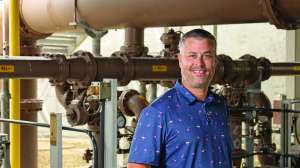
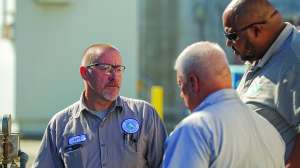
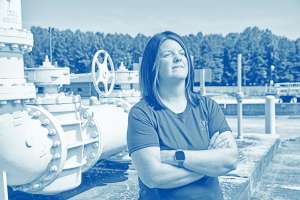
“When you’re an early adopter, things don’t always go right,” says Mel Liebmann, plant manager. “Sometimes there are problems and struggles along the way.”
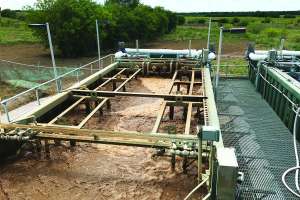
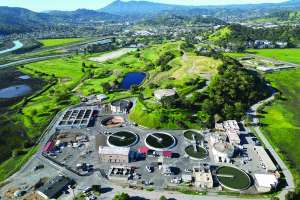
The wastewater treatment plant (2.79 mgd design, 2 mgd average dry weather flow) uses an integrated fixed-film activated sludge process that employs a Bio-Wheel (H2O Innovation).
“It’s effectively a very big wheel,” Liebmann says. “As it turns it captures ambient air and releases that slowly. That provides oxygen, but at the same time, the plates provide a fixed surface for bacteria that thrive in the aerobic environment.” The effluent is chlorinated and dechlorinated before discharge to a creek that flows into San Pablo Bay.
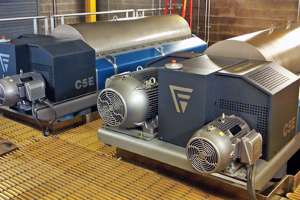
Solids are stored in lagoons and once a year applied to adjoining land. The district is working on a project to use the biosolids on a hay field, a more beneficial use. The district also takes part in a Purdue University study of PFAS and other substances in the biosolids and their effect on plants.
During heavy rains, the treatment plant can receive peak flows in excess of 20 mgd. The district recently expanded its secondary treatment to boost peak capacity to 18 mgd and it is working on other improvements to achieve 24 mgd.
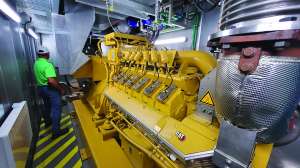
The plant’s combined heat and power system worked fine for decades, but when the Bay Area Air Quality Management District changed its emission limits for nitrogen oxides, the reciprocating engine could not meet the new standards.
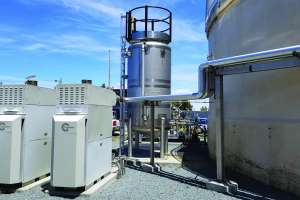
With the help of Cornerstone Environmental Group, the district developed a biogas energy recovery system built around two 65 kW microturbines (Capstone Green Energy) to provide electricity and heating for the digesters.
The system includes a gas conditioning system (Unison), a filling station to supply renewable natural gas to the district’s flusher truck and a hydronic boiler to provide supplemental heat. The system is designed as a closed loop to use 100% of the biogas from the digesters.
The project hasn’t played out exactly as planned. At present the truck is being fueled by utility natural gas grid instead of RNG from the treatment plant because the connection at the plant failed and can’t be repaired. The district hesitates to replace the filling station because of the cost and because California policies could change to favor electric over natural-gas-fueled vehicles.
The district lacks a biogas storage system other than the cover of the main digester, so biogas flow to the microturbines has peaks and valleys. So at times the need to heat the digesters takes priority over fueling the microturbines, and sometimes excess biogas has to be flared.
Nevertheless, Liebmann thinks the project is a success: “We replaced a CHP engine with a system that meets the air-quality regulations and is also more efficient at fuel-to-power conversion,” Liemann says.
A May 2024 California Energy Commission report estimated the project had savings of $100,000 annually mainly from power generation. It also noted air quality impacts from replacing an out-of-compliance engine and replacing a diesel-fueled flusher truck with one that uses natural gas.
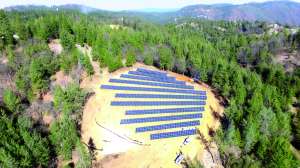
The district was also a pioneer with solar power, installing a 700 kW solar array in 2006, but the system had to be shut down in 2022.
“We were first adopters when solar was a new thing back in the early 2000s,” Liebmann says. “Those panels had issues. They were delaminating and creating gas cavities that degraded the metal connections in the panels.” That caused short-circuiting that set fire to the grass underneath. So for safety’s sake, the system was shut down.
Despite that experience, the district is working on a new solar power project on the same site. That 1 MW system, developed by Forefront Power under a power purchase agreement, will provide lower-cost electricity without capital investment and responsibility for maintenance. The new solar array is to begin operating in 2025.
Although some attempts to become more sustainable have had challenges, Liebmann is proud that the district’s board is committed to the effort: “What we’re doing should at least help smaller agencies like our own. Maybe they can avoid some of the pitfalls and challenges we’ve faced.”