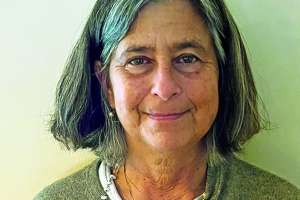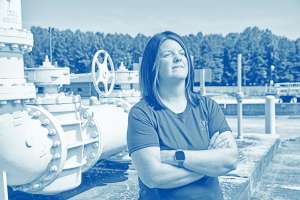
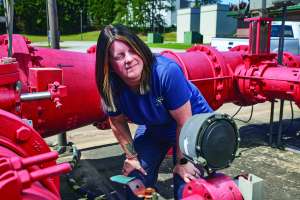
Crystal Dodson was vaguely casting about for a career direction in 2006 while working at a pharmacy.
Her neighbor worked in the IT department of the nearby Clayton County (Georgia) Water Authority and encouraged her to apply for a meter reading position.
Dodson got the job and hit the ground running, working 40-hour day shifts, taking as many classes as she could and volunteering nights and weekends to build her experience and qualify for her Class III Wastewater Operator license.
She passed the exam and then rapidly advanced through Class II and Class I levels within two years. Showing no sign of slowing down, Dodson attended the Georgia Association of Water Professionals Annual Conference in Savannah and is now enrolled in the authority’s leadership class, with her eye on top management in the industry.
“It has opened other avenues to me in order to eventually achieve leadership positions in the future,” she says. GAWP named her 2024 Wastewater Top Operator for District 3.
Now on the midnight shift, Dodson has definite ideas about her career direction: “I’d like to be on day shift, so I can learn as much as possible in order to achieve chief operator status. That’s the next step up from where I am now, and then hopefully supervising in the future.”
She’s laying a firm foundation, gradually but steadily, “just showing up and doing the job; making sure that I leave my building knowing I did everything I was meant to do, the best way I could do it.”
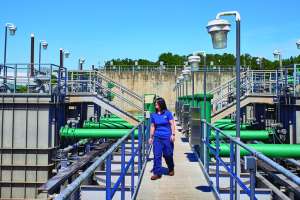
Her current building is the Northeast Water Reclamation Facility in the town of Rex, one of three plants that make up the authority’s wastewater treatment division. Three nights a week, she shares duties with operator Keri Gable; on the other two she’s on her own.
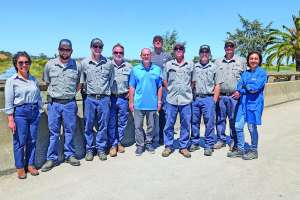
The rest of Northeast staff includes Herlon Fayard, plant manager and her immediate supervisor; Keith Kiblinger, chief operator; operators Daniel Hudgins, Carmen Burns, Miracle Johnson and Nathan Dorton; and plant worker Kentson Parks.
The plant serves the northeast section of Clayton County about 20 miles south of Atlanta. The other two plants are the Shoal Creek Water Reclamation Facility and the W.B. Casey Water Resource Recovery Facility. The three are fed by a complex distribution and conveyance system.
Located in an unincorporated area, the Northeast plant has a design capacity of 10 mgd and a peak flow capacity of 25 mgd, thanks to a 2007 plant upgrade that anticipated expected growth through 2050. Average flow is 4.5 to 5 mgd.
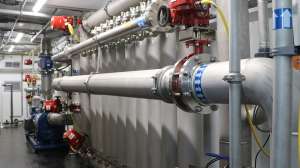
Flow enters through a pumping station powered by six Flygt pumps (a Xylem brand) and then passes to two preliminary influent structures equipped with fine screens (Parkson Corp.) A PISTA grit removal system (Smith & Loveless) follows.
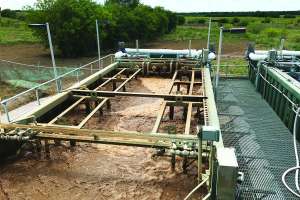
The flow bypasses the primary clarifiers to enter anaerobic and anoxic basins, followed by aeration basins with Schreiber fine-bubble diffusers (Parkson Corporation). Treated water flows to four circular secondary clarifiers. Tow Bro sweepers (Evoqua) remove solids.
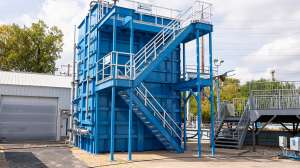
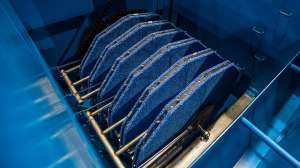
The water is then pumped to a flocculation tank followed by a battery of Schreiber Fuzzy Filters compressible media filters (Parkson Corporation). The flow is UV disinfected (WEDECO - a Xylem Brand) before discharge to Panther Creek, which flows into Big Cotton Indian Creek.
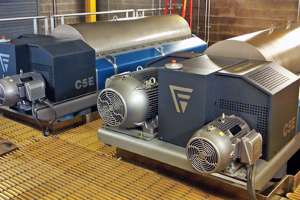
Two 10 hp WEMCO pumps (Trillium Flow Technologies) send waste activated sludge to Hycor rotary drum thickeners (Parkson Corporation). The thickened material is dewatered on centrifuges (Andritz) to 25-30% solids. Contractor ERTH Products recycles the cake biosolids for soil amendment, green roofs and other applications.
The plant consistently meets permit limits of 0.3 mg/L phosphorus, 1.3 mg/L ammonia, 20 mg/L TSDS and 6 mg/L BOD.
No one is without challenges; Dodson finds her biggest are the most rewarding aspects of her job: “I’m constantly learning out here. I’ve been in the plants for seven years, and I still do not know everything there is to know about it.
“So if something happens at night that I’m not familiar with, if a certain process goes down and I don’t know the inner workings, I still have to learn from my chief operators and ask how to fix it for the night. Then, the next day, I’ll ask for the blueprints of the affected process, or get them to show me exactly what I did wrong, and how to fix it for the next time.”
She’s not just reactive in her drive to learn. “I do try to come in and do some day shifts, because that’s where our chief operator Keith Kiblinger is,” she says. “He knows all about breaking things down, greasing things, changing the oil and everything. If you want to know things, he’s the one to teach you how to break it apart and put it back together.
“I have been trying to learn more from him, ask him as many questions as possible. I take a lot of notes. Now the challenge is trying to keep up with him, to study him, then take as many classes as possible. I went to Savannah last year for the GAWP Annual Conference, where they had multiple classes about everything lab-related, and other industry-related things I learned.”
Fayard has nothing but praise for Dodson’s work ethic, can-do attitude and teachability: “She works really hard. When we show her how to do something one time, it sticks. She doesn’t mind getting her hands dirty in anything that we’re doing or working hours of overtime when things come up on short notice. Whatever needs to be done, she does it. She’s really good about once something happens, she remembers how to solve that problem the next time.”
Dodson acknowledges support received from colleagues: “Ed Johnson [then meter reading supervisor] was a wonderful mentor. He helped encourage me there to put in for a position in distribution and conveyance. Once I was there, Alaine Mort and Pat Heinzerling in HR were a great encouragement. And here, Herlon has encouraged me to put in for multiple classes.
“I’m in a leadership class now, to hopefully become a chief operator. Keith encouraged me. He helped me get my Class II and my Class I licenses, like studying for classes and teaching me and doing exam questions. He wanted to help me.”
Dodson puts all that knowledge and help to good use each night as she clocks in. On the nights she works with a colleague, she says, “I do enjoy being with a really good partner.”
Depending which night of the week they come in, they review the previous shift log, using its information to decide their priorities. They then survey the SCADA system to understand what is going on and decide if they need to go immediately to check on the plant or take some other action first.
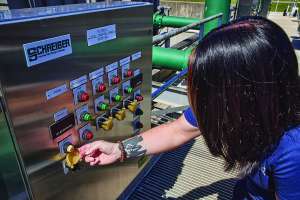
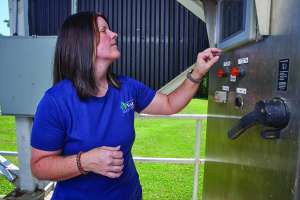
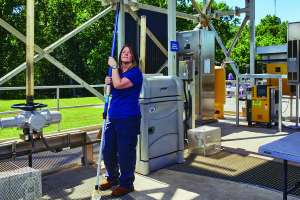
Eventually they go outside, walk the plant and check the various processes, then sample effluent and run process control analyses. “No matter what, we’re going to go outside to all corners of the plant,” says Dodson. “If it’s raining, cold, snowing, we’re going out, because the plant is running 24/7. What I enjoy the most is that every night could be different. I enjoy that we can make changes, depending on what’s going on within the plant.”
The Northeast plant lab team handles only process control tests on site, sending other tests to the authority’s central lab at the W.B. Casey plant to process all reportable parameters and run environmental compliance and FOG program tests for all treatment facilities.
Dodson and Gable input all their process control numbers every night. They were tapped to help implement a plant operations software upgrade. In the changeover, they moved from a laboratory information management system to a Hach water information management system.
Now the two midnight shift operators are responsible for all data entry in the mornings, from the previous day. The plant gets a daily SCADA report at 1 a.m., and they input all operational and process control data from that report into the WIMS.
Dodson’s husband Michael is also in the industry, working as a supervisor at the Henry County Water Authority in McDonough, Georgia. After she started at Clayton County, he realized there was opportunity in the industry and started at Henry County about a year later. They have three children ages 13 to 15.
When not working to keep Clayton County’s water quality high, Dodson enjoys reading, attending sporting events and vacationing in the mountains or at the beach. It seems she and her spouse have realized the great lifestyle afforded by a water industry career.