
We hear about it more every year: water scarcity and the need to manage water more creatively.
We also hear about another problem: more emerging contaminants of concern in community water sources. These contaminants can render some water sources unusable until the issue can be addressed. Water quality requirements vary, and in reusing water, it is essential to ensure that substances removed are not going right back into the environment.
An Israeli study[1] of data from 445 commercial agricultural fields irrigated with reclaimed water found that pharmaceuticals were found in all irrigation water and soils tested. Anticonvulsants were the major group detected. Leafy greens had the highest pharmaceutical concentrations, and antimicrobial agents were detected in low quantities in produce.
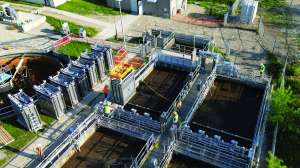
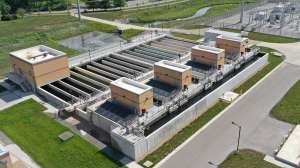
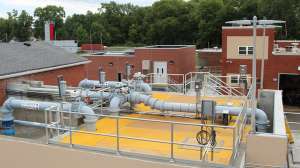
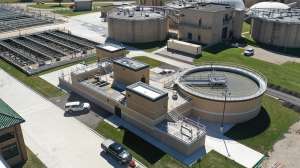
In light of these challenges, new treatment technologies are emerging. One of these combines biologically active filtration with ozone to achieve cost-effective removal of emerging contaminants, along with pathogen deactivation, removal of odor and color, and other benefits.
The list of emerging contaminants of concern includes a number of pharmaceuticals, pesticides and industrial chemicals, highlighted by PFAS, which have become the most prominent among them. The U.S. EPA has released new stringent guidelines on specific PFAS-related compounds that are spurring affected municipalities to act. Regulation often is what drives action to develop and implement treatment technologies to achieve new standards of water quality.
The public expects utilities to produce safe, reliable water supplies for drinking, bathing and other purposes, and public perception cannot be ignored. That underscores the importance of using proven technologies to meet evolving standards at affordable costs.
Effective treatment is especially critical in water recycling, including indirect and direct potable reuse. In farm irrigation, maximum contaminant removal is critical; recent research shows how pharmaceuticals and other chemicals can end up in soils and in produce grown with reuse water.
This area has not yet received close regulatory scrutiny; treatment standards are inconsistent and variable in the U.S. and across the globe. With increasing water reuse and rising emphasis on a safe food supply, the prospect of additional regulations in this arena is growing.
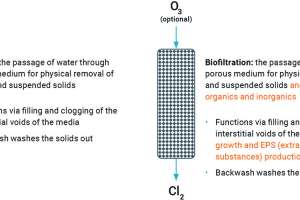
BAF does more than remove suspended solids, as traditional gravity media filtration does through straining, interception and sedimentation. BAF also biologically removes soluble organics and inorganics through the biodegradation and adsorption onto biofilms that grow on the filter media.
BAF backwash, besides washing out solids, regulates biomass accumulation that results from biological growth and the production of extracellular polymeric substances. Proper management of a BAF yields a biologically stable effluent and can also reduce costs by enabling lower and more consistent biocide dosage before the product water is distributed in potable applications.
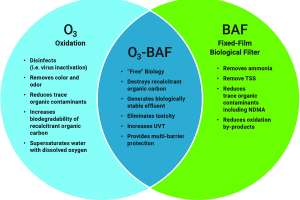
While BAF is a significant improvement by itself, the addition of ozone results in a process that is greater than the sum of its parts. Ozone alone is excellent for inactivating viruses and removing color, odor and trace organics. It is also effective in breaking up recalcitrant organic carbon and making it more bioavailable. Combining ozone with BAF is powerful because:
The result of this process is a “free biology”: a biological population that is essentially self-sustaining. It requires no supplemental microorganisms, nutrients or food.
There can be a perception that BAF results in higher microorganism counts in the effluent because of the active biology in the filter. In reality that is not the case: studies have shown that utilities using BAF see consistently lower microorganism counts than those without BAF.
The combination of ozone and BAF is powerful and synergistic, and advanced process control can maximize the benefit of that synergy, achieving lower operating costs and more biologically stable, consistent effluent.
Sensors and controls are essential to monitoring and ensuring unit performance and efficiency. While at present, it is not feasible to measure emerging contaminants in real time, TOC and UVA provide online, real-time surrogate parameters for monitoring and control. In an integrated ozone-BAF system, control of the process in real time can result in:
The combined ozone-BAF process can be applied in multiple applications; groundwater, surface water and wastewater. The process alone may suffice for agricultural reuse; for direct potable reuse or other applications it may need to be part of a larger treatment train. The key point is that in various applications the process can address a wide range of contaminants:
As for PFAS, while an ozone-BAF system should not be viewed as a sole treatment strategy, research has demonstrated that such a process upstream of granular activated carbon contactors designed for PFAS removal can improve PFAS removal efficiency and extend media service life.
Because every source water is unique, and because a given utility may need to address more than one contaminant or a unique combination of contaminants, piloting is usually essential to validating the effectiveness of ozone-BAF in treating water to the required standard.
Piloting provides necessary insights into feasibility and the configuration and control strategy that will achieve the treatment target. As ozone-BAF processes continue to be implemented globally, and as more data becomes available for review, it will likely become possible to predict and model treatment outcomes with more certainty, reducing the need for the piloting.
The ozone-BAF process is proven effective and economical in removing a host of emerging contaminants of concern across multiple applications, and with small and large flows. This makes the process a promising candidate to address the unique challenges many utilities face.
About the author
Lewis Veith (Lewis.Veith@xylem.com) is global product manager for Leopold Filtration with Xylem.
References:
[1] Pharmaceuticals in edible crops irrigated with reclaimed wastewater: Evidence from a large survey in Israel, ScienceDirect.