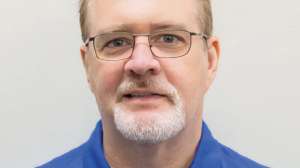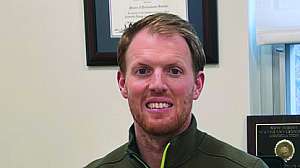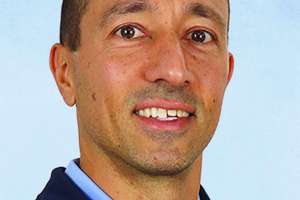
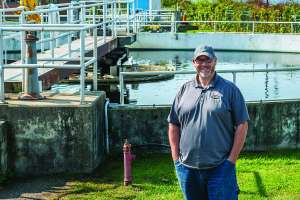

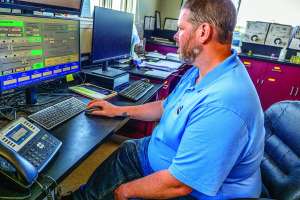
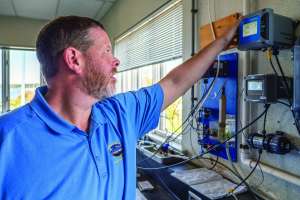
Matt Dow’s story is truly like father, like son.
His dad set an example that Matt followed into the wastewater treatment profession. The elder Dow brought Matt in one summer to help out at the treatment plant where he worked. Later he coached the Operations Challenge team Matt was on early in his career.
“He was in charge of a small lagoon system at one of Vermont’s ski areas,” says Dow, now wastewater facilities manager in Burlington. “I helped him in the summer. He let me get my hands dirtier than most, with experiences like cleaning out a digester. We talked wastewater at the dinner table. I literally followed my dad into the business.”
During another summer Dow worked for one of his dad’s associates at a treatment plant using spray fields for treated effluent: “I had a great time, going into the woods to replace pipes and spray nozzles.”
After college he was at home thinking about a white-collar job when his dad suggested he look into an opening for an operator at Richmond, Vermont. He got the job, worked there for a short period and then took a job at Burlington, Vermont’s biggest city, for better pay and more responsibility.
“I was surprised,” he remembers. “I got the job even though I hadn’t completed my license yet.” That was in 2006. Today, Dow is responsible for Burlington’s Main, East and North treatment plants, along with 25 pump stations, five combined sewer overflow locations and one CSO treatment facility. He won the 2023 Operator of the Year award from the New England Water Environment Association; in 2009 he received the Young Professional Award from the Green Mountain WEA.
“Burlington is an old city with lots of hills,” says Dow. “It’s a weird topography.” In the 1950s and 1960s, the city built three small treatment plants, reducing the challenges the landscape presented to citywide wastewater collection.
At the North Plant, the average daily flow is about 0.8 to 0.9 mgd, and treatment consists of headworks, primary settling, activated sludge and secondary clarification, followed by disinfection with sodium hypochlorite. “The North Plant is almost completely domestic wastewater,” Dow says. “It serves about 10,000 residents and several retirement homes.”
Conversely, the East Plant (0.4 to 0.5 mgd average) serves primarily industrial and commercial customers, including the University of Vermont and the community’s largest hospital. The flow scheme is the same as at the North Plant.
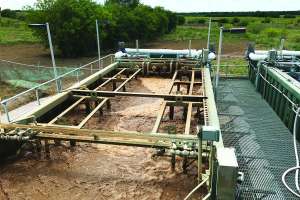
The Main Plant is a contact stabilization system, and it’s the largest of the three, handling 3.5 to 4.0 mgd on average with a peak capacity of 13 mgd. “Our dry-weather system uses a denitrification cell to accomplish phosphorus removal, and return activated sludge is fed to a re-aeration cell,” says Dow. “On a normal day we get good bug takeup at the Main Plant, and darned good treatment even during high flows.”
Heavy rainstorms and CSOs present some special challenges to Dow and his crew of 15.
“In anything more than a drizzle, we watch the weather very carefully,” he says. “We have a secondary permit for normal and CSO flows. In the old days we might have just waited for the high-water alarm. Now we’re much more proactive.”
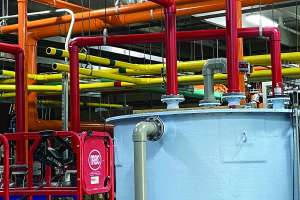
Dry- and wet-weather influent pumping stations are equipped with Flygt - a Xylem brand pumps. At the plant the headworks includes Fairfield dry- and wet-weather bar racks; the grit system was supplied by Schreiber (Parkson Corp.).
The city has about 100 miles of sewers, half of the system combined. Team members make sure they’re doing everything they can to handle increasing flows, but when the storm flow gets too high they capture as much of the solids load as possible in a swirl separator and add sodium hypochlorite as a strong oxidizer. “Ninety-eight percent of the time, every drop that comes into our Main Plant passes through our entire biological system,” says Dow.
The North and East plants discharge to the Winooski River, a tributary to Lake Champlain, an important recreational and surface water source for upstate New York, Vermont, and Canada. It is often referred to as the sixth Great Lake. The Main plant discharges directly into the lake.
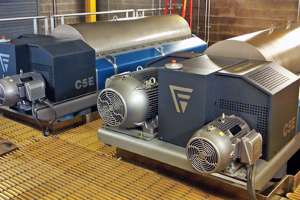
The Burlington utility is exploring the potential of turning the East Plant into a pump station and consolidating flow from that sewershed with the flow to the Main Plant. Solids from all three plants and from two small contract communities are dewatered on belt presses (Alfa Laval) at the Main Plant and then hauled to a lime stabilization operation in New York state where the biosolids are used to make fertilizer for farmers whose soil is lacking in phosphorus.
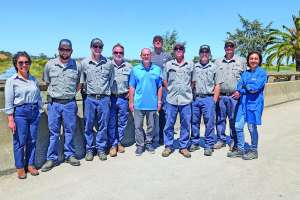
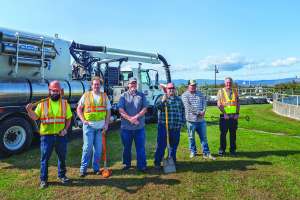
Each plant has its own staff, and the group shares three mechanics across all plants and the pump stations. Dow is proud of the way his team members work together.
“One thing to note is how well our staff supports each other,” he observes. “When there are problems or someone needs assistance, our staff always steps up. That can be during working hours, on nights and weekends or holidays. The respect they have for each other is amazing to see and a culture we want to nurture as much as possible.”
Some of that can be attributed to Dow’s open and cooperative management style that doesn’t insist on inflexible procedures: “It’s something I’ve learned. If something comes up at the last minute, it doesn’t matter. I want to be always there for you. It’s ‘Let’s see what we can do realistically,’ rather than dot all the I’s and cross all the T’s. I want to support you and make you feel valued.”
Dow emphasizes that wastewater operators, like many city workers, are “immensely important for our society, while the vast majority of the public doesn’t understand that importance. If we are doing our job well, it’s status quo. When we have issues, that’s when they know we exist. When there are issues, the general public only sees the negative.”
He is proud of the way his staff responded during the COVID pandemic. The wastewater group took on epidemiology sampling to look for COVID hot spots within the city.
“Our staff had to go out in the winter and deploy samplers in various legs of the collection system to isolate different sections of the city,” Dow remembers. “There were a few times when our sampling picked up higher signals in areas with vulnerable populations.” The effort helped the city identify COVID cases sooner than the normal procedures would have.
Nathan Lavallee, manager of the North and East plants for the last seven years, says Dow is great to work for and employs a trusting management style: “He’s always eager to help, especially with new people. He’s not the kind who’s always hovering or breathing down your neck. We get things done.”
Cale Whitcomb, senior operator at the Main plant, concurs. “Matt is able to step back and trust staff to make day-to-day decisions,” he says. “That being said, when asked for assistance with an issue around the plant or procedure, he is willing and excited to get his hands dirty and lend a hand. He’s a great guy who cares about his staff. He’s willing to hear our ideas and gives honest feedback.”
Megan Moir, division director of water resources and Dow’s boss, sings his praises: “Shortly after I took over as division director, the chief of Main Plant left. I don’t remember how much Matt and I had worked together before that, but I had seen the spark in him — someone who cared deeply, loved to problem-solve and was a systems-level thinker.
“Matt was the chief of the East Plant at the time. While it took a little convincing to get him to take over all the plants, it was one of the best decisions I have made in my eight years holding this position.”
Dow says his organization sees the need for more staff to meet current and anticipated demands. “We currently have three open positions with another opening up in a few weeks,” he said back in June. “We see light at the end of the tunnel, but this is one of our challenges. We have received support from our city as we have grown some of the positions in the last 10 years, but more are likely needed in the future.”
As of last year, the team was working toward a reorganization to create a collection systems team: the pump station and collection system crews would tag-team collection system preventative maintenance and pump stations duties. “The North and East operators will combine to run those two plants, as those plants are similar in design,” Dow adds.
Looking ahead, Dow sees his greatest challenge as a much-needed facilities upgrade. The plants haven’t been overhauled in more than 30 years, and the city needs to plan for the future of these assets. “We have a group of people who want to make it better,” he says. “To provide better treatment, to set up the utility for success in the future, to provide a well-thought-out operational design for those who are doing the work.
“We have the opportunity to really protect and improve water quality for Burlington, but it will be costly and we need to communicate the importance and the need for this to the ratepayers.”
That is not easy: “Trying to help the public understand the importance of these investments can be challenging, as it can be hard to reach them. We have a daunting task ahead of us with the education piece and then getting through an upgrade, but we are ready for the challenge.”
His dad, who passed away 17 years ago, would be proud.