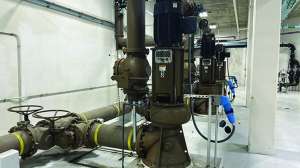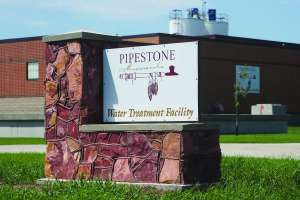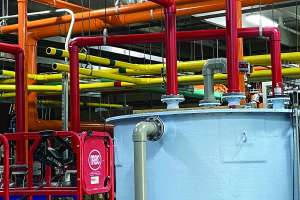
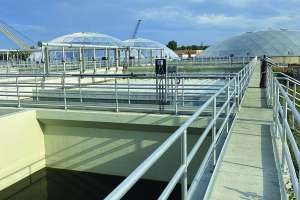
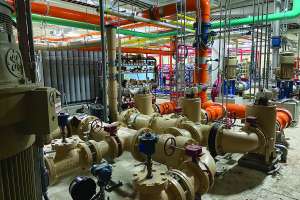
A major upgrade and expansion of the Fargo Regional Water Reclamation Facility included extensive protective coating for critical infrastructure.
The $124 million project, made necessary by population growth and a dedication to watershed quality and clean water, is more than doubling treatment capacity to 30 mgd. “The scale is massive,” says Mark Miller, wastewater utility superintendent for Fargo, on North Dakota’s eastern border. “This is a once-in-a-career project. We’re not just building for today. It’s an opportunity to safeguard the future.”
For the use of advanced protective coatings on concrete structures and piping, the project received top billing in the 2023 Sherwin-Williams Impact Awards, recognizing exceptional projects that feature high-performance coating and lining materials.
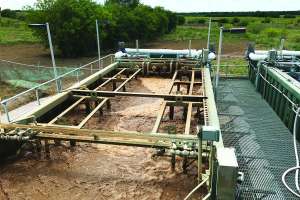
The multiyear project includes significant concrete for a large-scale integrated fixed-film activated sludge building and other structures. It also includes rehabilitation of existing facilities, significant excavations and extensive piping for an expanded headworks.
The plant, serving a population of more than 180,000, is fed by a collection system with 67 lift stations. Secondary treated effluent is UV disinfected before release to the Red River or delivery to stabilization ponds. Nutrient reduction is crucial.
Keeping key stakeholders aligned has been essential to the project. When plans fell through to use coatings from the supplier on the specifications, the applicator — Fargo-based Protech Contracting Services — turned to Sherwin-Williams Protective & Marine.
The switch to the new provider was seamless, according to Miller. The coatings met the project’s standards for reliability, compatibility and availability, keys to staying on schedule and minimizing disruptions.
“It wasn’t just about changing products,” says Dale Mulvaney, president of Protech. “It was about finding a solution that worked for everyone involved, while ensuring reliability and cost-effectiveness. We adapted to different specifications countless times. When the switch happened, we hit the ground running. There were no delays or hiccups.”
Throughout the project, Sherwin-Williams provided technical support to Protech to ensure that products were applied correctly. The support included on-site assistance and guidance on specifications and techniques. “Having a partner at the ready gives us confidence when taking on a project of this magnitude,” Mulvaney says.
The coordination was especially important given the project’s complexity. An intricate coating sequence, shaped by the demands of scheduling and space constraints, required ongoing collaboration with the general contractor PKG Contracting and the project engineer, Apex Engineering Group.
Together, the teams overcame challenges like managing multiple trades, adhering to tight schedules, adapting to shifting priorities and applying coatings without disrupting plant operations. “We knew that to find success, we needed to embrace careful planning together,” says Mulvaney.
The project involved coating surfaces including concrete, piping, equipment, walls and floors. Application techniques included hand-rolling for complex systems and confined spaces and high-pressure airless spraying for larger areas.
“In every infrastructure project, the details matter, and the right protective coatings are central to the durability and success of this one,” said Mulvaney. “The right coatings ensure the facility’s long-term performance and sustainability.”
To enhance nonslip properties on floors with heavy traffic and abrasion, the project team used broadcasting and back-rolling techniques, incorporating sand into the mid-coat and topcoat. This ensured a robust, durable and safe surface suitable for harsh environments, easy cleaning and chemical resistance.
In the IFAS facility, applicators mainly in four-person teams coated the top seven feet of the aerobic tanks exposed to gases with Dura-Plate 2300 as a base and Dura-Plate 6000 as a topcoat. The dual layers provide strong protection against chemical exposure, corrosion and leakage.
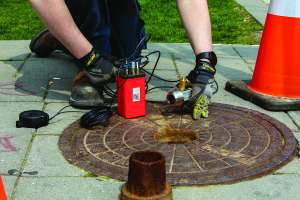
Applicators also treated the return activated sludge splitter box, the IFAS splitter box, the wet well in the implant waste pump station, the valve vault, and several manholes with high-pressure-sprayed Dura-Plate 6000 over mortar-sprayed Dura-Plate 2300. They manually applied coatings for smaller or hard-to-reach structures, minimizing containment and cleanup.
For outdoor basins and other concrete exposed to hydrogen sulfide gas, chemicals and abrasion, Protech used a multilayer coating system of a primer and Sher-Glass FF (a glass flake-reinforced epoxy) as a mid-coat, plus a urethane topcoat for visible areas.
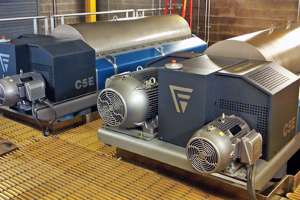
For general piping not exposed to gases, Macropoxy 646 epoxy with a urethane topcoat provided comprehensive protection against corrosion and chemical exposure. Protech blasted new and existing concrete surfaces to ensure proper coating adhesion. For external surfaces exposed to UV light, such as motors and outdoor equipment, the team selected Hi-Solids Polyurethane 250 for durability, gloss and color retention, serving as a heavy-duty maintenance layer.
For metal and fiberglass surfaces like tanks and ducting, Corothane Mio-Zinc Primer, Macropoxy 646 and Acrolon Ultra were used for corrosion resistance, UV protection and aesthetic enhancement.
“We needed coatings that last long, delaying the next maintenance cycle and extending asset longevity,” says Mulvaney.
By doubling the facility’s capacity, the city now meets or outperforms effluent permit limits. The enhanced treatment process cuts ammonia nitrogen by 30% and phosphorus by 80% in wastewater discharged to the Red River.
“Our effluent numbers have never been better,” says Miller. “The quality of the treated water we’re releasing is exceptionally high. We’re removing more waste before it reaches the river, which improves overall water quality and protects the watershed.”
Mulvaney adds, “We take great pride in playing a role in helping make clean water more accessible and improving how wastewater is processed. The coatings will ensure that this vital infrastructure stands the test of time.”
While the majority of major components are complete, construction will continue until its final phase concludes in 2025. The project stands out for its scale and for meticulous coordination, thoughtful coatings, product selection and expert application. As Fargo grows, the expansion and upgrade will enhance operational resilience, crucial to supporting the city’s environmental and public health needs.
“Coatings play a significant part in the work we do to improve quality of life in our region,” says Miller. “They’re more than just a protective layer. They represent a long-term commitment to the community, ensuring that our infrastructure remains strong and reliable for years to come.”
About the author
Paul Trautmann (Paul.Trautmann@sherwin.com) is marketing director for water and wastewater with Sherwin-Williams Protective & Marine.