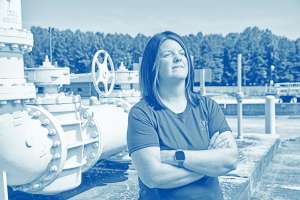
Joel Adelman is the water and wastewater supervisor in a small town where the water utility is a big deal.
Most water and wastewater systems operate almost invisibly. In Pipestone, Minnesota, the water system is front and center and in fact a tourist attraction. A city water tower is on the National Register of Historic Places, and in late June every year, it’s celebrated in a three-day Water Tower Festival, complete with a parade and street dance.
The 132-foot-tall concrete tower, designed by L.P. Wolf, was completed in 1921. Although it no longer functions, it was restored in 1990 and remains one of Pipestone’s claims to fame. The city also has a new award-winning water treatment plant that Adelman helped design and build.
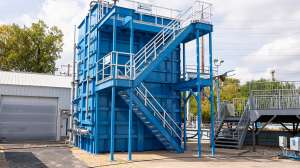
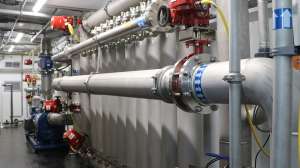
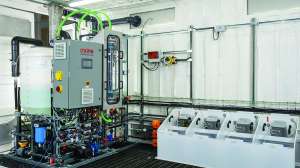
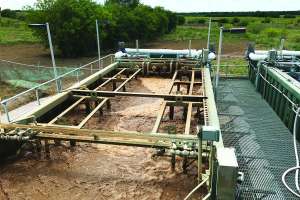
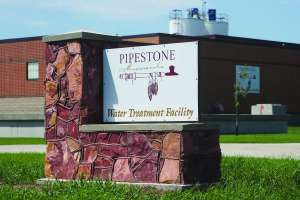
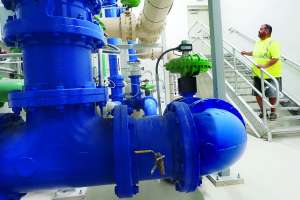
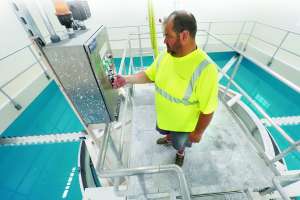
Completed in 2019, the plant received an Aquarius Award from the U.S. EPA for its innovative approach to jointly addressing drinking water and wastewater issues through drinking water treatment.
The city (population 4,000) is near the Pipestone National Monument, named for the red quartzite stone that Indigenous people have used for thousands of years to make ceremonial pipes. The city has five wells, all drilled deep into rock, and the water from those wells is high in dissolved minerals.
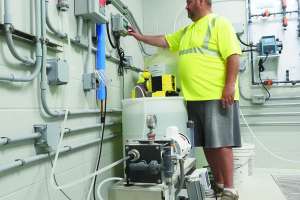
“We had high gross alpha and radium levels in the water, and we were exceeding our threshold on that,” says Adelman. “And then on the wastewater side, chloride was an issue. To meet the limits, the city constructed a new lime-softening plant.
“All our wells come to our new plant, and by softening the water in-house, we knocked the wastewater chlorides down because homeowners could use less water softener salt. Our water is really hard here. It’s about 40 to 42 grains hard coming out of the wells, and what is considered soft water is 0 to 3 grains.”
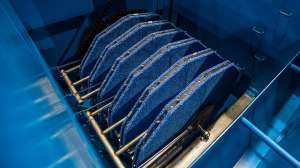
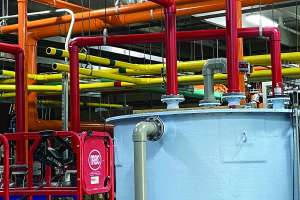
The new treatment plant uses lime to precipitate out the minerals along with the gross alpha and radium. “By the time it leaves here, we’re down to about 5 to 6 grains hard,” Adelman says.
When the plant went online, the city paid plumbers to help adjust customers’ water softeners for the new lower level of hardness. “We told them that it’s softer, but it’s not considered soft water,” says Adelman. "We advised people to shut their softener off for a period of time and then see if they could adjust to the water quality. Quite a few of them kept the softeners, and quite a few had their softeners removed because they were OK with the water.”
The change has made a big difference in the chloride in the wastewater ponds. “We were up over 300 mg/L of salt coming to our wastewater system, and we have to be under 297 to discharge to our ponds,” Adelman says. “Right now, we are at 230 on average for 2024. I’ve been monitoring the raw sewage, and on the influent coming to the ponds, we’re averaging about 163.”
Softening wasn’t the only option Pipestone considered. Another was a reverse osmosis plant. “The problem with RO is we just don’t have the capacity at our wastewater plant to handle the reject water,” Adelman says. “So we had to go with softening,”
The water treatment plant produces an average of 400,000 to 500,000 gpd. The wastewater treatment system, which consists of a series of six ponds, handles about the same volume. The city can discharge from the ponds into an unnamed creek during two periods a year, late spring and early fall. The capacity issues are the result of inflow and infiltration.
“We’re getting excessive groundwater in the sewer system on rain events,” Adelman says. “The city has been working for the last 15 to 30 years to replace sewer pipes and other infrastructure. Since 2004, we’ve spent about a million dollars a year on infrastructure. Sometimes that means eight to 10 blocks in a year, sometimes three or four. We’re not doing just the underground infrastructure. We’re replacing the street, curbs and gutters, and sidewalks as well.”
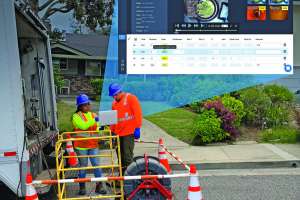
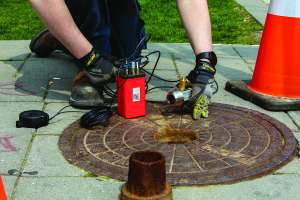
To help find problem areas, Pipestone has done extensive televising of the sewer system as well as smoke testing and dye testing. In one problem area, the city temporarily capped off the storm sewer main and filled it with dyed water.
“It was pretty educational to watch all the dyed water come through over into the sanitary sewer,” says Adelman. “The storm line was leaking out of the joints, and the water found its way through the dirt into the sanitary lines. We actually could watch the storm line water level drop and watch the water level rise in the sanitary line. Both lines were replaced."
Adelman, who has been supervisor in Pipestone since 2004, can see improvements from all the repairs but he would like to see a lot more progress: “We average about 400,000 to 500,000 gpd on the wastewater side, and on a 2- to 3-inch rain I’ve seen it go to upwards of a million to a million and a half.”
The city has already expanded its pond system once. In 2011, Pipestone was placed under a sewer connection moratorium until the I&I problems were solved or treatment capacity was added. The city bought land next to the existing ponds and added two more. Now it has six 20- to 25-acre ponds, five of which are 6 feet deep and the other 7 feet deep.
On the drinking water side, Pipestone won a 2023 Dave Neiman Source Water Protection Award from the Minnesota Department of Health and the Minnesota Rural Water Association.
The award recognized the city’s efforts to protect its water source by connecting homes that had failing septic systems to the municipal sewer. The utility also sealed a private well that was in a high vulnerability area of the watershed and connected that customer to city water.
Pipestone also joined the Minnesota Department of Natural Resources in an aquifer monitoring project to determine whether draw-down from two of the city’s deep wells was affecting the level of a lake. Two years of study concluded that the answer was no, but the monitoring equipment is still in place and generating data.
In addition, with help from the Bolton & Menk and Leonard Rice Associates consulting engineering firms, Pipestone developed a wellhead protection program following the requirements of the Minnesota Department of Health.
Part of that effort is distributing information to farmers about the potential effects of excessive chemical and fertilizer use on the watersheds. The plan also identified properties with failing septic systems that should be connected to city sewers and abandoned wells that are not sealed.
Adelman grew up in Dawson, a small Minnesota town about 75 miles north of Pipestone. After high school he studied water and wastewater treatment at St. Cloud Technical College; within a year, he had Class D water and wastewater treatment licenses. He now holds Class B Water Operator and Class C Wastewater Operator certifications.
His first job was in Pipestone with the People’s Service contracting firm. He worked there as a water and wastewater operator for a few years and then was transferred to Tracy, Minnesota, in the same role. In 2004 he returned to Pipestone as a municipal team member.
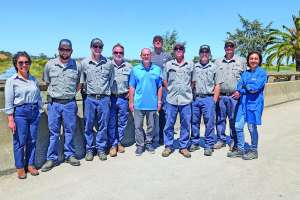
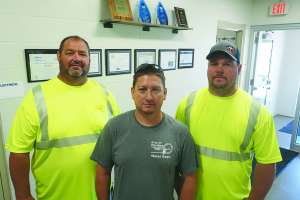
In his current roles as superintendent, Adelman leads a team that includes foreman Justin Powers, technician Tyler Hughes, and operator Dave Swenson, plus a couple of part-time summer helpers. In addition to the treatment facilities, they operate a system of 35 miles storm and sanitary sewers, plus 16 lift stations with pumps from Myers (Pentair) and Flygt - a Xylem Brand.
Adelman lives in Pipestone with wife Shannon, daughter Kaitlyn, 16, and son Parker, 13. “It’s a good community to live in, and I’ve enjoyed the challenges and the different things that I’ve had to deal with here. The city has made great progress in our utilities and our treatment processes through the years.”
Adelman says Pipestone has achieved things that he didn’t expect, such as winning the source water protection award and the Aquarius Award for the new treatment plant, but he hasn’t yet achieved the goal he had since he became superintendent.
“The big goal for me is to get an award for the wastewater system,” he says. “Because of our I&I issues, we’re close, but we’re just not there yet. That’s definitely still a goal in sight.”