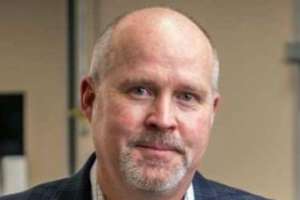
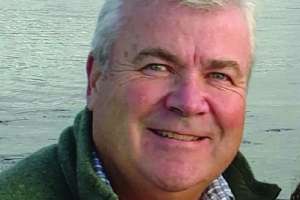
Hank Trent embodies an old adage: Do something you love and you’ll be good at it.
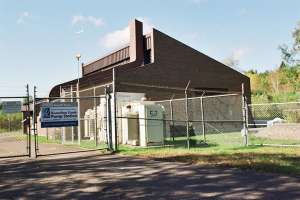
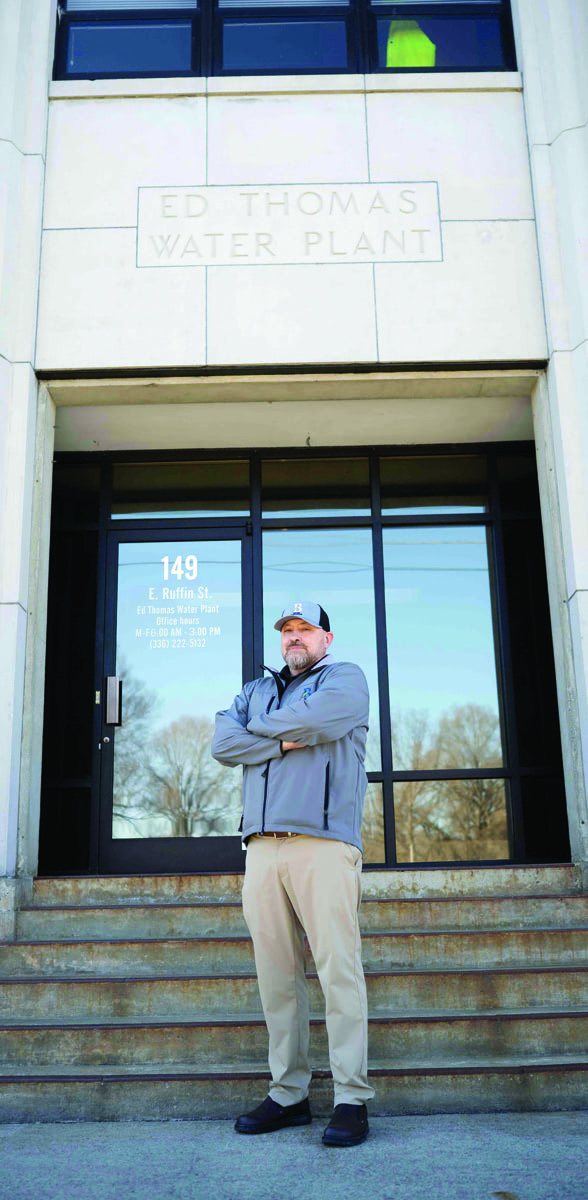
Trent gave up a career in criminal justice, discovered water treatment and made it a calling. Today he’s superintendent of the Ed Thomas Water Treatment Plant in Burlington, North Carolina, and operator in responsible charge at the plant and the city’s JD Mackintosh Water Treatment Plant.
“I saw a newspaper ad for a water operator, and it sounded interesting,” Trent recalls. “When I applied and checked out the plant, it was amazing. I started working there, and I took to it like a fish in water. I don’t know if it was my genetics or what, but I just loved it, and I still love it. It just seems like I’m made for this kind of work.”
His supervisor, Ben Bani, P.E., assistant water resources director, observes, “Hank has achieved sustainable improvements in the plant’s efficiency, focused on treatment optimization, technology integration, empowerment of team members and a commitment to continuous improvement.” Trent was named the 2025 Outstanding Operator of the Year by the North Carolina Waterworks Operators Association.
Military background
Trent was born in Ohio; his family moved to North Carolina while he was in high school. After serving in the U.S. Army Military Police, he pursued a criminal justice degree at a community college, but he found law enforcement unsatisfying: “You see the bad side of everybody, and it was weighing on my heart. I didn’t want to get stuck in that career. Once you go down a certain path, it can be hard to get off.”
He began his water career in 1995 as an operator in Sanford, North Carolina. In just three years he attained A-surface certification, the state’s highest level for water treatment facility operators, and advanced to chief operator. In 2002 he joined Burlington as a water treatment operator. He became a lead operator in 2005 and superintendent at the Thomas plant in 2008.
Burlington (population of 62,000) lies in the north-central part of North Carolina and supplies water to several neighboring cities and villages, including 2 mgd to Greensboro. Source water for the Mackintosh plant comes from 1,100-acre Lake Mackintosh; the Thomas Plant draws from 140-acre Stoney Creek Reservoir, supplemented by 760-acre Lake Cammock.
Challenging water
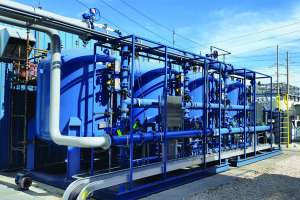
Both treatment plants use conventional processes. High reservoir manganese has historically challenged the 16 mg Ed Thomas plant. “It’s a smaller lake, and it heats up in summer,” Trent says. “Often when the water doesn’t flow, it goes stagnant and we get low dissolved oxygen in the lake. When we get low DO, manganese comes out from the sediment, and it was really bad to the point where we could barely treat it.

“We put an aeration system in the lake that has improved water quality dramatically. It has eight diffusers placed within about 12 acres near the intake. That keeps the lake churned so the surface water is always making contact with some oxygen. It gets the DO numbers up enough to make a big difference in dealing with the manganese.”
Turbidity was another issue: “After big rain events, we’ve had turbidities up to 160-170 NTU. When I started here, we weren’t able to run this plant after rainfalls. We’d shut it down.” Turbidities after settling at the plant approached 5 NTU.
The solution was to add FLOC AID cationic polymer. “It has dropped settled turbidities to where in most years we qualify for the Area-Wide Optimization Program Award,” Trent says. “Sometimes we joke that the settled turbidities are so low that we wouldn’t even need filters.” Filtered turbidity is as low as 0.03 NTU.
Automation moderation
Among other improvements, Trent installed baffle walls in the flash mixer to prevent short-circuiting and promote thorough and efficient chemical mixing. He built a powdered activated carbon feed system to reduce TOC and the formation of disinfection byproducts. He also enhanced automation, adding instruments crucial for process monitoring and control.

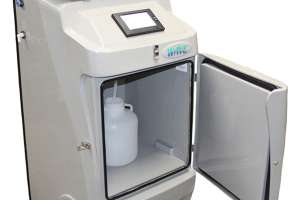
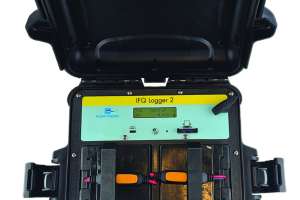
“We have a streaming current meter and Hach chlorine analyzers and turbidity meters,” says Trent. “We have a ChemScan (In-Situ) analyzer for monochloramine, total chlorine and free and total ammonia.” A ChemScan mini-analyzer monitors manganese after filtration, and another ChemScan unit detects TOC spikes that indicate poor filter washing. An Aqua TROLL device (also In-Situ) measures source water DO, pH, turbidity, conductivity and blue-green algae.
A SCADA system, VTScada by Trihedral, monitors plant functions, but process control remains partly manual: “The Sanford facility I came from was fully automated. Then whenever some automation went down, the operators were completely lost.
“When I came here it was the opposite: everything was purely manual. I like automation to eliminate busy work for operators, but I prefer that they still have to get their fingers in and understand how things function. Then in case something fails, we’re halfway there already.”
Learning culture
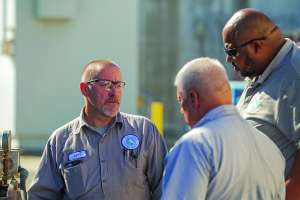
The team at the Ed Thomas plant includes Todd Hopkins and Ryan Green, lead operators; Troy Reeves, relief operator: Dave Rorer, Chris Dawson, Jonathan Williamson and Cliff King, plant operators; and Dalton Robertson and Darrell Scott, utility workers.

They’re challenged to keep an old plant running smoothly, one with equipment for which some replacement parts are no longer available and have to be custom-fabricated. A computerized maintenance management system (Hach JOB Cal) helps keep assets functioning.
Meanwhile, Trent strives to keep team members on a growth trajectory. “You bring people in as part of the team, get them involved and let them know they’re important. And then you give them some challenge. Even if they won’t admit it, people like to be challenged. They want to be able to accomplish something and get recognition for it.”
New team members need at least six months of on-the-job training before they can qualify as certified operators: “You find the diamonds in the rough. You work with them and set them up to succeed. I had somebody do that with me.”
That someone was Nathan Cotten, a lead operator while Trent was at Sanford: “He brought me on board and gave me a chance. After that, anything I needed or asked for, he was there. Even if I had to contact him in the middle of the night, he didn’t come in and complain. He just showed and explained.”
Reaching out
Beyond his own facilities, Trent is involved in the Water Supply Partners regional water management group, which besides Burlington includes representatives from Greensboro, Winston-Salem, Graham and several other communities. Members exchange expertise and guidance on water-related issues and promote public health.

Bani observes, “Hank has helped newer water managers troubleshoot or optimize treatment processes. He shares knowledge freely and has become a trusted resource for the group.”
Looking back, Trent takes pride in making what can be a difficult transition from military to civilian life and doing it without the benefit of a college degree. “Not having a degree forced me to work harder to prove myself,” he says. “A degree would have made things happen faster, but I’ve proven myself through other means. I’m proud of the improvements I’ve been involved in to make this a better facility.”
On the horizon is dealing with PFAS: “We recently completed studies on amounts of PFAS in our water and the possible sources. We’ve determined the treatment options for each of our water plants. We’re planning to do a design-build project, but it will be a few years before that process is up and running.”
In the meantime, he’s grateful for his team: “I’m proud of the work every one of these people put into this field. I’m privileged to have professional and motivated staff members who work together, leading to continuously successful outcomes. And my employer and superiors are incredible — they’ve given me the freedom and resources to have a successful career.”