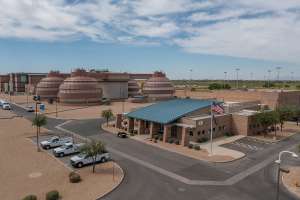
The Mesa Water Resources Department likes to keep its water in the ground.
“We consider groundwater nonrenewable, because in most cases, once you pump it from the aquifer, you can’t always recharge it very easily,” says Chris Hassert, water resources director. “We call surface water renewable because those reservoirs drain and fill and drain and fill.
“Going back to the 1980s, more than 70% of what we served our customers was groundwater. Now we’ve reduced that to single digits. We’re in the 7-8% range in terms of what we serve our customers coming from groundwater. The rest is all surface water.”
That transformation required conservation as well as building and constantly expanding a portfolio of water resources. It’s one reason the Arizona city’s water department won the 2023 Sustainable Water Utility Management Award from the Association of Metropolitan Water Agencies.
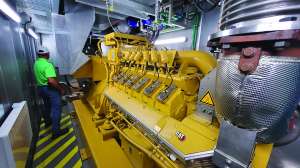
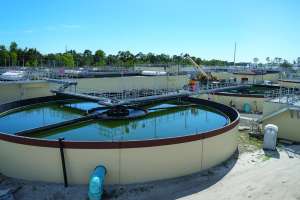
Mesa also constantly looks for ways to better use its wastewater treatment resources. Dissatisfied with the performance of the cogeneration system at its Northwest Water Reclamation Plant, the city has decided to scrub its biogas to pipeline quality for delivery to the municipal gas and electric utility and to fuel the city’s garbage trucks.
“There are all those synergies that really play into it,” Hassert says. “And then, just to build on that, we’re exploring a food waste processing facility, so we could supplement the digestion process and create more gas.”
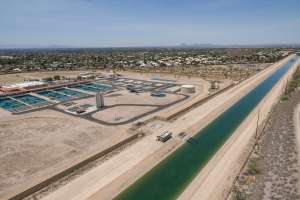
Mesa’s surface water comes from reservoirs on the Salt River and from the Central Arizona Project, a 335-mile canal that delivers water from the Colorado River. Several cities and tribes have entitlements to CAP water.
Mesa has increased its supply of CAP water by piping effluent from two water reclamation plants about 20 miles to the Gila River Indian Community, which uses the recycled water for agricultural irrigation. In return, the city receives rights to more Colorado River water.
“They’re not close to the CAP canal, so it’s a lot more convenient for them to take our recycled water than to build infrastructure to get Colorado River water,” says Hassert. “The exchange helps them because they get water right at their doorstep. It helps us, because we have two water treatment plants right on the canal. We treat that water and serve it to our customers.”
The exchange is at a 5-4 ratio. “For every 10 acre-feet of water we give them, we get eight,” Hassert says. “That’s because they’re giving us surface water, and we’re giving them recycled water. There’s that adjustment to make it more equitable.”
Construction is underway on a pipeline to connect a third wastewater treatment plant to the system that supplies the Gila River community. The effluent from that plant previously was used to recharge the aquifer through the Granite Reef Underground Storage Project, but that project has been closed because of flood damage.
“Most days we’re able to just recharge,” says Hassert. “We pipe the effluent to the recharge basins, and then we get long-term storage credits from that water. That’s basically banked underground. But because for the last couple of years it’s been very wet in Arizona, the water table is high, and the GRUSP has been closed. As a result, we divert that effluent to the Salt River, and don’t get any kind of credits for it. There’s no beneficial reuse.”
When the new pipeline is completed, Mesa will have two options for beneficial use of the plant effluent: Pipe it to a recharge basin or pipe it to be used for agriculture. “Preferably, we will just pipe that in with the other two plants and deliver all that water to the Gila River Indian Community,” Hassert says.
Mesa is in the unusual situation of wanting both to conserve water and to increase the volume of wastewater it treats: Beneficially used effluent can be exchanged for more water rights. To encourage conservation, Mesa gives property owners cash incentives for replacing turf with more desert-appropriate landscaping.
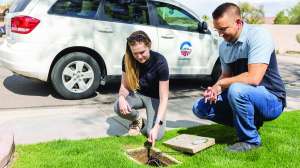
The city also has a robust pipe inspection program. “We take our large mains out of service a portion of the city at a time and do inspections,” says Hassert. “We repair defects and address leaks. In 2023 we had a 4.5% water loss. We have a good leak detection program. It’s something that you just have to do.”
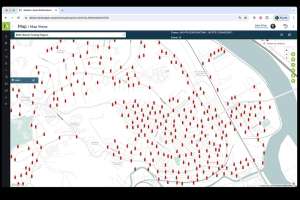
Mesa is in the early stages of converting to advanced metering infrastructure (Sensus) that will enable the Water Resources Department to get meter readings multiple times a day instead of once or twice a month. In the test phase, 1,000 homes were fitted with new smart meters, and right away the utility found three cases where the meters were never shutting off.
“That tells you there’s a leak somewhere on the property, either in the house or in the yard,” says Hassert. “In all three cases, it was subtle enough where there wasn’t water gushing out of the ground, but it could amount to 20,000 to 30,000 gallons a month. When we project forward for our whole system, we feel strongly we’re going to save up to 2 mgd of water that would be lost through leaks on people’s property.”
Although Mesa actively pursues conservation, some reductions in water demand have been outside the Water Resources Department’s control. For example, in the late 1990s, the plumbing code changed to require water-efficient toilets and other appliances. Developing irrigated farmland for residential and commercial use also tends to reduce demand.
Mesa has three wastewater treatment plants, but a portion of its wastewater goes to a reclamation plant west of Phoenix owned by Mesa and four other cities. Most of that plant’s effluent is used for cooling at the Palo Verde Nuclear Power Plant; some is used to create a wetland called Tres Rios.
Hassert observes, “We’re at the table with Phoenix and multiple other stakeholders to capture the effluent that does not go to the nuclear plant or the wetland — effluent that just goes down the river. We would take that and apply technologies like reverse osmosis, ozone and UV to where, in the eyes of the state of Arizona, it is pure enough to be used for drinking water.”
The water from that advanced purification project could be blended with Phoenix’s drinking water supply, and other cities in the project could work out exchange agreements for their shares. Mesa and other nearby cities are also exploring a project to enlarge the dam on the Verde River at Bartlett Lake.
“There are numerous stakeholders going into the feasibility study to build a new dam that’s about 100 feet taller and would substantially increase the size of that reservoir,” Hassert says. “All the stakeholders, including Mesa, would have to pay a portion of the cost, but then we would share in that new water source.”
Mesa is also looking to build its portfolio with much smaller measures, such as exploring the potential of sewering select areas with aging septic systems. That could create more wastewater and more effluent to be stored underground or traded for surface water.
“It’s not low-hanging fruit, but it’s on our radar,” Hassert says. “The more straightforward ways to grow our portfolio, other than maximizing the exchange agreement, would be to stay at the table with the Bartlett Dam project, and with Phoenix and other communities talking about advanced purification. Those are better areas to set our sights on.”