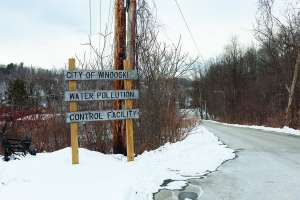

The Winooski Wastewater Treatment Facility has come a long way in the past three decades.
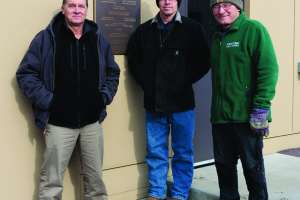
First commissioned in 1972, it has seen a number of upgrades since 1994, most of them completed in-house and without bond issues. That home-grown approach remains part of the capital improvement strategy for John Choate, utilities manager, and operators Brian Line and Tim Grover.
Together, with help from new hire Brian Giroux, they bring nearly a century of industry experience to bear on the clean-water plant and collection system, a 20-mile drinking water distribution network, and the stormwater management system in their Vermont community of about 8,500 residents.
It’s a lot to handle for a four-member crew, but Choate treats it with humility: “I don’t think it’s dissimilar to a lot of municipalities. It’s just done with a shoestring budget and a small staff. We try to only have a 4-5% rate increase annually to keep up with the technology.”
The Green Mountain Water Environment Association is less inclined to treat the accomplishments as routine: It recognized the clean-water plant (1.4 mgd design, 0.7 mgd average) with a 2022 Facility Excellence – Wastewater Award.
A little at a time
The Winooski plant uses an activated sludge extended aeration process. Chemical and biological phosphorus removal combine to meet a rigorous permit requirement equivalent to 0.2 mg/L. “The plant puts out effluent at 1-2 mg/L BOD and TSS,” says Choate. “People are amazed at the quality of water leaving this plant day in and day out.”
The experienced team certainly helps. Choate came to Winooski just eight years ago but has 40 years of industry background, all in Vermont, that includes management roles in Burlington and Hartford, along with a decade as a contract operator with Simon Operation Services. “I’ve operated probably 20 wastewater treatment plants and more than a hundred small water systems throughout the state,” he reports.
Grover, also with 40 years in the industry, entered the field by working at an industrial wastewater facility and then at a small ski area. The majority of his career has been with Winooski (19 years) and the neighboring city of Burlington. Line has spent his entire 18-year clean-water career with Winooski, his hometown.
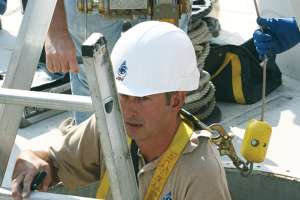
Line and Grover handle day-to-day duties; Choate fills in as needed. Giroux takes care of the drinking water system and is learning the stormwater side. All have CDLs to drive the city’s trucks.
“As operators we do regular maintenance of everything at the plant,” says Line. “That includes weekly greasing and oil changes on equipment and scheduled tank draining and inspections. We are proactive, not reactive. The four of us have helped each other continue to produce an impressive-quality effluent and to help improve this little city.”
Steady progress
Upgrades to the clean-water plant began in earnest in 1994-95, when the disinfection process was converted from chlorine gas to liquid sodium hypochlorite. In addition, a standby generator was installed, and the aeration basins and aerobic digesters were outfitted with fine-bubble diffusers (Sanitaire - a Xylem brand).
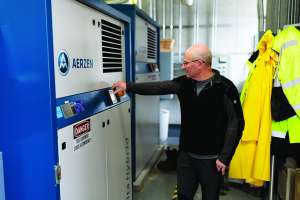
Some smaller upgrades including new clarifiers and return activated sludge pumps were completed later in the 1990s. In 2018-19, older 75 hp centrifugal blowers were replaced with 75 hp and 100 hp Aerzen hybrid blowers with variable-frequency drives, and a 150 kW natural gas standby generator replaced the original 60 kW diesel unit.
In 2020, as a previous bond issue was retired, the community bonded for a $1.2 million headworks upgrade that replaced manual bar racks and an old grit system with a 1/4-inch bar screen and wash press (HUBER Technology) and a PISTA grit chamber (Smith & Loveless).
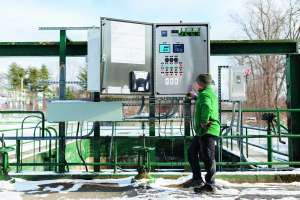
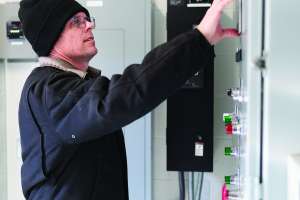
“Right now the plant is pretty well into the 21st century,” Choate says. “We have the (Allen-Bradley) SCADA system (Rockwell Automation) modulating our aeration equipment via sensors for automated control based on dissolved oxygen. We’ve tried to work with the tankage we have, and being an extended air facility we have a fair amount of tankage. We’ve upgraded as we went along so as to minimize new debt.”
Protecting the river
The plant’s treatment process helps protect the Winooski River, which separates its namesake city from Burlington. It flows to Lake Champlain and is a high-quality fishery with salmon, walleye and lake sturgeon.
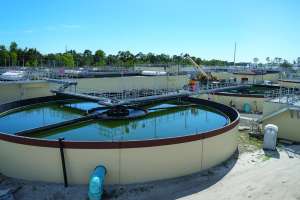
Grover states, “The town is on a hill so we are basically all gravity flow to the plant.” After the bar screen and grit chamber, influent goes directly to the aeration process, which includes eight basins holding 149,000 gallons each. Five basins operate at any given time.
A measure of biological phosphorus removal is accomplished by using timers to cycle the blowers off for 30 to 45 minutes at intervals of about two hours. (This strategy was meant to support nitrification and denitrification but also helps with phosphorus removal.)
Choate observes, “At the end of the process we add sodium aluminate to make sure the phosphorus is below the permit limit. Chemical phosphorus removal is really what we use, but we get a fair amount of biological removal by doing aeration control.”
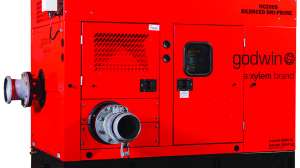
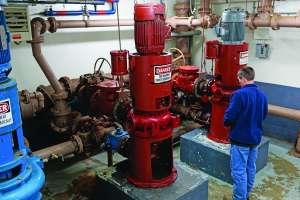
After aeration the flow passes to two secondary clarifiers (WesTech Engineering). Hayward Gordon pumps return activated sludge to the basins. After disinfection the effluent is released to the river. Waste activated sludge is sent to two aerobic digesters.
“A couple of our aeration tanks can be set up to store sludge if we need to, but we normally don’t,” says Grover. “To thicken the sludge we turn off the air to the digesters, let it settle for a day or two, and then decant.” Plant team members haul the thickened material at 2-3% solids to Burlington for dewatering. It is ultimately sent to a Casella Waste Systems facility for final processing and application to The Grasslands in upstate New York.
Team members handle all laboratory testing for parameters including TSS, E. coli, phosphorus, nitrogen, solids settling, pH and dissolved oxygen. Exceptions are BOD and less-frequent specialized tests such as priority pollutant scans and whole effluent toxicity testing.
On the industrial side, a city ordinance has been rewritten with stronger language to address the discharges of high-strength wastes and grease. “A stronger permitting process with high-strength waste surcharges helps limit industry discharges and brewery waste,” Choate observes.
Old piping
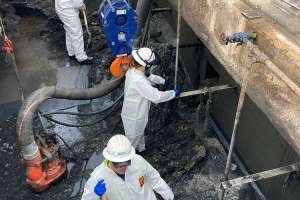
Delivering wastewater to the treatment plant is a 20-mile collection system built mostly in the late 1800s and early 1900s. Given the age of the manholes and mostly clay piping, infiltration & inflow is significant. Line leads collection system operations and runs the city’s Vactor flushing and vacuum truck.
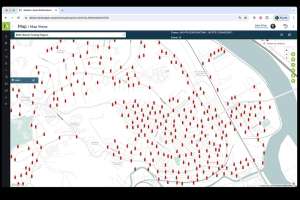
About one-fourth of the collection system is cleaned each year, and about one-fourth is also inspected using a trailer-mounted CCTV system and crawler camera (Envirosight). “Annually, we dedicate a couple hundred thousand dollars of our budget to CIPP lining and manhole repair,” says Choate.
About 600 to 800 feet of slip lining is contracted each year, and about eight miles of the system has been lined so far. Manhole rehabilitation includes replacement of the lid and frame and spraying of the brick structure with cementitious material.
Inflow from homes and commercial buildings is a meaningful source of wet-weather flow to the sewer system. “Many homes are the same age as the sewers,” says Choate. “We have a program where we determine whether there’s a sump pump plumbed into the sewer system.
“We help the owners financially to remove that connection and put the water into the storm drain. We pick the worst of the worst each year and work with the homeowners to get that separated.” Similarly, the team works with owners of older commercial buildings to disconnect roof drains from the sewer systems.
Rising waters
Rain events are a growing concern in Winooski as the climate changes. Tropical Storm Irene in 2011 threatened the treatment plant, and in heavy rains during July 2023, “We were literally an inch from flooding,” Choate recalls. “We built all kinds of tarping and dirt berms around sensitive outdoor equipment and the buildings.
“It’s not raging water that we’re affected by. It’s slowly rising river water. Flood mitigation is becoming a necessary expense. We’re going to focus on that in the very near future, essentially surrounding our sensitive tanks that are at a little bit lower elevation. We’ll be taking some Vermont redneck approaches to flood control.”
Plans include surrounding the aeration basins and the chlorine contact tanks with metal plates about 18 inches high, affixed to the railing systems. The treatment plant building will be outfitted with floodproof doors.
Looking farther ahead, Choate sees the prospect of new regulations related to PFAS: “We’re always needing to react to EPA mandates.” In his unassuming manner, he adds, “We do what we can with what we have.”
A hundred years of experience and unfailing dedication can do quite a lot.