
Artificial intelligence is suddenly everywhere in society. It’s in everything from industrial processes to writing and publishing, from banking to education.
The water and wastewater sector is not immune, and in contemplating AI plant operators understandably wonder: Will digital technology take over my job? The answer for the foreseeable future is emphatically no.
That’s according to two researchers working on projects that involve using AI to improve process performance in clean-water plants. In particular, the Jacobs engineering firm has developed and is testing an AI software tool for nutrient control as part of a project funded by The Water Research Foundation.
Jacobs has deployed the tool, designed to leverage advanced modeling techniques and machine learning, at three large treatment facilities. As this edition of Treatment Plant Operator went to press, the researchers were finalizing their report.
Bruce Johnson, a process engineer with Jacobs, is the principal investigator on the project, “Development of Innovative Predictive Control Strategies for Nutrient Removal” (WRF 5121). He and Jeff Moeller, P.E., a research unit leader with the Water Research Foundation, talked about the project in an interview with TPO.
TPO: How would you describe the opportunity for AI in wastewater treatment?
Johnson: Almost every wastewater treatment plant that I have been to has more data than its operations team can use effectively in a time-relevant manner. To do so, they would have to integrate numerous pieces of information from a number of sources. The digital tools and machine learning that we are using are focused on getting more value out of that data, giving operations staffs more insight and improved capability. It’s about extracting value from plants that is already there, but has not been tapped.
TPO: In the big picture, how would you describe the benefits of AI in these settings?
Moeller: A term in current use in the industry is process intensification. That means doing more with less: improving treatment but with less chemicals, less energy, a smaller footprint and lower cost, all while improving effluent quality. Machine learning and AI can help facilities do that, in many or most cases without having to build expensive new infrastructure. Instead they can use the data they have in a smarter way to manage the treatment process.
TPO: How specifically can AI have an impact on effluent nitrogen and phosphorus?
Johnson: In the plant, AI can look at the data and the performance of the system and recommend better or more reliable settings. Often, operators value stability in effluent results almost as much as compliance. In addition, machine learning tools can forecast what is coming into the plant based on historical patterns, so that operators can think proactively instead of just reacting to what they see. Around nutrients, for example, they could be aware that ammonia is predicted to have a higher load tomorrow, and then adjust treatment to avoid problems.
TPO: Is there a simple way to describe how machine learning tools function?
Johnson: They are like a well-trained dog, such as a seeing-eye dog. You train this dog on all kinds of situations, and that dog becomes really good at helping you do what you need to do. It’s similar with machine learning.
TPO: What are the typical approaches to deploying these technologies?
Johnson: There are basically two ways. Hampton Roads Sanitation District, for example, is building machine learning within the SCADA system and is using it as an enhancement for traditional PID control loops where those loops are insufficient to meet the treatment/control objective. The other approach is a little more complex. Many machine learning tools require a level of expertise to use that most facilities don’t have. So that can mean off-site cloud computing. The way we’ve implemented this in my work project is to advise operators once per day to say, for example, “We think the setpoint in your bioreactor system should be here.” Then the operator can agree or disagree. In a way it’s like Google Maps, which gives you a route and tells you the turns to take. If you know a better way, you can ignore the advice and do what you think is right. That’s how advice from the cloud is implemented in most facilities today.
TPO: How important is the human side of AI and machine learning?
Johnson: The people side is huge. I recently attended a worldwide modeling conference where there were two sections on AI and digital twins. Normally this is a very technical group, but the whole discussion was about people and how to think about the adoption of these tools. These are operations tools, and we have to deploy them in ways that make life better for the front- line staff. We need to avoid getting in their way and adding stress to the workload issues they are facing.
TPO: How would you characterize the importance of operators in the process?
Moeller: Operators have a really important role to play. It’s critical for them to be engaged — to understand what the machine learning tools are doing, what information they’re providing, and how it can be applied. Without the operators’ buy-in to these efforts, they won’t work. Another aspect on the people side is that implementing these tools requires a cross-disciplinary approach. It requires wastewater process engineers who understand how the process works, along with data scientists and machine learning experts who know how to employ the tools.
TPO: What is the role of instrumentation in putting these tools to work?
Johnson: That varies depending on the approach being taken. A focus on pure machine learning requires good instrumentation and relatively large datasets. On the other side is a hybrid approach that combines machine learning with mechanistic modeling. In that setting there is something called a soft sensor, as opposed to a hard sensor, which is an instrument. A soft sensor is the equivalent of an instrument, but it is software that doesn’t need an instrument at the location.
TPO: How does a soft sensor function?
Johnson: You can think of it as being like a skilled operator. If something goes astray at a plant, an experienced operator will usually have an idea what went on before, or where something might have gone on in the system. We can now do similar things with our models and machine learning tools. Based on what is happening at three places in the plant, we can estimate what must be going on at a different place. Some of these tools can make it possible to actually remove instrumentation from a facility while still improving efficiency.
TPO: How is the nutrient-control project structured?
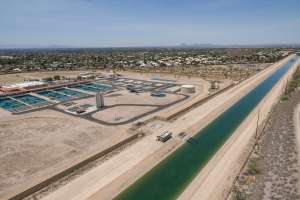
Johnson: We are piloting the tools at three facilities, each with different goals. We’re using the hybrid approach where we combine the best of machine learning and mechanistic modeling to provide advisory recommendations to the staff. At the Clean Water Services Durham Water Resource Recycling Facility in Oregon, we’re focused on phosphorus reduction. At the Agua Nueva Water Reclamation Facility in Tucson, Arizona, the goal is ammonia compliance and energy reduction. At the AlexRenew Wastewater Treatment Plant in Alexandria, Virginia, the focus is on total nitrogen removal.
TPO: What results have the pilot tests delivered?
Johnson: At Clean Water Services it appears that the tool is giving good recommendations so that the operators can keep phosphorus removal predictable and stable. At Agua Nueva, by using the recommendations, they are saving about $300,000 a year while treating about 28 mgd. At AlexRenew, it appears that we’ve reduced influent variability by about 30%, which can help stabilize nutrient removal. All three facilities have shown interest in keeping the projects going.
TPO: Beyond nutrient control, what applications exist for AI in wastewater?
Moeller: The Water Research Foundation is supporting other projects in machine learning. As one example, we have a research project funded by the U.S. Department of Energy on integrating data-driven process controls to maximize energy and resource efficiency in water resource recovery facilities. As part of that project, other applications include optimizing peracetic acid dosing for disinfection, optimizing magnesium dosing for phosphorus recovery, carbon diversion, and using acoustic sensing to optimize polymer dosing in solids dewatering.
TPO: How do you see the future of AI and machine learning in wastewater treatment?
Johnson: In my opinion, with the labor shortages and the cost pressures most facilities are facing, operations staffs can benefit from having tools that help reduce the time it takes to understand and apply the information they have on site. These tools will help reduce stress while helping operators get the most value from their facilities and reduce capital expansion needs.
TPO: What about concerns that these tools will replace facility operators?
Johnson: There is hyperbole around the future and AI taking over operations. If that ever happens, it is way far in the future. I’ve learned too much about AI to believe it is anywhere near ready to do things without the need for operators using common sense to interpret the information. The near future in using these tools is to help existing staff do more with less. One operator, after these tools were presented at the conference, came up and said, “It’s kind of like having a senior operator looking over your shoulder, but in your hand, helping you out.”