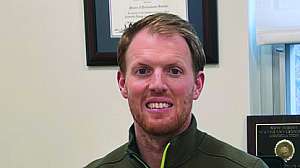
Laura Longa took a tour of the Fiesta Village Advanced Wastewater Treatment Plant soon after receiving her college degree in biology.
Fascinated by the processes, especially the microorganisms, she signed on as a trainee. After hours of study and working as an operator trainee, she achieved her certification. “Everybody here was helpful,” she remembers. “Even when I was here by myself, I got answers.”
Now, after five years at the plant she’s being promoted to lead operator. That’s how it goes in Lee County, Florida, site of the Fiesta Village and Three Oaks water reclamation facilities south and east of Fort Myers. Training is as essential to plant operations as lab testing or process optimization.
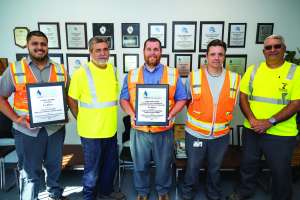
And it’s a big reason both plants have received numerous Earle B. Phelps Awards from the Florida Water Environment Association for outstanding effluent quality. The Fiesta Village plant won first place in advanced wastewater treatment last year, and Three Oaks was first in its advanced secondary category.
The awards are data-driven, says Jason Hopp of the Florida WEA, Phelps award coordinator.
“Every plant in the state gets visited once a year,” he says. The visits are an important criterion, as judges see how the facilities look and how well they are maintained. But the proof is in the numbers. Extremely high removal percentages of TSS, CBOD, nitrogen and phosphorus make Three Oaks and Fiesta Village special, says Hopp.
Advanced treatment
The Three Oaks facility is an extended aeration advanced secondary plant. It was recently expanded through a $45 million project, one of many expansions over the last 30 years. The design flow is 6.0 mgd; average flow is 4.1 mgd. The design maximum flow is 7.2 mgd, and the peak design is 9.0 mgd. The service area includes the southern part of the county, and the plant handles about 19% of the county’s total wastewater flow.
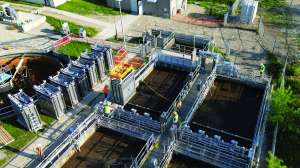
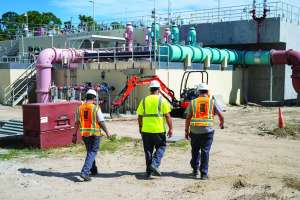
Flow enters the headworks equipped with one manual and two mechanical bar screens (Hydro-Dyne Engineering) followed by grit removal. Flow is then directed to a series of oxidation ditches (Lakeside), three powered by brush aerators and a fourth (added in the latest expansion) with surface aeration. Six 85-foot-diameter clarifiers (CROM) follow, after which the flow passes through deep-bed denitrification sand filters (Leopold - a Xylem brand) and two chlorine contact tanks, followed by dechlorination with sodium bisulfite.
Three Oaks has the largest permitted public access reuse capacity of all the plants in the county. Treated water is pumped to one of three reuse/reject basins or storage tanks. Rain is plentiful in the area, so surface water discharge is not feasible. The effluent is reused for irrigation of golf courses, athletic complexes, parks and public areas, and landscaping. Any excess is pumped into the groundwater table through two Class 1 underground injection wells.
Biosolids are aerobically digested in three basins and dewatered on filter presses (Alfa Laval).
Extensive automation
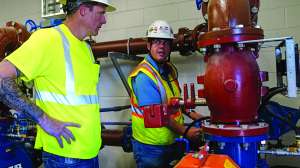
“The whole plant is controlled by our SCADA system (BCI Technologies),” says Tom White, lead operator. The first three oxidation ditches are controlled by brush timers and Hach dissolved oxygen probes. A DO probe controls ditch number four. Variable-frequency drives are used on all pumps and motors. If effluent quality is outside permit limits, flow is automatically routed to the reject tanks.
Chlorine feed is controlled by a sodium hypochlorite pump (ProMinent Fluid Controls) and analyzer (Emerson / Rosemount). The filter backwash cycles are fully automated. In the dewatering press building, cameras are strategically placed to allow the operator to monitor press operations and digester conditions. The operator can set the parameters so the press operates on its own.
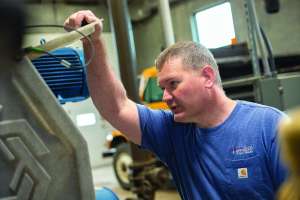
In addition to White, the plant staff includes Dereck Perez, Class A and assistant lead operator; Class B operator Bob Casey; Class C operators Barry Rickoski, Dave Simiele, Dan Stuck and Miguel Turino; and trainees Sascha Wilson and Roberto Garcia. In total, the crew has 86 years of total experience. Casey alone has 32 years in wastewater and 41 in water.
Handling growth
The Fiesta Village Water Reclamation Facility (5.0 mgd design, 2.9 mgd average) sits on 7.5 acres and serves the south Fort Myers area. It had humble beginnings as a small package plant in 1968, but the rapidly increasing population prompted the county to construct a new 2.5 mgd capacity facility at the site in the mid-1980s. In 2001, capacity was increased to 5.0 mgd; average flow now is 2.9 mgd and peak design flow is 7.6 mgd.
Influent passes through two mechanical screens (Hydro-Dyne). Odors are controlled through a Sierra Environmental activated carbon system (the same as at Three Oaks) plus the novel use of return activated sludge, which contains nitrite that helps control hydrogen sulfide.
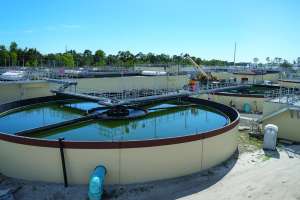
The oxidation ditches (Lakeside) have a capacity of three million gallons each and use horizontal surface aerators to mix and aerate the contents before the water moves on to a pair of 90-foot diameter circular clarifiers (CROM).
After settling, the overflow is pumped to two chlorine contact chambers, followed by sodium bisulfite for dechlorination. Methanol is injected before the water passes through deep-bed sand filters (Severn Trent), which remove suspended solids and denitrify the flow. Final effluent is stored in a reuse tank and is pumped to several customers for irrigation.
Customers in nearby Fort Myers Beach are also connected and can receive recycled water as needed. As a last resort, Fiesta Village can pump treated water to the Caloosahatchee River, but that discharge is being phased out in favor of a deep injection well under construction.
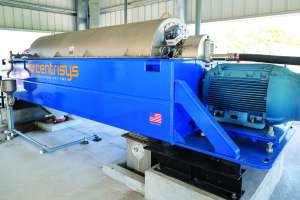
Biosolids are aerobically digested and centrifuged (Centrisys/CNP). Dewatered cake from both plants is hauled to the Lee County landfill where it is mixed with landscape waste and sold to residents as fertilizer.
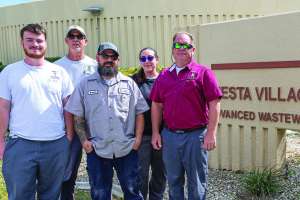
The staff at Fiesta Village consists of Zack Munoz, lead operator; Eugene McCartney, assistant lead operator; Jim Gabrick, Class A operator; Laura Longa and Steven Kennedy, Class B operators; and Mario Beauchamp, Angel Gerena and David Graves, Class C operators. McCartney, Kennedy and Beauchamp all have over 30 years on the job.
At both plants, the operational staff has been front and center on process improvements.
At Fiesta there are plans to switch from methanol, which is flammable, to MicroC 2000 biodegradable carbon source (Environmental Operating Solutions), a safer alternative.
In another staff-driven move, both plants have switched from NTU monitors to continuous TSS meters. “It saves costs and gives us instantaneous readings,” says operator Casey. “It has paid for itself by avoiding equipment breakdowns and other headaches.”
Meticulously trained
The Lee County utility goes to extra lengths to find and recruit new talent for its municipal positions, including water and wastewater. New team members receive thorough preparation.
The training program includes online and in-person coursework that emphasizes professional growth through continuing education, certification and license renewals. The utility provides internal training for CEUs and covers the cost of college courses or advanced training.
Multiple internal and external training opportunities are available throughout the year. They include process control training, tours of other facilities, safety training, wastewater math, troubleshooting and wastewater microbiology with a lab course. The courses are free to anyone who wishes to attend. Team members are also given time on the job for learning.
They are reimbursed for external training like Focus on Change or local short schools. The county also pays for license renewals and frequently invites manufacturers to the plants to deliver specialized training on their equipment. The county pays for the Sacramento State wastewater course books, exams, and licenses.
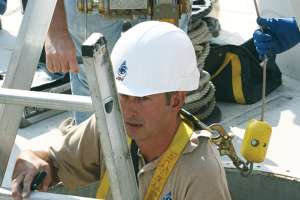
The county’s safety coordinator provides additional learning. Safety videos are shown regularly. Employees must take a classroom course with a hands-on practical portion before using forklifts or performing confined-space entry, Electrical personnel must take an arc flash training course. Each team member spends an average of 30 hours per year on safety training.
Finding talent
There’s nothing magical about the county’s effort to attract and hire new people, but it has been pretty successful. White says many new recruits are either changing jobs or coming right out of high school. “We get some because of interest from plant tours,” he says. “Our HR department is trying to work more closely with high schools in the area. We’re trying to set up more and more apprenticeships. We get a lot of new employees that way.”
It’s an opportunity to learn a skill, get licensed and grow with the county, White says: “Even if they have no experience, we hire them, teach them and they become successful. At the moment, despite several veterans with many years on the job, half our staff has less than five years of experience.”
Award plaques line the hallways at both plants, but that’s not the most important achievement. In this region, clean water is critical to the quality of life and to an economy heavily dependent on snowbirds and tourists. Pristine effluent is an absolute must; the Lee County plants deliver.