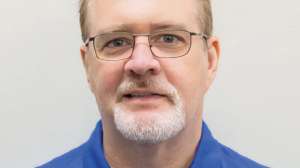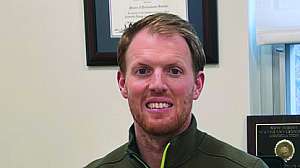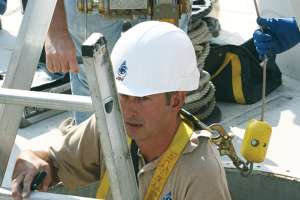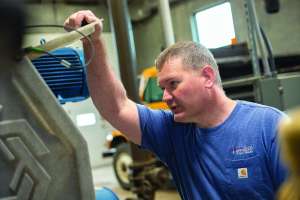
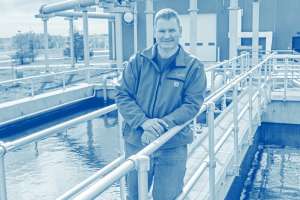
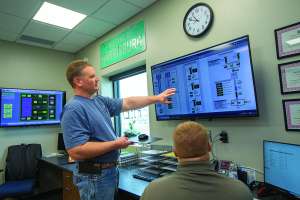
Dustin Preheim spent 10 years as a landscape designer developing backyard environments for homeowners. Now he designs the environments for hardworking bacteria at a wastewater treatment plant.
It was an unusual career move, but it has worked out. “I’ve been doing this now for 10 years, and I do not regret my career change whatsoever,” Preheim says. “I’m way better suited for this kind of work.”
Preheim, water reclamation supervisor with the Harrisburg Water Reclamation Facility, received the 2022 William Brinker Award from the South Dakota AWWA recognizing exemplary performance by a wastewater operator.
Brand new plant
Preheim helped build the Harrisburg Water Reclamation Facility from scratch. Harrisburg, a fast-growing suburb of Sioux Falls, had a lagoon system for years before the new facility was built. Wastewater flowed into ponds and was retained until the water evaporated.
By 2010 the volume of wastewater had begun to overwhelm the lagoons’ capacity, so a pump station and pipeline were installed to send the overflow to the treatment plant in Sioux Falls. Harrisburg did not have a permit to discharge effluent into any waterway.
“For 10 years, we pumped the extra wastewater to Sioux Falls, and they charged us accordingly,” Preheim recalls. “Then the city council decided to build our own treatment plant; we would treat it ourselves and discharge it to the Big Sioux River, which is what we do now. We went from a total retention lagoon system to a full-fledged treatment plant.”
The outfall and discharge point are about 5 miles from the treatment plant. “We decided to discharge there because it is a large river and we’re a small-volume plant,” Preheim says. “That made our discharge permit pretty reasonable to work with.”
Plan for growth
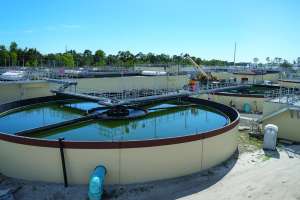
Harrisburg’s treatment plant is designed for 4 mgd, but so far it is only built to treat 1 mgd. The city built an Aero-Mod system that can be expanded incrementally. Space is earmarked for three more units. Average daily flow is around 380,000 gpd.
That flow is mainly residential since Harrisburg has very little industry. The collection system is relatively new and the pipes are mostly PVC. Infiltration and inflow isn’t much of a problem. “We have really high BOD coming into the plant,” says Preheim. “It’s a very tight system because it’s mostly new, and therefore we can maintain that high-strength influent.”
Treating the flow
The treatment process is biological nutrient removal. The influent passes through two aeration basins, each with a two-hours-on, two-hours-off aeration cycle. “That gives it a lot of time for denitrification before it goes into the clarifier, so most of the nitrates at that point are used up,” Preheim says.
“Then when we recycle our return activated sludge, it is nitrate-free, so to speak, and we can achieve the anaerobic conditions in our fermenter and our selector which is necessary for phosphorus removal. The plant is customized for our wastewater, which is pretty stable and consistent.”
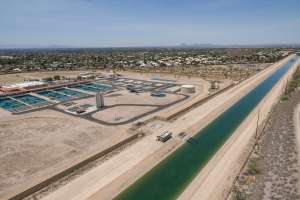
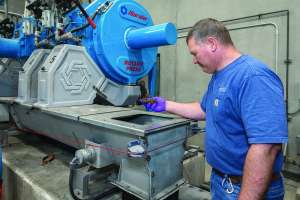
The plant went online in 2021. Built on a former farm field, it has three structures. The building closest to the entrance houses the screening equipment (FSM Frankenberger) and a rotary fan press (Fournier) for biosolids dewatering.
“The idea there was, it was the two messy processes,” Preheim says. “The pretreatment has large debris and there are harmful corrosive gases. And then the dewatering process has biosolids cake that gets dumped into a dump truck. The design team decided to put that all in one building, separate from the rest of the process.”
From pretreatment, the influent flows through underground pipes to the concrete Aero-Mod activated sludge basins (2.4 million-gallon capacity). From there the water flows to the third structure, the operations building, which has offices and a lab, and the aeration blowers (Aerzen). It is also where the water is UV disinfected (Trojan Technologies) before cascade re-aeration and pumping to the outfall.
Smooth operation
Construction went smoothly, and so far operations have also been smooth. “There haven’t been a lot of surprises, just a learning curve,” Preheim says. “What works for one plant doesn’t work for the next plant. You can’t just match up your numbers and settings to what somebody else is doing.
“The most challenging part was finding what works out for this plant, testing this and testing that, and making adjustments and seeing how it responds.” Sometimes the adjustments are complicated by South Dakota’s brutal winters.
“We get the horribly cold winters with blizzards and whatnot. That brings the water temperature so far down that we have to make drastic changes to the process in order to maintain a good-quality effluent.” It gets cold enough for days at a time that the plant staff has to be concerned with valves and other parts of the process freezing.
“That affects treatment because you have to switch over to physical control, where you’re not letting stuff shut off and letting things freeze,” Preheim says. “You have to sacrifice some of your ideal treatment timing and settings just to maintain function. You can come out of it in three days, and then kind of switch everything back, but you have to survive that stretch.”
Preheim thinks being involved in the plant design helped him tremendously. Among other things, it convinced him that the city chose the right treatment process after investigating various alternatives.
“I was fortunate to sit through the design process and the construction process and help make the choices while the facility was being built,” he says. “I could manage my expectations and realize how things were going to go. It made it a lot easier to get started because I knew exactly what I had and how it was built and why it was chosen.”
Changes in permitting
Preheim’s goal is to achieve required nutrient reductions through biological methods without adding more treatment steps. “That’s what we’re fine-tuning,” he says. “We don’t have total nitrogen or total phosphorus limits at present. We have to monitor our total nitrogen and our total phosphorus, but we don’t have a limit in our discharge permit for that.
“At some point, we will have those nutrient limits. Everybody knows it’s coming. We’re making small adjustments to timers, the on-off cycle, the aeration and how often we mix. We’re trying to meet what we think our future nutrient limits will be.
“So far, especially for the last several months, we’ve probably been under the future limits strictly using biological nitrogen and phosphorus removal. If we can maintain these nutrient levels where we have them now, we would potentially meet those future limits. Phosphorus removal is tricky. A lot of times it requires chemical precipitation or additional filtration.”
Native son
Preheim grew up in Harrisburg and graduated from Harrisburg High School in the 1990s. It was a much smaller town then; it has grown about tenfold to a population of 7,000, and it is still growing. He went to South Dakota State University in Brookings, planning to study engineering, but he changed his focus after the first year.
“I switched my major to landscape design because my family owned a landscaping business,” he says. “I got a degree and then I worked with our family business for about 10 years out of college. Ten years ago, we sold the business and I decided to try something different.”
Looking for something to fit with his engineering interests, he ended up in the Harrisburg Public Works Department. At first, he worked in water distribution, a one-person operation. Harrisburg gets its drinking water from the Lewis & Clark Regional Water System, which draws from aquifers along the Missouri River, nearly 60 miles away.
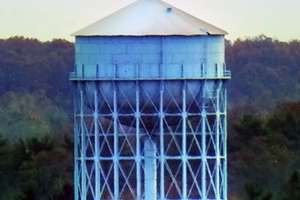
He did sampling for bacteria, lead and copper and also worked with the water towers, hydrant flushing, and chlorine disinfection: “I did all that for the first six years of working for the city, and then we decided to build a wastewater treatment plant.”
Flexible team
The city didn’t have much luck finding certified operators to oversee construction and manage the plant, so Preheim volunteered to learn wastewater treatment from the ground up. He spent a couple of years preparing, taking tests and getting certified, and then helped monitor plant construction.
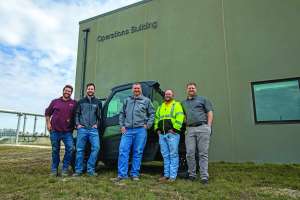
Now, as the water reclamation supervisor, he oversees the treatment process with Chris Kullander and Jonathan Lewis. Nolan Meyer took over Preheim’s job in water distribution.
“Three of us report down here every day, and we take care of the treatment plant and the collection system,” Preheim says. “But we also help out at public works with snow removal or with the drinking water system as needed.”
Preheim appreciates the challenges of wastewater treatment, and he enjoys the work more than his previous profession. “Landscape design is a lot of sales and meeting with customers and designing, which is an abstract thing,” he says.
“It just didn’t fit my personality. I’m more of a technical person. I like black-and-white numbers and investigating problems rather than trying to sell somebody something. I couldn’t be more content with my career change.”