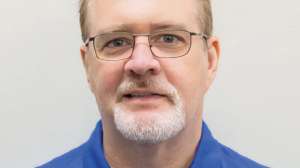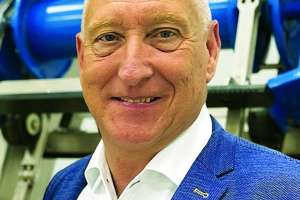

You may have heard of Leonard Whitt.
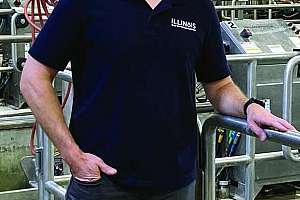
He’s famous for finding and returning valuable objects like wedding rings he spots in the biosolids cake coming off the belt press at the Water Pollution Control Works in Russellville, Arkansas.
A biosolids operator, he’s been featured in numerous media stories and carries the nickname Eagle Eye. But his contributions to Russellville’s clean water program go far beyond that.
A Class III operator who has worked in the wastewater profession for less than 10 years, he is always the first to volunteer when needed. His colleagues say he takes pride in being asked to take on tasks and see them to completion.
He is quick to volunteer for extra hours. He’s the guy who gets to the plant early and makes the coffee for the rest of the shift. And he is the winner of the 2024 William D. Hatfield Award from the Arkansas Water Environment Association.
“He’d be a hard guy to replace,” says his boss, Tony Sanchez, plant supervisor. “He’s dependable and is always willing to cover a shift that’s not his own.
“He takes on whatever is thrown at him. He has a great eye for detail, especially with our equipment, catching things early that might have led to a disruption in our operations. He’s willing to learn and asks questions when he doesn’t understand something. He does an excellent job when asked to teach and train new operators.”
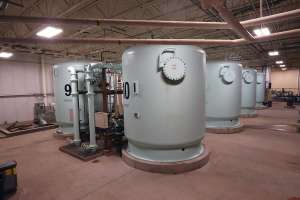
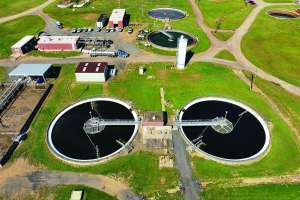
The Russellville Pollution Control Works is an activated sludge plant using a four-stage Bardenpho process. The design flow is 8.5 mgd with a peak of 18 mgd; the average flow is 4-6 mgd. Effluent is disinfected with peracetic acid (Evonik), a mixture of acetic acid, hydrogen peroxide and water, before discharge to Whig Creek, an Arkansas River tributary.
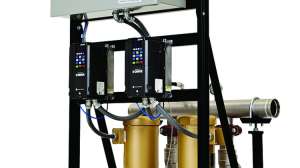
The utility maintains an active industrial pretreatment program. A $15 million upgrade completed at the end of 2022 included:
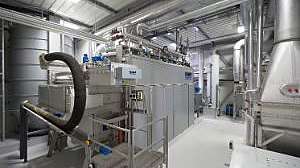
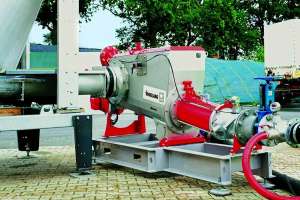
Class A Exceptional Quality biosolids are produced using a belt press (BDP Industries) and a Schwing Bioset lime stabilization reactor. Cake at 25% solids is land-applied. Whitt is responsible for stockpiling the biosolids cake and dealing with the various haulers.
“He’s somebody we can rely on in biosolids operations,” says Greg Kremers, wastewater superintendent. “He’s our contact guy with the drivers, loading the trucks. Our nine local haulers remove an average of 63 tons of our biosolids every week and take it to farmers around the county.
“Leonard is laser-focused on providing outstanding service, and our haulers greatly appreciate working with him. He gets along with everybody. He’s also pursuing his CDL so we can haul biosolids ourselves.” For that purpose the utility plans to add a spreader truck to its fleet of vehicles.
Arkansas is relatively new territory for Whitt. He grew up at the other end of the country, six miles from the Canadian border in northern Minnesota, known for snow and cold weather. He worked for Polaris, a manufacturer of snowmobiles and ATVs, and moved up through the ranks there, taking industrial management and leadership courses.
“Polaris was super training,” he remembers, citing injection molding and welding. “We made our own engines. I was there 23 years.” He also worked for a time at Oshkosh Corporation, a heavy-duty truck manufacturer in Wisconsin.
When family matters took him and his wife Rhonda to Arkansas, Whitt joined the team at the Russellville treatment plant. It’s operated by the City Corporation, an entity created by Russellville in 1985 to be responsible for the city’s sewers and its water and wastewater treatment plants.
“Actually, Rhonda applied for me,” Whitt says. “I was working in a freezer plant. It was 40 to 50 degrees below zero.” The treatment plant assignment was a welcome change. Hired as an operator in training, Whitt moved up quickly, getting his operator’s certification and basic industrial wastewater license.
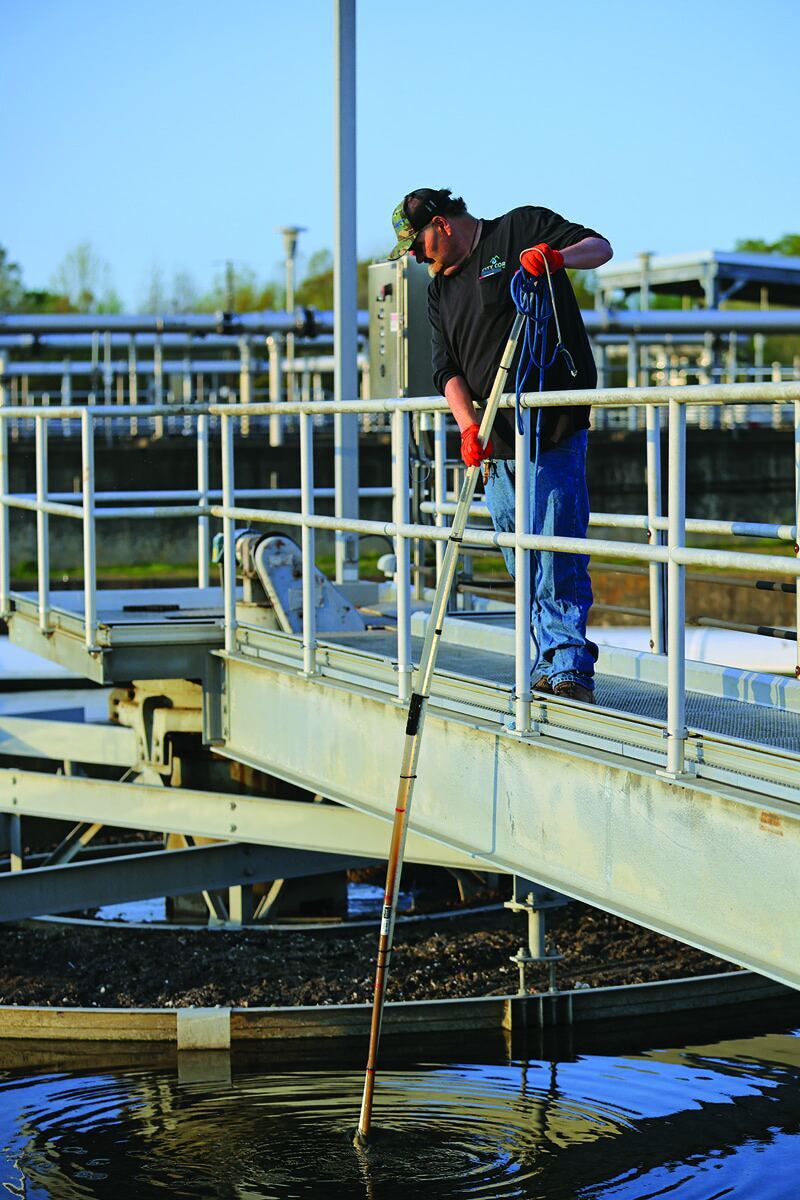
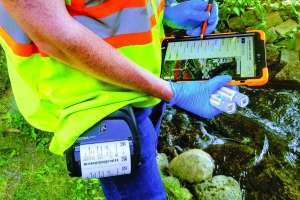
Besides operating the biosolids process, Whitt does rounds on his morning shift, trying to finish them all on a single pass so the laboratory can produce results as early as 9 a.m.
This includes daily reading and recording of plant data from the SCADA system (Garver), daily observation of sludge depth and settleability, viewing and recording of microorganisms in the aeration basins, and making operational adjustments to various processes and treatment units to ensure proper plant operation.
“I’m there by 6:15 a.m.,” Whitt says. “I start in one spot and go all the way around, obtaining all the samples. I love going to work. I’m meticulous in everything I do. It’s a challenge. It makes the mind work. Every day is a learning experience.”
That work ethic was rewarded when he received the Hatfield Award. Like most recipients, he was surprised when named. “It was the highlight of my life,” he says. “It’s kind of sad that one can get that award only once in a lifetime.”
The City Corporation newsletter said the award was “a great personal accomplishment to Leonard and his love of learning. Leonard has proven himself to be a responsible and proficient operator, one who can always be depended upon when needed.” For his part, Whitt expresses thanks for the support he receives from the City Corporation leadership.
Whitt and Rhonda have two grown sons who live near them. In his spare time, Whitt likes to hunt and fish (catch and release), but he misses Minnesota: “Down here we get crappies and catfish. Nothing like Minnesota, which is beautiful and you see moose and eagles and you fish for muskies.”
That’s not to say he doesn’t enjoy finding things in the biosolids bin. Last December, he found a 2009 class ring, and the owner of the ring was tracked down through Facebook. The owner later said he had flushed the ring down the toilet over a decade ago and thought it was “gone for good.”
In another case, a wedding band bearing the names William and Deanna and the date 2009 turned up. Efforts to find the owners so far have failed. “Was this ring accidentally lost down the drain or was it intentionally ‘lost’ from a failed romance?” asked an article in the City Corporation newsletter.
While the plant team usually tries to locate the owners of the found items, there’s one that Whitt plans to hang onto. It’s a bus token with the Green Bay Packers logo on it.