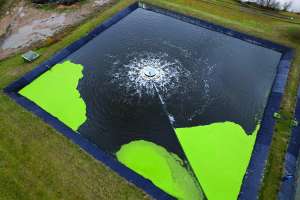
The aging wastewater lagoon aerator system in the Michigan village of Lakeview was losing effectiveness and needed replacing.
The village’s simple three-lagoon system with aeration and a rib-shaped array of pipes for final discharge went online in the 1970s. Over time, the aeration system deteriorated. Leaves and debris clogged air hoses, algae mats built up and neighbors complained of odors.
In reviewing solutions Darin Dood, village manager, was discouraged at the prices being quoted. In the end, the village selected a set of TITUS Twister model FL-6 floating aeration blowers. The affordable, energy efficient units quickly resolved the lagoon’s issues.
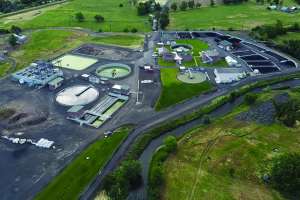
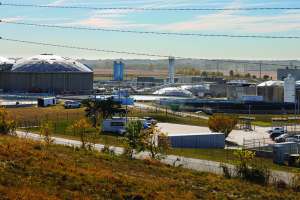
Lakeview, a community of about 1,100 in the center of Michigan’s Lower Peninsula, has a collection system with lift stations that move wastewater to gravity mains, which then convey it to the treatment system in a residential area.
From a final lift station, the water is pumped to the lagoons, each about 150 feet square and 12 feet deep, where solids settle out. Tougher flows are pumped back and forth between lagoons to help break down solids.
In the original treatment process, the wastewater was aerated by a system of air pumps connected to weighted, perforated hoses on the bottom of one lagoon. The hoses emitted bubbles that supplied oxygen. After treatment the water was pumped to a sprinkler system.
“As time progressed, we dealt with a series of issues,” says Dood. “The hoses would get clogged up with matter because it wasn’t an even array throughout the lagoon. All of a sudden, one area would clump, and we got what we called mats.”
The mats, composed of leaves and other debris, tended to still the water despite the aeration bubbles. Volunteer plants grew from seeds stuck in the mats, and then algae formed. “Then we had what looked like a deck of corn floating there or rooted to the hoses,” says Dood.
Multiple times a year, lead operator Jared Nielsen and public works crew members Brian Holds, Brian Buchholz, Brian Charron and Brian Jeffery had to pull and clean the hoses — a three- or four-day job — and then dispose of the debris. Hoses that could not be cleared out had to be replaced. The matting issue also caused significant odors.
For help, the Lakeview team turned to Amanda White, a circuit rider from the Michigan Rural Water Association. Together, they found that the manufacturer of the original aeration system was out of business. In the meantime, the state Department of the Environment, Great Lakes and Energy put the village on notice to correct its problems.
In seeking alternatives, Dood and White first found only systems similar to the one already failing, at costs from $300,000 and 400,000. Then, while attending the National Rural Water. Association, White met Lewis Titus, owner of TITUS Wastewater Solutions, a vendor of aeration and mixing systems.
Dood contacted Titus, and the two exchanged information. “Lewis was more than thorough in asking questions about our system, our needs and how best to help us, given our limited budget,” says Dood. “We concluded that his system was a fraction of the cost of others and would work better than those similar to what we were replacing. We were able to put the TITUS Twister system in for just over $100,000.”
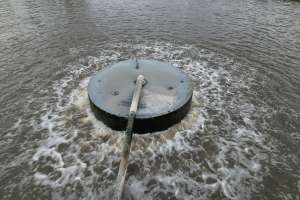
The FL-6 units are designed for lagoons 8-12 feet deep. Lakeview’s new system includes a 40 hp Howden positive-displacement, direct-drive blower with a variable-frequency drive. A hose 100 feet long delivers high-volume, low-pressure air to two floating aerators made of rotationally molded, corrosion-free polyethylene.
The system’s air lift technology efficiently moves large volumes of water to provide mixing. Fine bubbles released through thousands of tiny slits in a cone-shaped plastic membrane rise through an oxygen transfer chamber, pushing water up while transferring oxygen to the water. The membrane diffuser is maintenance-free for a 10- to 15-year life and is easily replaceable.
A large float head ejects the oxygenated water below the surface at high velocity. It directs the flow down and toward the lagoon banks at a 15-degree angle. The discharge is a 360-degree flow with no rotational torque. Because there are no moving parts or electrical power in the water, no boat-based maintenance is required.
The system is designed to pass rags without fouling. The intake floats just over the lagoon bottom, enabling it to pull water and solids up and then discharge the flow horizontally. This keeps diffusers from becoming buried in sludge.
The units are simply tied off to the bank with a rope and can easily be moved around the lagoon by hand, even while operating. This increases the area of influence and results in complete mixing, reducing sludge deposits by 50-60% or more. Other benefits include:
Lakeview started with one blower. “We’re going to put in a second, so we can alternate them,” Dood says. “Then if one should fail, we’re not out of business. Having a $30,000 pump is pricey, but if we exercise them both and alternate by month, we will be able to sustain that as a good, long-term plan.”
Titus helped the Lakeview team with the installation. “Working with Lewis has been an absolute pleasure,” Dood says. “He has been great to connect with. He calls and checks in on things with us.”
The aerators made a nearly immediate difference. “Before, there were ripples in the water,” Dood says. “Now, it’s like the difference between a calm swimming pool and a hot tub. The difference in turnover volume in that lagoon is insane!”
After about two weeks, there was significantly less matting. Within a couple more weeks, the foul odor was gone: “I’ve touched base with some homeowners, and they just can’t believe it. They used to call up here and complain.”
Two of the lagoons now have the floating aeration machines. The TITUS pumps are much more efficient than the old ones; a single unit can handle both lagoons at about half the RPM, using far less energy.
As for sludge buildup in the lagoons, a survey by MRWA’s White before the new aerators were installed and six months after showed over 50% reduction, while maintaining more than 6 mg/L of dissolved oxygen.
News of Lakeview’s success has been spreading. “I got a call from someone who works for the Ohio Rural Water Association,” says Dood. “He’s coming here to tour our plant so he can bring this technology back to Ohio.”