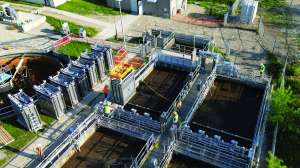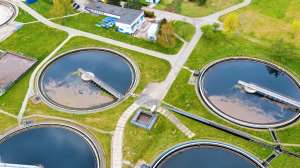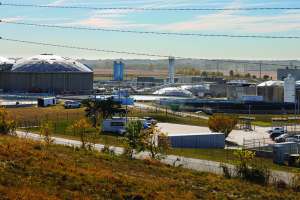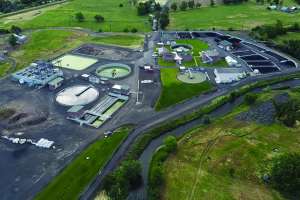
Saving and producing energy in Pendleton’s wastewater treatment process has been successful for a long time.
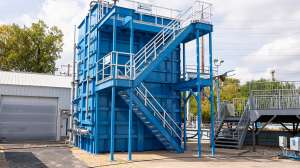
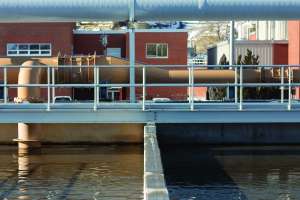
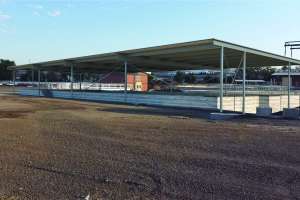
But Kyle Willman, lead plant operator and technician for the city in eastern Oregon, has plans to go farther. “We should be getting close to a true zero, not just a net-zero, but a true zero for utility energy consumption,” he says. A part of that plan is a solar array on a roof to be built over the Wastewater Treatment Resource Recovery Facility’s chlorine contact chamber.
Since 2008 the city has bought power for the plant (5.5 mgd design, 2.5 mgd average) from a solar array sited on its property and operated by Honeywell. The plant also has two 65 kW Capstone microturbines that generate heat and electricity from biogas.
Biogas production is enhanced by co-digesting FOG brought in by contract haulers and adding aerobically digested sludge from a nearby town.
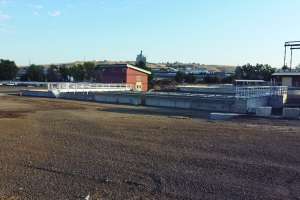
The chlorine contact chamber roof, under construction as of last November, is similar to an open pole barn. That solar energy project will be owned by the utility. Willman sees several potential benefits in addition to the electricity the solar panels will produce.
The roof will provide shade to keep the water in the tank from being warmed by the sun in summer. That’s significant because the plant discharges into the Umatilla River, a salmon and steelhead stream that is sensitive to thermal loading.
The shade also should help save money on disinfection. Records indicate that the plant uses less chlorine on cloudy days, and Willman expects the shading to reduce usage of chemicals for chlorination and dechlorination.
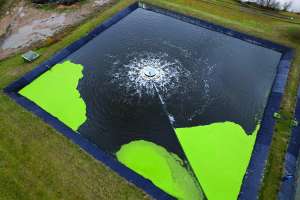
In addition, less sunlight hitting the water should reduce algae formation in the tank, meaning less maintenance, although that might not be a net improvement. “It’s possible that we’ll see less algae growth, but then we’ll have maintenance on the solar panels,” Willman says. “Maintenance is maintenance. We’re just moving it from one spot to another.”
He expects the project to have a 13-year payback, or perhaps shorter if utility power prices rise by more than the conservative forecast he used for his calculation. The $1.8 million project cost will be 80% covered by grants and tax credits.
Pendleton has also reduced energy usage by replacing all the plant’s lighting with LEDs, putting programmable thermostats and occupancy sensors in all buildings and tweaking the equipment settings at various points in the treatment process.
Improved biosolids dewatering has also brought savings. “We have an FKC screw press along with nine drying beds,” Willman says. The press yields material at about 20% solids; the drying beds are used extensively in the summer because the climate is warm and fairly dry.
“We just put the biosolids in the drying beds and spread it around with our loader,” Willman says. During drying, a crust forms that tends to keep moisture in. “Team members periodically break up that crust using a small John Deere tractor with a rototiller on the back.”
After the beds, the biosolids are stored in piles. “We take the loader, move the pile around and get air reintroduced to it just like you would a compost pile,” Willman says. “It continues to break down and continues to use up the volatile solids.”
Sometimes the biosolids reach 70-80% solids before being hauled away for land application as Class B material. The goal is to haul material with at least 50% solids: “We’ve reduced our haul time almost by three-quarters by doing that.”
Willman has researched producing Class A material in line with the plant’s biosolids management plan but notes that in eastern Oregon, “There’s not a lot of reason to produce Class A. The capital investment is fairly substantial, and there are acres and acres of wheat fields where we can apply Class B.”
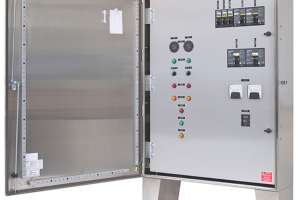
Willman’s plans for energy savings don’t stop there. He recently won a grant to develop battery storage in a microgrid. The plan is for all the plant’s renewable energy sources to tie into a 500 kW Elm battery to be tapped when the renewable power sources aren’t running. A 1 mW diesel generator would provide a backup power source for the system.
Before working in wastewater treatment, Willman was a wind turbine technician, and he envisions using wind energy at the Pendleton plant, along with some in-pipe hydro power.
“The aeration basin has a pipe out of it that has about a 20-foot fall, and it’s a 24-inch pipe,” he says. “I want to put a vertical turbine there, like a 10 kW generator.”
He also thinks several 5 kW wind turbines could be installed on top of the aeration basin. The turbines would be 5 or 6 feet tall; atop the basin they would be about 20 feet above ground. “They’d produce power when the wind is blowing, and the hydro would produce power the entire time the water is running.”
If those projects work out, along with conservation and renewable energy production already underway, Willman foresees the plant being self-sufficient in electricity. “Right now, we have a $120,000 a year electric bill,” he says. “My goal is to reduce that and, hopefully, eliminate it.”