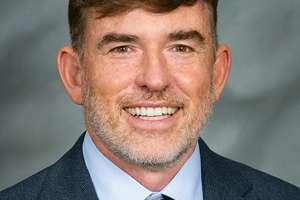
Life happened pretty fast for Scott Hersey in 1990. He graduated from a high school military academy and the next year got married and had a baby on the way.
His father-in-law told him he needed to get a job with good benefits and suggested the utility industry. Hersey took the advice, applied with the village of Palm Springs (Florida) Utilities and was hired as a maintenance technician.
“Then I worked my way into the water treatment plant as a trainee,” he says. With a voracious appetite for learning, he worked his way up over the next 30 years, eventually taking on large projects, overseeing 45 team members and multimillion-dollar budgets, and doing a lot of administration.
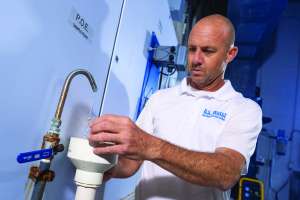
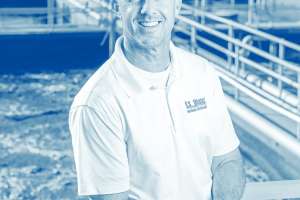
That was all in the public sector; in October 2022 a move to Jacksonville to be near family led to a job with the private sector U.S. Water Services Corporation. Hersey was hired on at the Nassau-Amelia Utilities combined water/wastewater plant in Fernandina Beach, where he is chief operator. A dual Class A (highest) water and wastewater license holder, he was recognized as the 2024 Drinking Water Operator of the Year by the Florida Rural Water Association.
Hersey was born in Bangor, Maine, in 1972. His father was a golf pro whose job took the family to Nyack, New York. They lived there until Hersey was 6; his father then landed a job at a golf course in West Palm Beach. There Hersey graduated from Riverside Military Academy, met his future wife, Tammy, and started his water career.
Hersey loved his treatment plant job in Palm Springs. “I told my wife that was going to be my career,” he says. “I was hungry to become knowledgeable in every aspect of what I was doing. It didn’t necessarily come easy, but I liked it, and when you like something, you’re going to go all in with it. I quickly got my C license and then my B license four years later.”
In 2004 he and Tammy moved to Ocala, a quieter town and a good place to raise their three sons. He joined the Marion County Utilities as a B-level water operator, in the process getting some time on the wastewater side. He embraced that enthusiastically, even going to the plant on his own time to get hours in.
He continued to take classes to advance in his career. He sat at the table with his kids in the evenings doing his homework while they did theirs. Hersey moved up from dual B operator to AB, and finally dual A, which was rare at the time. That enabled him to become an operations manager and hone his administrative and management skills. He did that for 10 years until he moved to Jacksonville and the Nassau-Amelia plant.
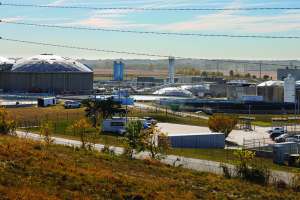
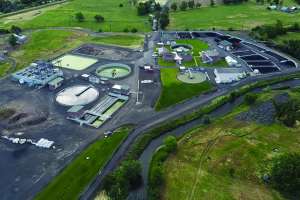
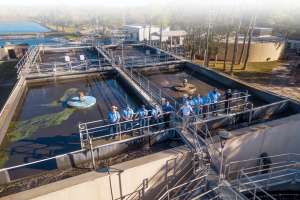
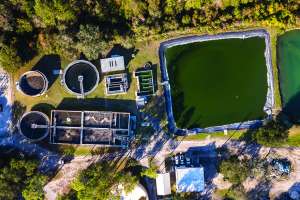
The extended aeration wastewater treatment plant (0.95 mgd design, 0.475 average) serves a population of 10,000 in an area of luxury homes, oceanfront resorts and world-class golf courses. “We’re able to meet very low turbidity,” Hersey says. “The other day it was 0.125 NTU, which is right there with drinking water standards.”
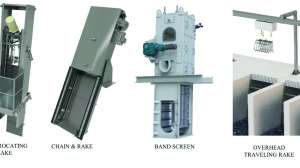
Forty-five lift stations feed into rotary and bar screens at the headworks (IPEC/JWC Environmental). From there the influent goes into a splitter box followed by a flow equalization tank, then to two 210,000-gallon aeration basins for nitrification, followed by anoxic zone tanks, each 186,500 gallons.
“Then we hit the bugs with some air after we’ve made them work for their food in the anoxic zones and send them to the two secondary clarifiers,” says Hersey. The clarified water goes to traveling bridge sand filters (Veolia Water Technologies & Solutions) and finally chlorination.
All the tertiary-treated effluent goes for reuse at area golf courses — 300,000 gpd. “We have a consumptive usage permit on the water side, and a permitted area on the wastewater side for reuse,” Hersey says. “It’s exciting to us that the water is being used.”
Operators can control three things: dissolved oxygen, return activated sludge and waste activated sludge. “We return from the clarifiers back into the aeration basins and then waste according to mixed liquor suspended solids,” Hersey says. “We waste into our aerobic digester.” Biosolids are dewatered on a rotary press (Fournier Industries) and sent to landfill as Class B material.
The water plant produces 1.1 mgd. Three wells in the northern Floridan aquifer feed into a 600,000-gallon storage tank where cascade aerators remove sulfides. Sodium hypochlorite is added before release to the distribution system.
“We have a new booster pump station (Peerless),” Hersey says. “There are six- and seven-story buildings on the island, so we need to provide high pressure water for fire flow. Our new 1.0 mgd tank (CROM) with high-service Peerless pumps feeds from 60 psi for low-pressure to 120 psi for the high rises.”
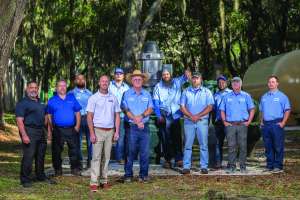
Hersey’s job as chief operator entails everything that goes into producing reuse water and drinking water. The plant team includes director Scotty Soares and operators Shaquille Rose, Derrick Graham and Briar Beasley (trainee). On the maintenance side are supervisor Alexander Chacho; Brian Nicholson (electrician and lift station technician); and technicians Matthew Moran, Griffin Bowen and Paolo Conde.
“And Danny White just completed his 46th year,” Hersey says. “He’s one of the go-to guys who knows where every valve is and every road. He will be retiring soon and will be heavily missed.”
Hersey has strong ideas about his supervisory role: “I was so young getting into this that the old-timers were hesitant to give me information. I know how that affected me, so I made the decision a long time ago to make that better for others when I became a supervisor.”
His role also enables him to connect with customers, speaking to them one on one when he’s out getting remote samples or giving plant tours. He is also on familiar terms with all the resort managers. He views any criticism he might run into as information and an opportunity to do better or educate more.
Hersey spends 80% of his time in his role as chief operator, but training is an increasingly important part of his job. When new operators come in, he spends time with them, learns their game plan and the certifications they want, and helps them on their journey.
His training role with U.S. Water is expanding beyond the Nassau plant. The regional training director calls on him when a trainer is needed at various places around the state. “It might be going down to Flagler for three days to train a couple operators on lime-softening, for example,” he says. “Those are exciting days. They’re working on making me a regional training manager for the entire state of Florida.”
Hersey also wants to educate the public on career opportunities in the field: “I was in a class five years ago. The proctor asked how many people were 55 or older, and the majority of hands went up. Then he asked how many were under 25. One hand went up. That resonated with me. People are naïve to water and wastewater. It’s my job to get out and bring this career to high school students and others so they know this is a viable career option.”
Hersey says his award from Florida Rural Water was based on his training the succession of new operators coming into the industry, something very important to him. “I went to Daytona to receive the award and had my wife there with me,” he says. “To be recognized by an organization that I have looked up to and admired for years was a very special moment.”
Hersey and Tammy have been married 34 years and have three sons, Greg, Garrett and Grant, and one grandson, Gavin. When not working, Hersey loves spending time with them. He also enjoys golfing, riding his motorcycle and playing drums with the boys. He believes life balance is very important.
“It has been a very rewarding career,” he says. “And I’m as excited about my job today as I was when I got into it. The next 10 years of my career I really want to be hyperfocused on membranes. I think that’s going to be the driver for not only water, but wastewater.”
He believes he has been a good example to his children who have seen how happy a person can be in their career: “You have one run at this thing in life. Don’t settle. Do something that’s going to make you happy. Do something that makes a difference and do it well. Make your mark. I think that has resonated with all my children.”