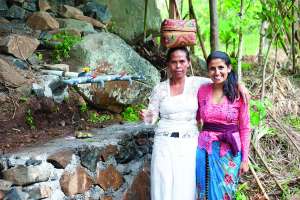
Women and girls in some remote communities walk an average of nearly four miles per day to get clean water for their families.
Globally, fetching water means 200 billion hours per year that people could have spent on more productive activity. Most of that time is spent by women and girls. The responsibility for providing water means, among other things, that girls are less able to attend school.
Addressing these and other issues is the mission of Surge for Water, a nonprofit focused on providing access to clean water and improving sanitation and hygiene in impoverished regions. “Women and girls bear the greatest weight of the water crisis,” says Shilpa Alva, the organization’s founder and executive director.
A related concern is that some 12 million girls miss up to 20% of school each month due to lack of proper care for menstruation, Alva observes. “This disruption, which is also related to water, often leads to higher dropout rates, limiting their future employment opportunities and, in many cases, contributing to early marriage and childbirth, further curtailing their ability to earn an income.”
Women-led Surge for Water, founded in 2008, works in communities in Haiti, Uganda and Indonesia. Now the organization, looking to raise its profile and meet ambitious growth objectives, has formed a strategic partnership with Boeh Agency, a full-service marketing and public relations firm focused on the water and wastewater industry and led by Beth Boeh (pronounced “bay”) as president and CEO.
Under the partnership, the agency, nationally certified as a Women’s Business Enterprise, will apply its expertise in strategic communication to help expand Surge’s reach, engage new audiences and strengthen the message of water sustainability and equity. Alva and Boeh talked about their venture in interviews with Treatment Plant Operator.
TPO: What was the motivation for establishing Surge for Water?
Alva: I grew up in Dubai. As a child visiting family in India, I saw children my age who didn’t have the luxury of playing; instead many were fetching water. Even as a 7-year-old child, I saw the inequity. Children should not have to bear this kind of responsibility for their families’ survival. When I was 21, I spent a few months on a teaching assignment in a remote village in India. Many of my students missed school due to waterborne illnesses or constraints. Again I witnessed how access to water was a fundamental precursor to attending school and getting a proper education. The founding of Surge was in response to this essential need and a calling.
TPO: How did you take the initial steps to form Surge for Water?
Alva: I moved to the United States and studied biomolecular and chemical engineering at Johns Hopkins University. After I graduated and started working, I began to feel a void. I needed to do something more with my life; my purpose was not the corporate job I had. I asked myself: How can I use the privilege and the skills that I have to do something better? That’s what led to the founding of Surge for Water. Today, a global team of talented staff and volunteers run the organization, and together with the local communities where we work, we are making a transformational difference.
TPO: Why do you say that so much of the burden of acquiring water falls on women?
Alva: Women and girls are the ones typically responsible for caring for their families. We’re bathing the children, we’re cooking, we’re doing the domestic chores. And with that comes the responsibility of walking long distances to collect water. At the same time we are the most affected, we are also the least represented in government and leadership roles related to water management. And so we have the least ownership and ability to make decisions and lead change.
TPO: Practically speaking, how are girls held back by water-related tasks?
Alva: Early in the morning, instead of studying, girls have to go collect water for their families, or it is their responsibility after school to do so. Sometimes they have to do it late at night, and so they may be exposed to sexual harassment. These problems are the most acute in sub-Saharan Africa.
TPO: What does access to water look like in communities you serve?
Alva: In the communities in Uganda and Indonesia, for example, where we provide a water source, it’s still shared by the community. There still may be 300 people getting water from one tap. I ask people: Can you imagine 300 people lined up at your kitchen tap right now?
TPO: How did you choose the three countries where your organization now works?
Alva: We were once in 12 countries, and we were thinly spread. About six years ago we looked at our model to see where we could have the strongest impact. We identified our differentiators and the places where we had really strong relationships with community partners and local governments, and where we were the only nongovernment organization working in a sustained way to achieve their goals of water access, sanitation and hygiene. And we decided to scale down so that we could go deeper and make a bigger impact.
TPO: How many people do you serve? How would you characterize your goals for growth?
Alva: We are serving about 300,000 people across the three countries. Our goal is to reach 1 million people daily by 2030 within those countries, but in additional geographical areas. We are open to being in a new country if there is a partnership that brings us there, but that is not currently in our plan.
TPO: How do you form the partnerships on which relationships are built?
Alva: That is the magic of why we have been successful. We came into these countries and communities and just started listening and learning. People would say, “I know someone who has a water issue and is an incredible leader.” We would trust the social fabric, go into those remote areas, meet the local leaders and try it out. We did pilots, started slowly and scaled from there. In order to bring about sustainable change, it had to be them driving the agenda, on their terms and timelines. Now we have beautiful relationships that are trust-based. The communities are extensions of Surge for Water, and we are an extension of them.
TPO: Why did you seek out an organization like Boeh Agency to help you toward your goals?
Alva: We want our story to get out there. We want more people to hear about the incredible work we’re doing. Many water organizations focus on women’s issues, but very few are women-led. We have a unique perspective on how we work and how we prioritize women’s experiences. We want that story to be refined and told in a wider way. We also love that Boeh Agency is women-led and that they are already integrated in the water space. We do work in water access, but we don’t know a lot of the organizations and companies on the corporate or industrial side of it. We feel that Boeh Agency can help us bridge that gap.
TPO: From the agency’s perspective, how is this a mutually beneficial partnership?
Boeh: Their values and goals align closely with ours. We do different things, but the end goals are very similar in terms of what we care about. They are one of the first women-led nonprofits in the water space. They’re not just handing money to communities, and they’re not just putting in systems. They are empowering people. We’re led by women. Surge is led by women. Their focus is on women and how they can change the world of water in communities. I love what they’re doing.
TPO: How specifically do you envision the agency helping Surge for Water?
Boeh: Our first year of collaboration will be structured as a partnership. Our team put together a plan that looks at where they are now, what their goals are, how they can stand out, and how they want to grow. We offer ideas on how to reach people and how to tell their story. Team members Tori Andrews, Megan Sweat and Barbara Beran put a really great plan together. We intend to increase brand awareness so that people will know who they are and engage with Shilpa and her team. And then they really want to expand partnerships, so we will look for opportunities for them to collaborate with similar organizations and corporate sponsors.
TPO: What do you see as the audience for the public relations campaign?
Boeh: It includes the water sector and associations we already work with, but there are other organizations that relate to water, like consumer product corporations that have a strong focus on environment and sustainability, or that have a charter to value water and especially women.
TPO: What has it been like for Surge for Water to work with Boeh Agency?
Alva: They are doing this as part of their charitable giving, and usually when people take us on in that way, they don’t give us a plan like what Boeh Agency did for us. Boeh didn’t treat us like people have in the past, where it’s pro bono, so we’ll work on you after we finish all our paid work. They are holding themselves to a higher standard than I could have dreamed of.
TPO: What is Surge for Water expecting in terms of tangible results?
Alva: We are not in a position to achieve our goals unless partners like Boeh Agency support us. If we gain more exposure and more people hear about us, and that turns into a financial benefit, that helps us get closer to that 2030 plan. It starts with getting out there and being more heard of. We can’t do that just with social media posts. We need to do it in a more serious way.
TPO: What are the rewards for Boeh Agency in taking on this partnership?
Boeh: I’ve been in the industry for 26 years and have spent most of the time promoting treatment technologies and all kinds of really great equipment. But this is the realization of a dream for me. Even if we’re helping sell equipment that is amazingly good for the world, I’ve always wanted to do more. This partnership is more tangibly exciting. It’s about changing the world.